Risk disclosure: Independent research finds 70–84% of Polymarket traders lose money (Sergeenkov, April 2026; Akey et al., SSRN, March 2026). Forex CFDs: 70–85% retail loss rate. Binary options: 80%+ in most jurisdictions. AI agents don't change these baselines. Full disclaimer. Security context: Three critical CVEs disclosed in OpenClaw in Q1 2026 (CVE-2026-25253, CVE-2026-32922) plus the ClawHavoc supply-chain attack (1,184 malicious skills). Always run v2026.4.12 or later. Full security assessment.
Learning from others' mistakes is cheaper than learning from your own. This guide collects the most common mistakes OpenClaw traders make — from setup through strategy through psychology — so you can avoid the errors that have cost others money and frustration. Most of these are entirely preventable, and most blow-ups trace back to one or more of them. Read this as a list of traps to sidestep.
Many of these mistakes are covered in depth elsewhere on the site; here we consolidate them into one reference so you can scan for the traps you might be walking into. Forewarned is forearmed.
TL;DR — The 30-second answer
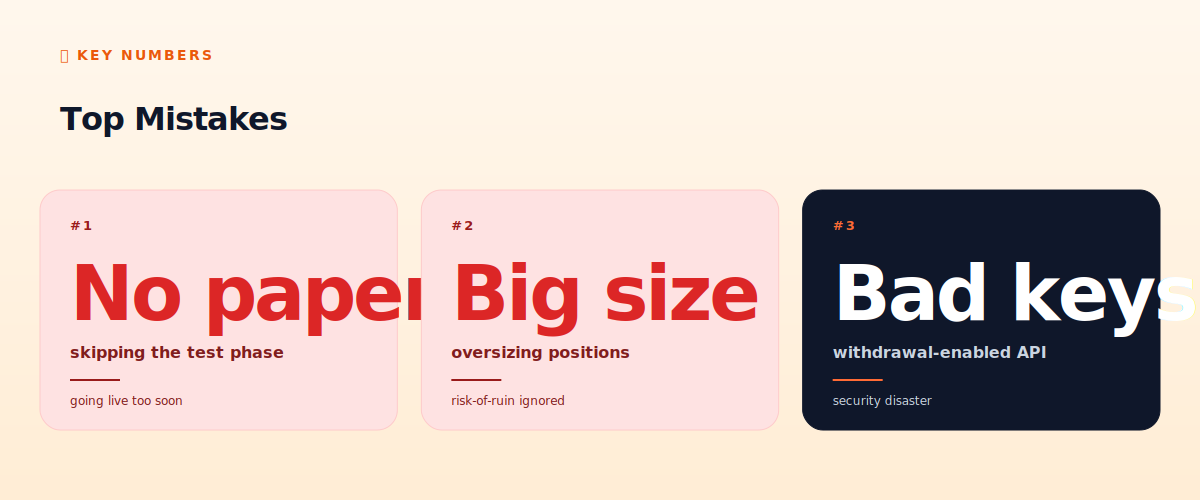
- #1: Skipping paper trading — going live before validating the system.
- #2: Oversizing positions — ignoring risk of ruin and the 1% rule.
- #3: Withdrawal-enabled API keys — a security disaster waiting to happen.
- #4: No monitoring — no heartbeat, so silent failures go unnoticed.
- #5: Unrealistic expectations — believing the hype, chasing alpha that isn't there.
- #6: Not auditing skills — installing community skills without checking them.
Top mistakes
Setup and security mistakes
- Withdrawal-enabled API keys. The cardinal security sin — a compromised key can drain your funds. Always trade-only, never withdrawal (see our wallet hygiene guide).
- Not auditing installed skills. The ClawHavoc incident (1,184 malicious skills) makes this critical — an unaudited skill can steal keys or drain wallets (see our audit guide).
- Keys in plain config files instead of the OS keyring — exposed if the file leaks.
- Running the bot on a daily-use machine instead of an isolated VPS — mixing trading with everything else expands the attack surface.
- Putting all your capital where the bot can reach it instead of keeping the bulk in cold storage.
Strategy and risk mistakes
- Skipping paper trading. The most common and costly mistake — going live with an unvalidated system (see our pre-live checklist). Paper test 2-4 weeks first.
- Oversizing positions. Ignoring the 1% rule and risk of ruin — betting too big so a normal losing streak wipes you out (see our risk of ruin guide).
- Using high leverage. The fast track to liquidation, especially for beginners (see our leverage guide).
- Trading without stop-losses — letting losses run unbounded (see our guide).
- Using martingale or 'recovery' systems — mathematically guaranteed ruin (see our martingale trap).
- Wrong strategy for the regime — mean reversion in a trend (falling knives), momentum in a range (whipsaw). Regime detection matters.
- Over-trading — a bot that trades constantly, racking up fees, when patience would serve better (see our fees guide).
Operational mistakes
- No monitoring / no heartbeat. A bot can fail silently for hours or days — the heartbeat's absence should be your alarm (see our Telegram guide).
- No error handling. A bot that crashes on the first API hiccup instead of retrying gracefully (see our API errors guide).
- No kill-switch. When something goes wrong, you need to stop everything fast — and you should have tested it beforehand.
- Ignoring fees and slippage. A strategy that looks profitable on paper but loses to real execution costs (see our slippage guide).
- Not version-controlling configs — so when something breaks, you can't see what changed.
- Runaway LLM costs — no billing alerts, an inefficient setup racking up a surprise bill (see our cost calculator).
Psychological and expectation mistakes
- Believing the hype. Expecting AI to beat the market or deliver the '95% win rate' of the ads — it doesn't (see our hype vs reality).
- Revenge trading. Trying to win back losses by sizing up — the classic path to a bigger blowup (see our returning trader guide).
- Trading money you can't lose. Rent, savings, or borrowed money — never.
- Quitting your day job for unproven trading — a recipe for disaster (see our side-hustler guide).
- Falling for 'guru' schemes — signal groups, courses, mentors promising guaranteed returns (see our scam recognition guide).
- Scaling up too fast after a few wins — mistaking luck for skill before it's proven.
The meta-mistake
Underlying most of these is one meta-mistake: rushing. Rushing past paper trading, past the checklist, past risk management, past skill auditing — usually driven by the excitement of potential profits or the impatience to start. Nearly every item on this list is prevented by slowing down: validate before going live, size conservatively, secure properly, monitor diligently, and hold realistic expectations. The market rewards patience and punishes haste. If you catch yourself rushing — skipping steps because you're eager — that's the warning sign to slow down. The eager beginner who rushes blows up; the patient one who does it properly survives.
The honest verdict
These mistakes — skipping paper trading, oversizing, withdrawal-enabled keys, no monitoring, believing the hype, unaudited skills — are common, costly, and almost entirely preventable. Most blow-ups trace back to one or more of them, and most are prevented by the single discipline of not rushing. Use this as a checklist of traps to avoid: scan it before going live, and honestly ask whether you're walking into any of them. Learning these from a list is far cheaper than learning them from your own losses. The traders who survive aren't smarter or luckier — they're the ones who avoided these specific, well-known mistakes that everyone is warned about and too many make anyway. Be the one who heeds the warning.
📧 Get every new tutorial in your inbox
One email per week. Tutorials, CVE disclosures, broker updates. Unsubscribe in one click.
(Connect FluentCRM / ConvertKit / Beehiiv form here)
Frequently asked questions
What's the most common OpenClaw mistake?
Skipping paper trading — going live with an unvalidated system. Paper test the complete system 2-4 weeks first. It's the most common and most costly error.
What's the worst security mistake?
Withdrawal-enabled API keys — a compromised key can drain your funds. Always use trade-only keys, never withdrawal-enabled. Also: not auditing community skills (ClawHavoc risk).
What risk mistakes blow up accounts?
Oversizing positions (ignoring the 1% rule), high leverage, no stop-losses, and martingale/'recovery' systems. These ignore risk of ruin and cause most blow-ups.
What operational mistakes matter?
No monitoring/heartbeat (silent failures go unnoticed), no error handling (crashes on the first hiccup), no tested kill-switch, ignoring fees/slippage, and runaway LLM costs.
What's the underlying meta-mistake?
Rushing — past paper trading, the checklist, risk management, and skill auditing, driven by excitement or impatience. Nearly every mistake is prevented by slowing down. The market rewards patience.
What to read next
- The Definitive Pre-Live Checklist
- Risk of Ruin: The Math Every Trader Must Know
- The 12-Point Hardening Checklist
- When to Stop: Knowing You're Not Cut Out for Trading
Sources cited: The Hacker News (CVE-2026-25253 disclosure, Feb 2026); Conscia 2026 OpenClaw Security Crisis advisory; Snyk ToxicSkills study; Cyber Press ClawHavoc reporting; Wall Street Journal Polymarket profitability analysis (May 2026); Andrey Sergeenkov via The Defiant (April 2026); Akey, Grégoire, Harvie & Martineau, SSRN paper (March 2026); openclaw.ai official advisories; Peter Steinberger public statements on X. common trading and bot operational errors; OpenClaw security incidents.