Risk disclosure: Independent research finds 70–84% of Polymarket traders lose money (Sergeenkov, April 2026; Akey et al., SSRN, March 2026). Forex CFDs: 70–85% retail loss rate. Binary options: 80%+ in most jurisdictions. AI agents don't change these baselines. Full disclaimer. Security context: Three critical CVEs disclosed in OpenClaw in Q1 2026 (CVE-2026-25253, CVE-2026-32922) plus the ClawHavoc supply-chain attack (1,184 malicious skills). Always run v2026.4.12 or later. Full security assessment. This article explains why martingale is dangerous. We do not recommend it under any circumstances.
Martingale is the most seductive and most destructive strategy in trading. The pitch is irresistible: double your position after every loss, and when you finally win, you recover all previous losses plus a profit. It sounds mathematically bulletproof — you 'can't lose' as long as you eventually win one. But the math that makes it seductive is exactly the math that destroys accounts. This guide explains precisely why martingale guarantees ruin, eventually, for everyone who uses it.
We're including this as a deliberate anti-strategy. You'll encounter martingale everywhere — in binary options bots, grid variations, 'recovery' systems. Understanding why it fails is one of the most important pieces of trading self-defense.
TL;DR — The 30-second answer
- The pitch: double your bet after each loss; one win recovers everything plus profit.
- Why it's seductive: it 'works' most of the time, producing many small wins.
- Why it's fatal: position size explodes exponentially; one losing streak wipes you out.
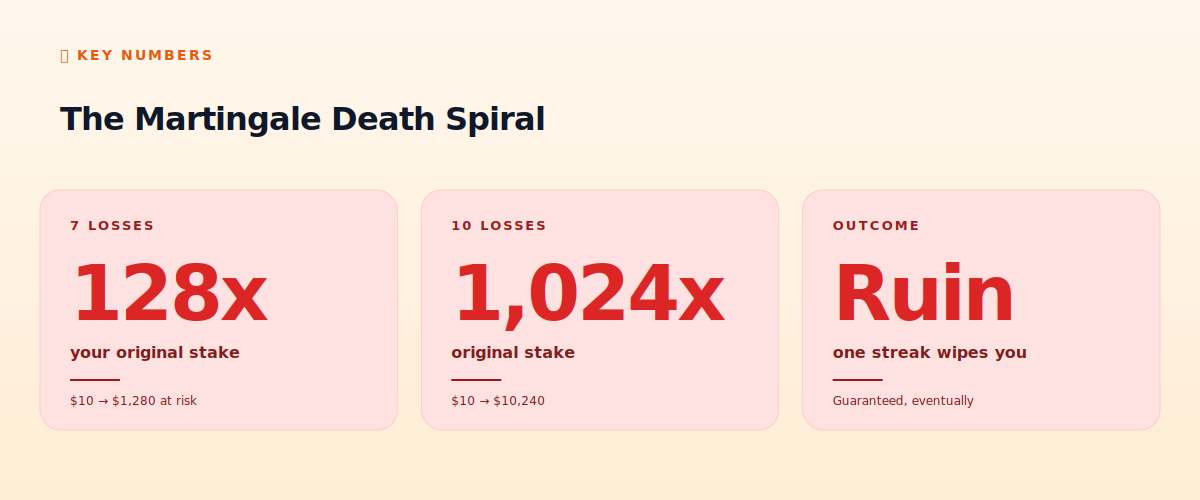
- The math: 7 losses = 128x your stake; 10 losses = 1,024x. Streaks happen.
- The guarantee: given enough trades, the ruinous streak will occur.
- Our position: never use martingale. It's not a strategy; it's delayed ruin.
The death spiral
How martingale works
The system is simple. Start with a base bet — say $10. If you lose, double to $20. Lose again, double to $40, then $80, $160, and so on. The logic: whenever you finally win, that single win covers all your accumulated losses plus delivers a profit equal to your original $10 stake. Then you reset to $10 and repeat. Since you'll 'eventually' win a trade, you 'eventually' recover — so you 'can't lose.' This reasoning has lured traders to ruin for centuries (martingale originated in 18th-century gambling).
Why it feels like it works
Here's the insidious part: martingale works most of the time. Most trading sessions don't contain a long losing streak, so most of the time, martingale produces a steady stream of small wins. A trader runs it for days or weeks, sees consistent small profits, and concludes they've found a money machine. The early success is real — and it's exactly the trap. The strategy is quietly accumulating tail risk that hasn't materialized yet. Every small win increases confidence and often position size, setting up a larger eventual disaster.
The math that kills you
The fatal flaw is exponential position growth. Each loss doubles your stake, so a losing streak escalates terrifyingly fast:
- After 5 losses: you're betting 32x your base stake ($10 → $320 on the next bet).
- After 7 losses: 128x ($10 → $1,280). Total at risk across the streak: $2,550.
- After 10 losses: 1,024x ($10 → $10,240). Total risked: over $20,000 — to win back $10.
- After 13 losses: 8,192x. You're betting over $80,000 to recover a $10 base profit.
Two things kill you. First, your account runs out of money — you can't fund the next double, so the streak ends in a catastrophic unrecovered loss. Second, even if you had infinite money, exchanges have position limits you'll hit. Either way, a long enough losing streak means you can't make the next bet, and all the accumulated losses become real. The streak doesn't need to be that long — 7-10 consecutive losses happens regularly in trading, especially in noisy short-term timeframes.
The mathematical guarantee of ruin
This is the crucial point: a losing streak long enough to wipe you out is not a freak event — it's a statistical certainty given enough trades. If each trade has even a 45-50% chance of losing, then over hundreds or thousands of trades, a streak of 8, 10, or 12 consecutive losses will occur. It's not a question of if, but when. Martingale doesn't reduce your risk of ruin — it concentrates it into a single inevitable catastrophic event, while disguising it with many small wins beforehand. You're not avoiding losses; you're deferring and compounding them into one account-ending blow.
Where you'll encounter martingale
Martingale lurks under many names and disguises:
- Binary options 'recovery' bots that double after each loss (see our binary options analysis). Especially destructive given the asymmetric payouts.
- 'Anti-martingale' and grid variations that increase size into losses — same fatal math dressed up.
- Deriv synthetic-index 'strategies' sold in signal groups, often martingale-based, that blow up on Boom/Crash spikes.
- Forex 'recovery' EAs that average down into losing positions — martingale by another name.
Any system that increases position size after losses is martingale or a variant, and carries the same guaranteed-ruin math. The marketing always emphasizes the many small wins and hides the inevitable blow-up.
What to do instead
The opposite of martingale is sound: fixed or risk-based position sizing (risk a constant small % per trade, as in our lot sizing guide), and cutting losses rather than doubling into them. Good trading accepts small losses as the cost of doing business and lets winners run — the exact opposite of martingale's 'never accept a loss, double until you win.' If you build OpenClaw bots, hard-code a rule that position size never increases after a loss, and never averages down into a losing position beyond a strict pre-set limit. Make martingale structurally impossible in your own system.
The honest verdict
Martingale is not a strategy — it's a mechanism for converting many small wins into one inevitable catastrophic loss, dressed up to look like a sure thing. The math is unambiguous: given enough trades, the ruinous streak will occur, and it will wipe you out. Every 'martingale bot' or 'recovery system' sold online is selling delayed ruin to people who don't understand exponential growth. Never use it. If you take one thing from this entire strategy series, let it be this: any system that doubles down after losses will eventually destroy your account, no matter how well it seems to work at first.
📧 Get every new tutorial in your inbox
One email per week. Tutorials, CVE disclosures, broker updates. Unsubscribe in one click.
(Connect FluentCRM / ConvertKit / Beehiiv form here)
Frequently asked questions
Does martingale actually work?
It works most of the time — producing many small wins — which is exactly the trap. It quietly accumulates tail risk until one losing streak wipes out everything. Given enough trades, that streak is a statistical certainty.
Why is martingale so dangerous?
Position size doubles after each loss, growing exponentially. 7 losses = 128x your stake, 10 losses = 1,024x. You run out of money (or hit position limits) and the accumulated losses become a catastrophic real loss.
Isn't a long losing streak unlikely?
No — it's a statistical certainty over enough trades. Streaks of 8-12 consecutive losses happen regularly, especially in noisy short-term timeframes. It's when, not if.
Where will I encounter martingale?
Binary options 'recovery' bots, grid variations that increase size into losses, Deriv synthetic-index signal-group strategies, and forex 'recovery' EAs that average down. Any system that grows position after losses.
What should I do instead?
Fixed or risk-based position sizing (constant small % per trade), and cutting losses rather than doubling into them. Hard-code your bots so position size never increases after a loss.
What to read next
- Forex Lot Sizing & Risk Management
- Why 80% of Binary Options Traders Lose
- Grid Trading with OpenClaw
- The 12-Point Hardening Checklist
Sources cited: The Hacker News (CVE-2026-25253 disclosure, Feb 2026); Conscia 2026 OpenClaw Security Crisis advisory; Snyk ToxicSkills study; Cyber Press ClawHavoc reporting; Wall Street Journal Polymarket profitability analysis (May 2026); Andrey Sergeenkov via The Defiant (April 2026); Akey, Grégoire, Harvie & Martineau, SSRN paper (March 2026); openclaw.ai official advisories; Peter Steinberger public statements on X. probability theory on gambler's ruin; risk management literature.