Risk disclosure: Independent research finds 70–84% of Polymarket traders lose money (Sergeenkov, April 2026; Akey et al., SSRN, March 2026). Forex CFDs: 70–85% retail loss rate. Binary options: 80%+ in most jurisdictions. AI agents don't change these baselines. Full disclaimer. Security context: Three critical CVEs disclosed in OpenClaw in Q1 2026 (CVE-2026-25253, CVE-2026-32922) plus the ClawHavoc supply-chain attack (1,184 malicious skills). Always run v2026.4.12 or later. Full security assessment.
Momentum trading is mean reversion's opposite: instead of betting that extremes revert, you bet that trends continue. Buy strength, sell weakness, ride the trend until it ends. It's the strategy behind 'the trend is your friend,' and like mean reversion, it works brilliantly in the right regime and bleeds in the wrong one. This guide covers momentum strategies, the indicators, the whipsaw problem, and how OpenClaw fits.
Understanding momentum alongside mean reversion completes the foundational picture: these are the two opposing strategy families, and knowing which regime favors which is the core trading skill.
TL;DR — The 30-second answer
- The idea: trends continue. Buy strength, sell/short weakness.
- Works in: trending markets with sustained directional moves.
- Fails in: choppy, ranging markets — whipsaw eats you alive.
- Key indicators: moving average crossovers, MACD, ADX, breakouts.
- The opposite of mean reversion — they win in opposite regimes.
- OpenClaw fit: good — regime detection and trend confirmation.
Momentum vs mean reversion
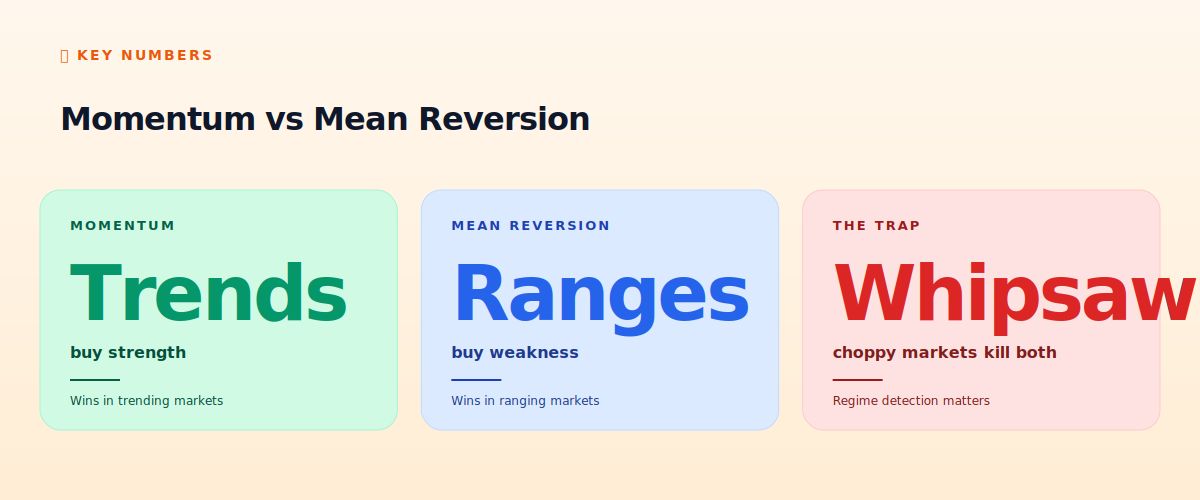
Momentum's premise is the mirror image of mean reversion. Where mean reversion says 'extremes snap back,' momentum says 'trends persist.' When price is rising strongly, momentum says buy — expect it to keep rising. When falling, sell or short. The strategy rides established trends, aiming to capture the bulk of a sustained move rather than betting on a reversal.
This works because markets do trend — driven by sustained flows, narrative shifts, or fundamental changes, prices can move in one direction for extended periods. Momentum traders aim to identify these trends early, ride them, and exit when they exhaust. The famous traders who 'let winners run' are applying momentum.
The indicators
- Moving average crossovers: a faster MA crossing above a slower one signals upward momentum (buy); crossing below signals downward (sell). The classic trend-following signal.
- MACD: measures momentum via the relationship between two moving averages. MACD crossing its signal line flags momentum shifts.
- ADX: measures trend strength (not direction). High ADX (>25) confirms a strong trend worth following; low ADX warns of a range where momentum fails.
- Breakouts: price breaking above resistance or below support can signal the start of a momentum move (see our breakout guide).
The whipsaw problem
Momentum's enemy is the choppy, ranging market — exactly where mean reversion thrives. In a range, price oscillates without a sustained trend. A momentum bot sees a small upward move, buys (expecting continuation), then price reverses — sells at a loss. Then a small downward move, shorts, price reverses again — another loss. This 'whipsaw' — getting chopped up by false trend signals in a range — bleeds a momentum strategy in sideways markets. Each whipsaw is small, but they accumulate into death by a thousand cuts.
This is the symmetry with mean reversion: momentum loses in ranges (whipsaw), mean reversion loses in trends (falling knives). Neither works everywhere. The skill is matching strategy to regime.
Regime detection — again the key
Just as mean reversion needs to confirm 'ranging' before entering, momentum needs to confirm 'trending.' ADX is the workhorse here: high ADX (>25) confirms a trend strong enough to follow; low ADX warns you're in a range where momentum will whipsaw. Combining ADX with MA slope and price structure gives a robust regime read. The discipline: only take momentum signals when the regime is confirmed trending; stand aside (or switch to mean reversion) in ranges.
Where OpenClaw helps
OpenClaw's reasoning suits momentum well. The LLM can confirm trend strength across multiple signals, assess whether a move has genuine momentum or is likely a whipsaw, factor in relevant context (is this trend news-driven and likely to persist, or a thin-volume blip?), and manage trailing stops to let winners run while protecting gains. A conceptual OpenClaw momentum skill: on a MA crossover signal, confirm the regime is trending (ADX > 25, aligned MA slope) before entering, then manage the position with a trailing stop, exiting when momentum indicators weaken. The judgment layer helps distinguish real trends from noise.
The honest verdict
Momentum is a sound, well-documented strategy — trend-following has decades of research behind it — that works in trending regimes and fails in ranges. Like every strategy here, it's not a money printer: whipsaw in choppy markets is real, false signals are common, and discipline (regime filtering, stop-losses, letting winners run) separates profit from churn. Paired with mean reversion (for ranges) in a regime-aware system, momentum forms half of a robust approach. Deploy it where trends exist, filter out the chop, and — as always — paper trade and start small.
📧 Get every new tutorial in your inbox
One email per week. Tutorials, CVE disclosures, broker updates. Unsubscribe in one click.
(Connect FluentCRM / ConvertKit / Beehiiv form here)
Frequently asked questions
What market suits momentum trading?
Trending markets with sustained directional moves. The opposite of mean reversion, which suits ranges.
Why does momentum fail in ranges?
Whipsaw — in choppy markets, price reverses after small moves, so the bot buys and gets stopped out repeatedly. Death by a thousand cuts.
What indicators does momentum use?
Moving average crossovers, MACD, ADX (trend strength), and breakouts. ADX is key for confirming a trend is strong enough to follow.
How is momentum different from mean reversion?
Opposite premises. Momentum bets trends continue (buy strength); mean reversion bets extremes revert (buy weakness). They win in opposite regimes.
How does OpenClaw improve momentum trading?
It confirms trend strength across signals, distinguishes real trends from whipsaw-prone noise, factors in context, and manages trailing stops to let winners run.
What to read next
- Mean Reversion Strategies for Crypto Bots
- Breakout Trading: Filters & False Signals
- Building a Multi-Strategy Portfolio
- Forex Strategies That Actually Work
Sources cited: The Hacker News (CVE-2026-25253 disclosure, Feb 2026); Conscia 2026 OpenClaw Security Crisis advisory; Snyk ToxicSkills study; Cyber Press ClawHavoc reporting; Wall Street Journal Polymarket profitability analysis (May 2026); Andrey Sergeenkov via The Defiant (April 2026); Akey, Grégoire, Harvie & Martineau, SSRN paper (March 2026); openclaw.ai official advisories; Peter Steinberger public statements on X. trend-following and momentum research; technical analysis literature.