Risk disclosure: Independent research finds 70–84% of Polymarket traders lose money (Sergeenkov, April 2026; Akey et al., SSRN, March 2026). Forex CFDs: 70–85% retail loss rate. Binary options: 80%+ in most jurisdictions. AI agents don't change these baselines. Full disclaimer. Security context: Three critical CVEs disclosed in OpenClaw in Q1 2026 (CVE-2026-25253, CVE-2026-32922) plus the ClawHavoc supply-chain attack (1,184 malicious skills). Always run v2026.4.12 or later. Full security assessment.
Pairs trading — a form of statistical arbitrage — is a market-neutral strategy that trades the spread between two correlated assets rather than betting on either's direction. When two historically correlated assets diverge, you bet they'll converge again: long the underperformer, short the outperformer. If you're right, you profit from the convergence regardless of whether the overall market rises or falls. This guide explains the mechanics, the appeal, and the correlation-breakdown risk that catches the unwary.
Pairs trading is more advanced than the directional strategies, requiring statistical thinking. It's genuinely market-neutral in theory — but 'in theory' is doing heavy lifting, as we'll see.
TL;DR — The 30-second answer
- The idea: trade the spread between two correlated assets, not direction.
- The trade: when they diverge, long the laggard + short the leader; profit on convergence.
- The appeal: market-neutral — profits regardless of overall market direction.
- The math: cointegration, z-score of the spread, statistical thresholds.
- The risk: correlation breaks down — both legs lose, no convergence comes.
- OpenClaw fit: reasonable — slow-moving, but requires statistical rigor.
How pairs trading works
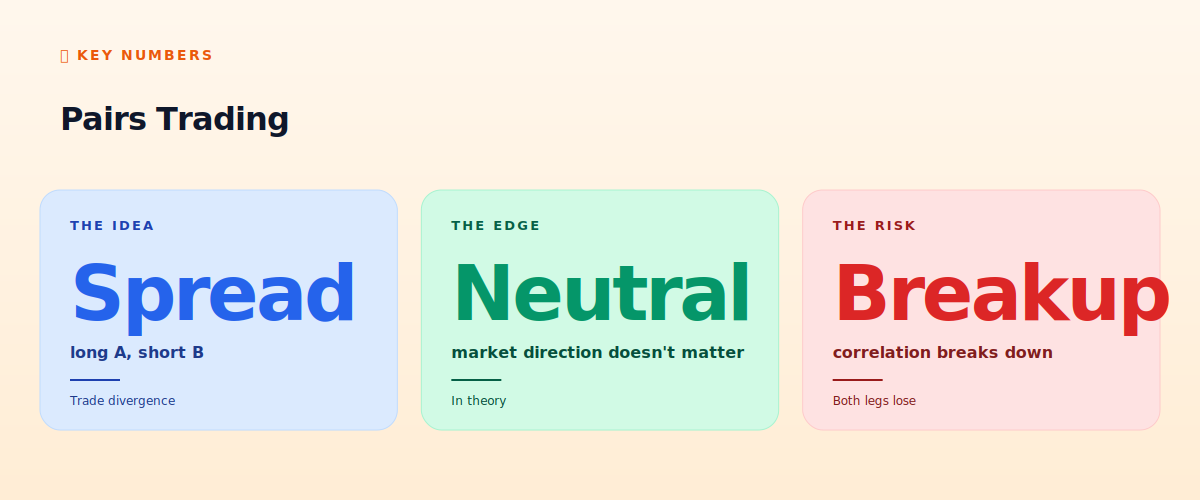
Pick two assets that historically move together — say, two correlated crypto tokens, or two related stocks. Normally their prices track each other closely. Occasionally they diverge: one rises while the other lags, widening the usual spread between them. Pairs trading bets this divergence is temporary — that they'll converge back to their normal relationship. So you short the outperformer (expecting it to come down) and go long the underperformer (expecting it to catch up). When they converge, both legs profit, and you close the trade.
The beauty: you don't care if the overall market goes up or down. If both assets rise but your laggard rises more (converging), you profit. If both fall but your outperformer falls more (converging), you profit. You've isolated the relative movement and hedged out the market direction. That's the market-neutral appeal.
The statistics
Real pairs trading is quantitative. Key concepts:
- Correlation: a starting filter — do the two assets historically move together? But correlation alone isn't enough.
- Cointegration: the deeper property — do the assets share a long-term equilibrium relationship that the spread reverts to? Cointegrated pairs are the proper candidates; merely correlated ones can drift apart permanently.
- Spread z-score: how many standard deviations is the current spread from its historical mean? You enter when the spread is extreme (z-score ±2 or more) and exit when it reverts toward zero.
The discipline is in pair selection (find genuinely cointegrated pairs, not coincidentally correlated ones) and threshold setting (when is the spread extreme enough to trade, and when has it reverted enough to exit?).
The correlation-breakdown risk
Here's where pairs trading bites. The entire strategy assumes the two assets will converge — that their historical relationship holds. When that relationship breaks down, the trade goes wrong in the worst way: instead of converging, the assets diverge further. Your short keeps rising, your long keeps falling, and both legs lose simultaneously. There's no convergence because the relationship that justified the trade no longer exists.
Correlations break for real reasons: a fundamental change in one asset (a hack, a regulatory action, a project pivot), a sector rotation, or simply a relationship that was always spurious. The 2008 crisis and various crypto blowups are littered with 'market-neutral' pairs trades that became double losses when correlations broke. 'Market-neutral' protects against overall market direction, not against the specific relationship you bet on failing.
Where OpenClaw fits
Pairs trading moves slowly (positions held days to weeks as spreads revert), so OpenClaw's latency is fine. The LLM can help with the judgment around correlation breakdown — the hardest part. A conceptual OpenClaw pairs skill: monitor the spread z-score of pre-selected cointegrated pairs, enter when the spread is extreme, but — critically — before entering and while holding, evaluate whether the historical relationship still makes sense (any news suggesting a fundamental break in one asset?). The LLM can catch context that a purely statistical bot misses: 'this spread widened because Asset B was hacked — the correlation is broken, don't bet on convergence.' That judgment is exactly where pure stat-arb bots fail and an LLM can help.
Guardrails remain essential: stop-losses on the spread (if it widens beyond a threshold, the relationship may have broken — exit rather than hope), position-size caps, and limits on concurrent pairs.
The honest verdict
Pairs trading is a legitimate, sophisticated, market-neutral strategy used by professional quant funds — but it's advanced, requires genuine statistical rigor (cointegration testing, not just eyeballing correlation), and carries the under-appreciated risk that the relationship you're betting on can break, turning a 'hedged' trade into a double loss. For retail with OpenClaw, it's viable but demanding: you need good pair selection, statistical discipline, hard stop-losses on the spread, and the judgment (LLM-assisted) to recognize when a correlation has broken. It's not a beginner strategy. Master the directional strategies and funding rate arbitrage first; approach pairs trading once you can think statistically and respect the breakdown risk.
📧 Get every new tutorial in your inbox
One email per week. Tutorials, CVE disclosures, broker updates. Unsubscribe in one click.
(Connect FluentCRM / ConvertKit / Beehiiv form here)
Frequently asked questions
What is pairs trading?
A market-neutral strategy: trade the spread between two correlated assets. When they diverge, long the laggard and short the leader, profiting when they converge — regardless of overall market direction.
Why is it called market-neutral?
Because you're hedged against overall market direction — you profit from the relative movement (convergence) of the two assets, not from the market rising or falling.
What's the main risk?
Correlation breakdown. If the historical relationship breaks, the assets diverge instead of converging, and both legs lose simultaneously. 'Market-neutral' doesn't protect against this.
What's the difference between correlation and cointegration?
Correlation means they move together; cointegration means they share a long-term equilibrium the spread reverts to. Cointegrated pairs are proper candidates; merely correlated ones can drift apart permanently.
Is pairs trading good for beginners?
No. It's advanced, requiring statistical rigor (cointegration testing) and respect for breakdown risk. Master directional strategies and funding rate arbitrage first.
What to read next
- Funding Rate Arbitrage
- Mean Reversion Strategies for Crypto Bots
- Building a Multi-Strategy Portfolio
- Backtesting with OpenClaw: Tools & Limits
Sources cited: The Hacker News (CVE-2026-25253 disclosure, Feb 2026); Conscia 2026 OpenClaw Security Crisis advisory; Snyk ToxicSkills study; Cyber Press ClawHavoc reporting; Wall Street Journal Polymarket profitability analysis (May 2026); Andrey Sergeenkov via The Defiant (April 2026); Akey, Grégoire, Harvie & Martineau, SSRN paper (March 2026); openclaw.ai official advisories; Peter Steinberger public statements on X. statistical arbitrage and cointegration literature; quantitative finance research.