Risk disclosure: Independent research finds 70–84% of Polymarket traders lose money (Sergeenkov, April 2026; Akey et al., SSRN, March 2026). Forex CFDs: 70–85% retail loss rate. Binary options: 80%+ in most jurisdictions. AI agents don't change these baselines. Full disclaimer. Security context: Three critical CVEs disclosed in OpenClaw in Q1 2026 (CVE-2026-25253, CVE-2026-32922) plus the ClawHavoc supply-chain attack (1,184 malicious skills). Always run v2026.4.12 or later. Full security assessment.
Backtesting — testing a strategy against historical data — is essential for systematic trading, and it's also where OpenClaw has a genuine limitation. Because OpenClaw's strategies involve LLM reasoning, they're hard to backtest deterministically: the same historical data might produce different decisions across runs. This guide covers the tools, the realistic limits, and the hybrid approach that works.
Understanding this limitation is important — it's one of the few areas where OpenClaw is genuinely weaker than traditional coded bots like Freqtrade, and pretending otherwise would mislead you.
TL;DR — The 30-second answer
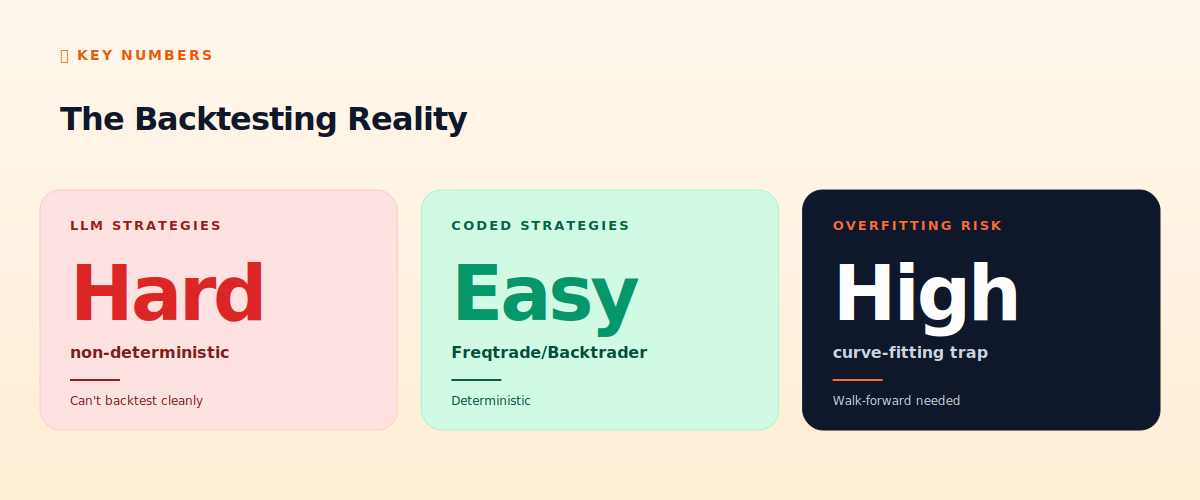
- LLM strategies are hard to backtest — non-deterministic, can't replay cleanly.
- Coded strategies backtest well — use Freqtrade or Backtrader for the systematic core.
- The hybrid approach: backtest the systematic logic, forward-test the LLM judgment layer.
- Overfitting is the universal trap — a great backtest often means curve-fitting.
- Walk-forward analysis is more honest than a single backtest.
- Paper trading is OpenClaw's real validation method — embrace it.
The backtesting reality
Why LLM strategies resist backtesting
Traditional backtesting replays historical data through a deterministic strategy: given these exact inputs, the strategy always produces these exact outputs. You can run it a thousand times and get identical results, which lets you measure performance precisely.
OpenClaw's LLM-driven strategies break this. The LLM might interpret the same market situation slightly differently across runs — reasoning is not perfectly deterministic. It might weigh news sentiment differently, or reach a judgment call differently. This means you can't cleanly replay an OpenClaw strategy through history and trust the result. The non-determinism that makes the LLM flexible also makes it hard to backtest. This is a real limitation, and we'd be doing you a disservice to pretend OpenClaw matches Freqtrade here.
What you CAN backtest
The systematic, deterministic parts of your strategy backtest fine. If your OpenClaw bot uses clear rules — 'enter when RSI crosses 30, exit at 2% profit or 1% loss' — you can implement those exact rules in Freqtrade or Backtrader and backtest them rigorously. The LLM's role then becomes a judgment layer on top of a backtestable core, rather than the whole strategy.
This is the practical path: extract the systematic logic, backtest it in a deterministic tool, then add the LLM judgment layer for the parts that need flexibility (news interpretation, regime awareness, multi-venue decisions). You validate the core mathematically and the judgment layer through forward-testing.
The tools
- Freqtrade: best for crypto. Detailed metrics, Hyperopt for parameter optimization, multi-pair testing. Open-source.
- Backtrader: general-purpose Python framework. Good for stocks, forex, crypto. More flexible, steeper learning curve.
- VectorBT: fast vectorized backtesting for large parameter sweeps. Advanced.
- TradingView Strategy Tester: built into Pine Script. Convenient for visual validation, less rigorous than the Python tools.
- MT5 Strategy Tester: for forex strategies, multi-threaded and capable (see our MT4 vs MT5).
The overfitting trap
Here's the danger that catches everyone: a great backtest usually means you've overfit. If you tweak parameters until the backtest shows 300% annual returns with no drawdown, you haven't found a great strategy — you've curve-fit to the specific historical data, and it'll fail forward. The more parameters you optimize and the better the backtest looks, the more suspicious you should be.
Signs of overfitting: too many parameters, performance that degrades sharply with small parameter changes, results that look 'too good,' and strategies that work beautifully in-sample but fall apart out-of-sample. The cure is discipline: few parameters, out-of-sample testing, and walk-forward analysis.
Walk-forward analysis
More honest than a single backtest: optimize your strategy on one period (say, 2023), then test it unchanged on the next period (2024), then re-optimize on 2024 and test on 2025, and so on. This simulates how you'd actually use the strategy — optimizing on the past, trading the unknown future. If a strategy survives walk-forward testing across multiple periods, it's far more likely to have genuine edge than one that just looks good on a single historical fit.
Paper trading — OpenClaw's real validation
Because OpenClaw's LLM layer resists backtesting, paper trading is your primary validation method for the complete strategy. Run the full OpenClaw bot (LLM judgment and all) in paper mode for 2-4 weeks, logging every decision. This forward-tests the actual system you'll deploy, including the non-deterministic LLM behavior that backtesting can't capture. We emphasize this throughout the site (see the Polymarket bot guide) precisely because it's OpenClaw's honest validation path.
The honest workflow
- Extract systematic rules from your strategy idea.
- Backtest those rules in Freqtrade/Backtrader with discipline (few parameters).
- Walk-forward test to check the edge survives across periods.
- If the core has edge, build the OpenClaw bot with LLM judgment on top.
- Paper trade the full system for 2-4 weeks to validate the LLM layer.
- Go live small, scale only after live profitability is proven.
📧 Get every new tutorial in your inbox
One email per week. Tutorials, CVE disclosures, broker updates. Unsubscribe in one click.
(Connect FluentCRM / ConvertKit / Beehiiv form here)
Frequently asked questions
Can I backtest an OpenClaw strategy?
Not the full LLM-driven strategy — it's non-deterministic. You can backtest the systematic core in Freqtrade/Backtrader, then forward-test the LLM layer via paper trading.
Is this a weakness of OpenClaw?
Yes, honestly. For rigorous backtesting, coded bots like Freqtrade are better. OpenClaw's strength is flexibility and reasoning, not backtestability.
What's the best backtesting tool?
Freqtrade for crypto, Backtrader for general use. Both open-source and free.
Why is my backtest so good but live is bad?
Almost certainly overfitting. A too-good backtest means you've curve-fit to historical data. Use walk-forward analysis and out-of-sample testing.
How long should I paper trade?
2-4 weeks minimum for the full OpenClaw system. This forward-tests the LLM layer that backtesting can't capture.
What to read next
- Freqtrade vs OpenClaw
- Best Free Trading Tools
- Crypto Arbitrage Realistic Expectations
- The 12-Point Hardening Checklist
Sources cited: The Hacker News (CVE-2026-25253 disclosure, Feb 2026); Conscia 2026 OpenClaw Security Crisis advisory; Snyk ToxicSkills study; Cyber Press ClawHavoc reporting; Wall Street Journal Polymarket profitability analysis (May 2026); Andrey Sergeenkov via The Defiant (April 2026); Akey, Grégoire, Harvie & Martineau, SSRN paper (March 2026); openclaw.ai official advisories; Peter Steinberger public statements on X. Freqtrade and Backtrader documentation; quantitative finance literature on overfitting and walk-forward analysis.