Risk disclosure: Independent research finds 70–84% of Polymarket traders lose money (Sergeenkov, April 2026; Akey et al., SSRN, March 2026). Forex CFDs: 70–85% retail loss rate. Binary options: 80%+ in most jurisdictions. AI agents don't change these baselines. Full disclaimer. Security context: Three critical CVEs disclosed in OpenClaw in Q1 2026 (CVE-2026-25253, CVE-2026-32922) plus the ClawHavoc supply-chain attack (1,184 malicious skills). Always run v2026.4.12 or later. Full security assessment.
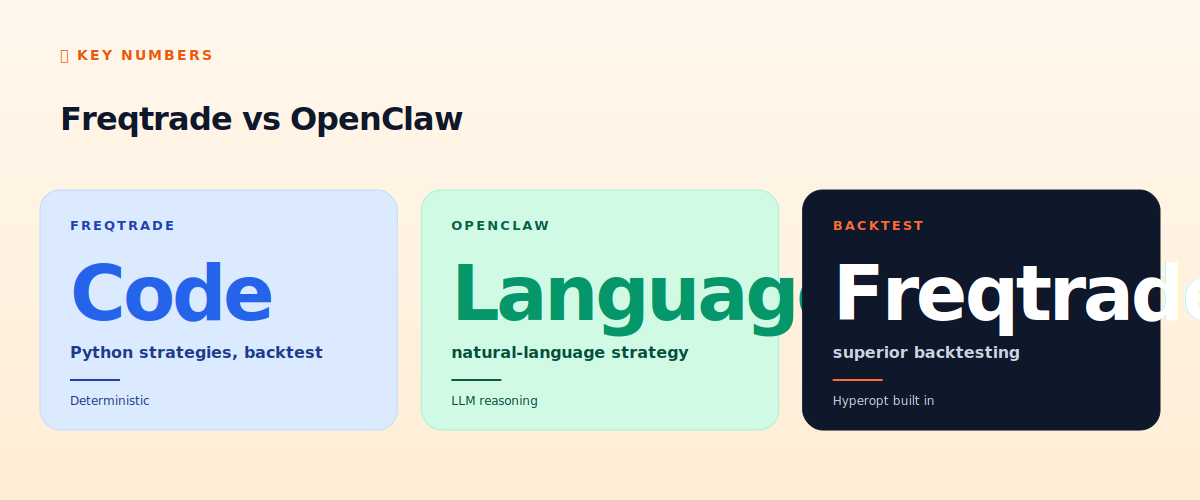
Freqtrade is the most popular open-source crypto trading bot — a mature, Python-based framework with excellent backtesting, hyperparameter optimization, and a large strategy community. OpenClaw is the AI agent newcomer that lets you describe strategies in natural language. They represent two philosophies: deterministic code vs LLM reasoning. Both have a place.
We compare them on strategy definition, backtesting, flexibility, learning curve, and the kinds of traders each suits.
TL;DR — The 30-second answer
- Freqtrade: Python-coded strategies, superb backtesting, deterministic, free.
- OpenClaw: natural-language strategies, LLM reasoning, flexible, broader scope.
- Backtesting: Freqtrade wins decisively (Hyperopt, detailed metrics).
- Flexibility: OpenClaw wins for judgment, news, multi-venue logic.
- Learning curve: Freqtrade needs Python; OpenClaw needs prompt-writing.
- For backtested crypto strategies: Freqtrade. For judgment-driven trading: OpenClaw.
Two philosophies
Strategy definition
Freqtrade strategies are Python classes. You define entry/exit logic, indicators, and risk rules in code. This is precise, deterministic, version-controllable, and testable — but requires Python skills and produces strategies that do exactly and only what you coded. There's no judgment, no adaptation to unforeseen conditions.
OpenClaw strategies are natural-language SKILL.md files. You describe what you want ("monitor BTC, buy if RSI drops below 30 and news sentiment is positive") and the LLM interprets and executes. This is flexible and accessible (no Python required) but non-deterministic — the LLM might interpret edge cases differently, and you must hard-code guardrails because you can't fully predict its behavior.
Backtesting
Freqtrade wins decisively here. Its backtesting engine is excellent: detailed metrics, Hyperopt for hyperparameter optimization, walk-forward analysis, and the ability to test against years of historical data quickly. For developing and validating systematic strategies, Freqtrade's backtesting is a major advantage.
OpenClaw has no equivalent backtesting framework. Because strategies involve LLM reasoning, they're hard to backtest deterministically — the same historical data might produce different decisions depending on LLM behavior. This is a real limitation: you can't rigorously validate an OpenClaw strategy the way you can a Freqtrade one. You're more reliant on forward-testing (paper trading).
Flexibility and scope
OpenClaw wins on flexibility. It can interpret news, reason about novel situations, orchestrate across multiple venues and data sources, and handle strategies that are hard to express as code. Freqtrade is crypto-focused and strategy-execution-focused; OpenClaw spans research, monitoring, multi-asset trading, and judgment calls. If your strategy involves anything beyond mechanical rules, OpenClaw's reasoning is an advantage.
Learning curve
Freqtrade requires Python proficiency — you write actual code. The community provides example strategies, but customizing them needs programming. OpenClaw requires prompt-writing skill — you describe strategies in clear natural language and learn to write good SKILL.md files. Neither is trivial, but they demand different skills. Non-programmers find OpenClaw more accessible; programmers often find Freqtrade more controllable.
The verdict
Use Freqtrade if: you can code Python, you want rigorously backtested systematic crypto strategies, and your logic is mechanical (clear rules, no judgment). Use OpenClaw if: you prefer natural-language strategy definition, your trading involves judgment or news interpretation, or you want broader scope (research, multi-venue, alerts) beyond mechanical execution.
Honestly, many traders benefit from both: Freqtrade for the systematic, backtestable core strategies, and OpenClaw for the research, monitoring, and judgment layer around them. They're not mutually exclusive.
📧 Get every new tutorial in your inbox
One email per week. Tutorials, CVE disclosures, broker updates. Unsubscribe in one click.
(Connect FluentCRM / ConvertKit / Beehiiv form here)
Frequently asked questions
Is Freqtrade free?
Yes, fully open-source. No paid tier.
Can I backtest OpenClaw strategies?
Not rigorously. LLM reasoning makes deterministic backtesting hard. Rely on forward-testing (paper trading) instead. This is a real OpenClaw limitation.
Do I need to code for Freqtrade?
Yes, Python. You can start from community strategies but customization requires programming.
Which is better for crypto?
Freqtrade is crypto-specialized with better backtesting. OpenClaw is broader but less rigorous for systematic crypto strategies.
Can I use both?
Yes, and many do. Freqtrade for systematic core strategies, OpenClaw for research, monitoring, and judgment.
What to read next
Sources cited: The Hacker News (CVE-2026-25253 disclosure, Feb 2026); Conscia 2026 OpenClaw Security Crisis advisory; Snyk ToxicSkills study; Cyber Press ClawHavoc reporting; Wall Street Journal Polymarket profitability analysis (May 2026); Andrey Sergeenkov via The Defiant (April 2026); Akey, Grégoire, Harvie & Martineau, SSRN paper (March 2026); openclaw.ai official advisories; Peter Steinberger public statements on X. Freqtrade documentation; OpenClaw documentation.