Risk disclosure: Independent research finds 70–84% of Polymarket traders lose money (Sergeenkov, April 2026; Akey et al., SSRN, March 2026). Forex CFDs: 70–85% retail loss rate. Binary options: 80%+ in most jurisdictions. AI agents don't change these baselines. Full disclaimer. Security context: Three critical CVEs disclosed in OpenClaw in Q1 2026 (CVE-2026-25253, CVE-2026-32922) plus the ClawHavoc supply-chain attack (1,184 malicious skills). Always run v2026.4.12 or later. Full security assessment.
The 'brain' you connect to OpenClaw determines its behavior more than any other choice. Claude (Anthropic) and GPT-5 (OpenAI) are the two leading options for trading bots, and they have genuinely different strengths. Claude tends toward more careful reasoning; GPT-5 toward faster responses. Neither is universally better — the right choice depends on the task.
We tested both on real OpenClaw trading tasks over 30 days: strategy interpretation, news evaluation, hedging logic, and tool use. Here's what we found, with the honest caveat that LLM capabilities shift rapidly and any specific comparison ages fast.
TL;DR — The 30-second answer
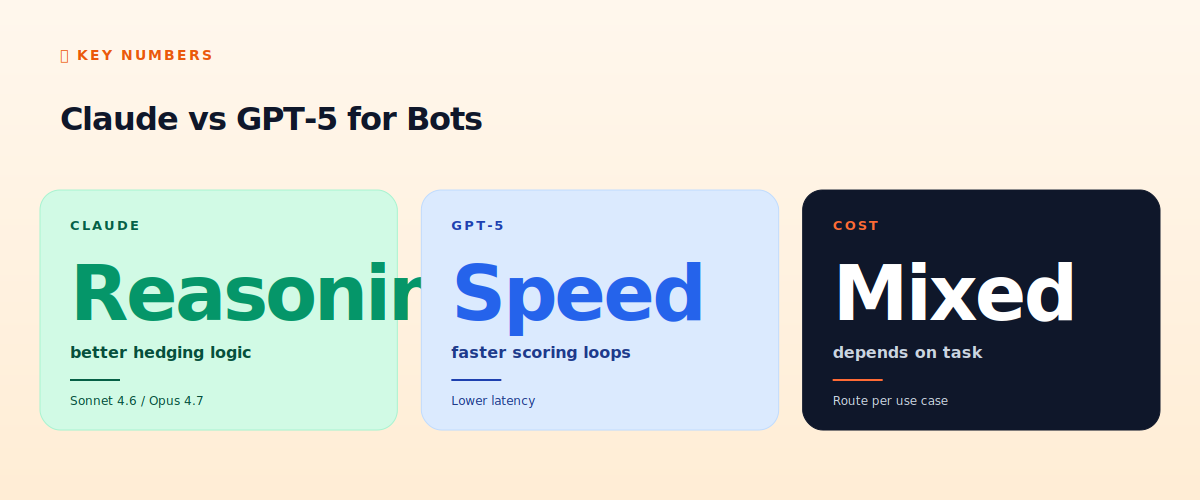
- Claude (Sonnet 4.6 / Opus 4.7): better at multi-step reasoning, hedging logic, careful judgment.
- GPT-5: faster responses, good for high-frequency scoring loops.
- Hallucination: both hallucinate; both need hard-coded guardrails. Neither is safe to trust unsupervised.
- Tool use: roughly comparable; both handle OpenClaw skills well.
- Cost: varies by task and tier; route per use case.
- Best practice: Claude for decisions, GPT-5 for fast loops, route by task.
Head to head
Reasoning quality
In our testing, Claude (particularly Opus 4.7) produced more careful, defensible reasoning chains on complex trading decisions — hedging logic, evaluating conflicting signals, reasoning about risk under uncertainty. When we asked both models to evaluate whether to close a position given mixed news and technical signals, Claude's reasoning was more consistently sound, with fewer leaps. For decisions where the quality of reasoning matters more than speed, Claude had an edge.
This isn't universal — GPT-5 reasons well too — but the gap was noticeable on the hardest judgment calls. For an OpenClaw bot making consequential decisions (whether to enter, how to hedge, when to exit), Claude's reasoning reliability is valuable.
Speed
GPT-5 was generally faster to respond in our tests, which matters for tasks you run frequently — a heartbeat loop checking conditions every few minutes, or a scoring function evaluating many candidates quickly. For high-frequency-ish OpenClaw tasks (still slow by HFT standards, but frequent for an LLM), GPT-5's lower latency adds up. Neither is fast enough for true HFT — that's not what LLM bots are for.
Hallucination and reliability
Critical point: both models hallucinate, and both will eventually make a wrong call. We documented cases where each model misinterpreted a signal or invented a detail. This is why — regardless of which model you choose — you must hard-code your guardrails (position size, daily loss limit, kill-switch) outside the LLM. Never trust either model to enforce its own risk limits. We cover this in our hardening checklist.
Neither model is meaningfully 'safer' for trading in the sense that matters — both require the same external guardrails. The difference is in reasoning quality and speed, not in whether you can trust them unsupervised (you can't, with either).
Tool use
Both models handle OpenClaw's tool/skill invocation well. They reliably call the right skills, pass correct parameters, and chain tools to accomplish multi-step tasks. We found them roughly comparable here — both are mature enough that tool use isn't a differentiator for most OpenClaw bots.
Cost
Pricing shifts frequently and depends on the specific model tier and your token usage, so we won't quote exact numbers that'll be stale by the time you read this. The practical pattern: both have premium tiers (Claude Opus, GPT-5) that are expensive for high-volume use, and the smart move is routing — use the expensive model only for consequential decisions, cheaper models (or DeepSeek, see our DeepSeek comparison) for routine checks. OpenClaw's Model Resolver makes this routing straightforward.
The verdict
Don't choose one — route by task. Use Claude for: consequential decisions, hedging logic, news interpretation, anything where reasoning quality matters. Use GPT-5 for: frequent scoring loops, faster monitoring, latency-sensitive (by LLM standards) tasks. OpenClaw lets you assign different models to different parts of your strategy, which is the optimal approach. For a single-model setup making important decisions, we'd lean Claude for the reasoning reliability.
Caveat worth repeating: LLM capabilities change fast. This comparison reflects our May 2026 testing. Re-evaluate periodically — the leader on any specific task can shift with new model releases.
📧 Get every new tutorial in your inbox
One email per week. Tutorials, CVE disclosures, broker updates. Unsubscribe in one click.
(Connect FluentCRM / ConvertKit / Beehiiv form here)
Frequently asked questions
Which LLM is best for trading bots?
Neither universally. Claude edges reasoning quality; GPT-5 edges speed. Route by task — Claude for decisions, GPT-5 for fast loops.
Can I trust either model to manage risk?
No. Both hallucinate. Hard-code guardrails (position size, loss limits, kill-switch) outside the LLM regardless of which you use.
Which is cheaper?
Depends on tier and usage. Route expensive models to important decisions only, cheap models or DeepSeek to routine checks.
Can I use both in one bot?
Yes. OpenClaw's Model Resolver routes different tasks to different models. This is the recommended approach.
Will this comparison stay accurate?
No — LLMs evolve fast. This reflects May 2026 testing. Re-evaluate when new models release.
What to read next
- DeepSeek vs Claude: Cost/Performance
- What Is OpenClaw?
- Freqtrade vs OpenClaw
- The 12-Point Hardening Checklist
Sources cited: The Hacker News (CVE-2026-25253 disclosure, Feb 2026); Conscia 2026 OpenClaw Security Crisis advisory; Snyk ToxicSkills study; Cyber Press ClawHavoc reporting; Wall Street Journal Polymarket profitability analysis (May 2026); Andrey Sergeenkov via The Defiant (April 2026); Akey, Grégoire, Harvie & Martineau, SSRN paper (March 2026); openclaw.ai official advisories; Peter Steinberger public statements on X. Anthropic and OpenAI model documentation; our 30-day OpenClaw task testing.