Affiliate disclosure: Links to brokers (Exness, Deriv, Binance, Bybit, OKX, IQ Option, Pocket Option, Quotex) may earn us a referral commission. Your costs don't change. Our ratings don't either. Risk disclosure: Independent research finds 70–84% of Polymarket traders lose money (Sergeenkov, April 2026; Akey et al., SSRN, March 2026). Forex CFDs: 70–85% retail loss rate. Binary options: 80%+ in most jurisdictions. AI agents don't change these baselines. Full disclaimer.
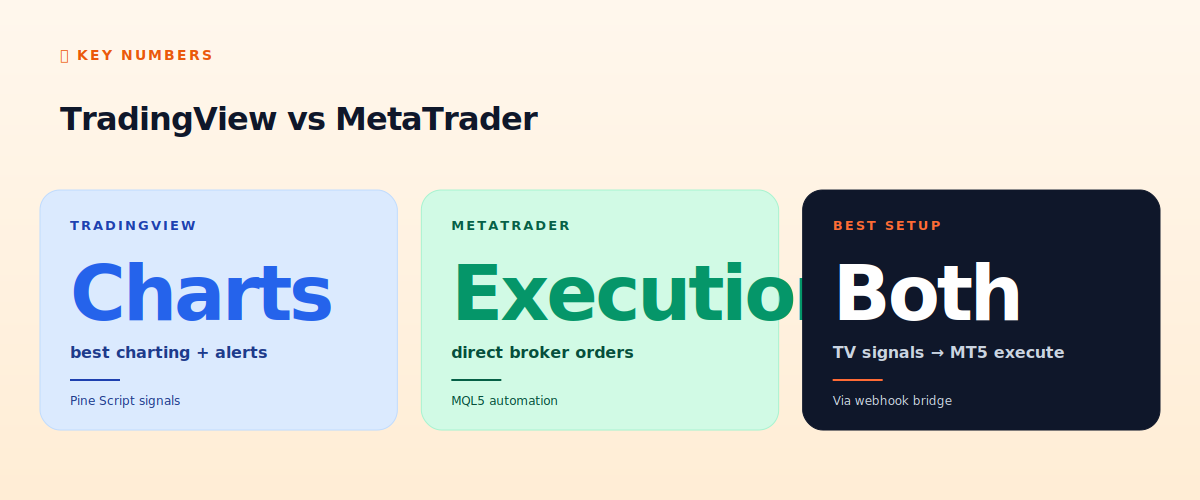
TradingView and MetaTrader are often framed as competitors, but they're really complementary tools that excel at different things. TradingView is the best charting and analysis platform in the world; MetaTrader is the workhorse execution platform for forex and CFDs. Most serious traders end up using both — TradingView for analysis and signal generation, MetaTrader for execution.
We compare them across charting, scripting (Pine Script vs MQL5), execution, automation, and how they fit into an OpenClaw workflow.
TL;DR — The 30-second answer
- TradingView: best-in-class charting, Pine Script, cloud-based, social.
- MetaTrader: direct broker execution, MQL5 automation, desktop.
- They're complementary, not competitors. Most pros use both.
- Best setup: TradingView signals → webhook → MT5 (or OpenClaw) executes.
- For OpenClaw: TradingView for signal generation, OpenClaw + MT5 for execution.
- Pine Script vs MQL5: Pine is easier; MQL5 is more powerful for execution.
Different strengths
Charting and analysis
TradingView is the undisputed leader in charting. Its interface is cleaner, its indicator library vaster, its drawing tools better, and its multi-timeframe analysis smoother than anything MetaTrader offers. The social features (shared ideas, public scripts) add a research dimension MetaTrader lacks entirely. For analysis, TradingView wins decisively.
MetaTrader's charting is functional but dated. It does the job for execution-focused traders, but nobody chooses MetaTrader for its charts.
Scripting: Pine Script vs MQL5
TradingView uses Pine Script — a domain-specific language designed for indicators and strategies. It's remarkably easy to learn (you can write a working indicator in 10 lines) and excellent for signal generation and backtesting visualization. Its limitation: Pine Script can't directly execute trades on most brokers; it generates alerts/signals that need an external bridge to act on.
MQL5 (MetaTrader) is more powerful for execution — it can place, modify, and close orders directly, manage positions, and run complex logic. It's harder to learn (closer to C++) but it's the language of execution. For OpenClaw bots, you'd typically use Pine Script for signal logic and let OpenClaw + an MT5 bridge handle execution.
Execution
MetaTrader connects directly to your broker and executes orders. TradingView added broker integrations (you can trade directly from TradingView charts with supported brokers like Pepperstone), but its execution ecosystem is narrower than MetaTrader's. For pure execution reliability, MetaTrader leads.
The best setup: both together
The professional pattern: use TradingView for analysis and to generate signals (via Pine Script alerts), push those signals via webhook to an execution layer (OpenClaw, or directly to MT5 via a bridge), and let the execution layer place orders. This combines TradingView's superior analysis with MetaTrader's (or OpenClaw's) execution reliability.
For OpenClaw specifically: TradingView generates a signal → webhook to OpenClaw → OpenClaw's LLM evaluates the signal against your strategy and risk rules → OpenClaw executes via the MT5 bridge or a crypto exchange skill. This is a powerful, flexible architecture.
The verdict
This isn't a versus — it's an and. Use TradingView for: charting, analysis, signal generation, backtesting visualization. Use MetaTrader for: reliable forex/CFD execution. Use OpenClaw to: tie them together with intelligent signal evaluation and risk management. Most serious traders run all three in some combination.
📧 Get every new tutorial in your inbox
One email per week. Tutorials, CVE disclosures, broker updates. Unsubscribe in one click.
(Connect FluentCRM / ConvertKit / Beehiiv form here)
Frequently asked questions
Is TradingView free?
Basic tier is free with limits. Paid tiers ($15-60/month) add more indicators, alerts, and data. The free tier is enough to start.
Can TradingView execute trades?
With supported brokers (like Pepperstone), yes, directly from charts. Otherwise it generates signals that need an external execution layer.
Pine Script or MQL5 for OpenClaw?
Pine Script for signal generation (easier), then OpenClaw + MT5 bridge for execution. You rarely need full MQL5 strategies with OpenClaw.
Can I connect TradingView to OpenClaw?
Yes, via webhook. TradingView alert fires a webhook, OpenClaw receives it, evaluates against your rules, and executes.
Which has better backtesting?
TradingView for quick visual backtesting; MetaTrader MT5 for rigorous multi-currency testing. Different purposes.
What to read next
- MT4 vs MT5 for Algo Trading
- cTrader vs MT5
- OpenClaw + MT5 Bridge Setup
- Forex Strategies That Actually Work
Sources cited: The Hacker News (CVE-2026-25253 disclosure, Feb 2026); Conscia 2026 OpenClaw Security Crisis advisory; Snyk ToxicSkills study; Cyber Press ClawHavoc reporting; Wall Street Journal Polymarket profitability analysis (May 2026); Andrey Sergeenkov via The Defiant (April 2026); Akey, Grégoire, Harvie & Martineau, SSRN paper (March 2026); openclaw.ai official advisories; Peter Steinberger public statements on X. TradingView and MetaQuotes documentation; Pine Script and MQL5 language references.