Risk disclosure: Independent research finds 70–84% of Polymarket traders lose money (Sergeenkov, April 2026; Akey et al., SSRN, March 2026). Forex CFDs: 70–85% retail loss rate. Binary options: 80%+ in most jurisdictions. AI agents don't change these baselines. Full disclaimer. Security context: Three critical CVEs disclosed in OpenClaw in Q1 2026 (CVE-2026-25253, CVE-2026-32922) plus the ClawHavoc supply-chain attack (1,184 malicious skills). Always run v2026.4.12 or later. Full security assessment.
Hummingbot and OpenClaw both automate trading, but they're fundamentally different tools solving different problems. Hummingbot is a specialized, open-source market-making and execution engine built for speed and deterministic strategies. OpenClaw is an AI agent framework that orchestrates trading through natural-language reasoning. Comparing them is less 'which is better' and more 'which is right for your job.'
We break down where each excels, where each fails, and the surprisingly common case where you'd use both together.
TL;DR — The 30-second answer
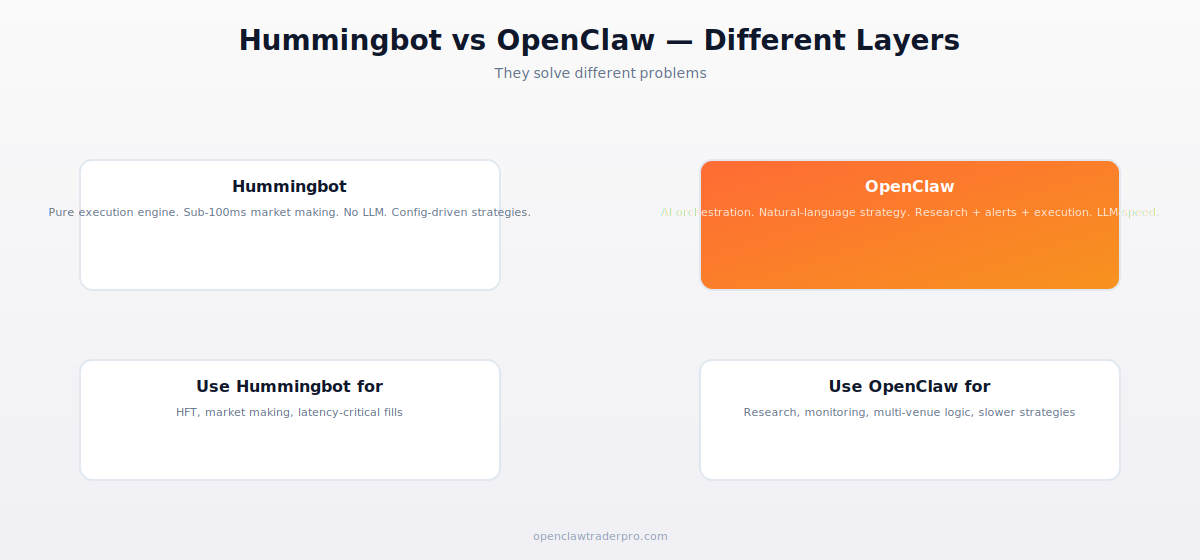
- Hummingbot: pure execution engine. Sub-100ms market making. No LLM. Deterministic.
- OpenClaw: AI orchestration. Natural-language strategy. Research + alerts + execution.
- Hummingbot wins for: HFT, market making, latency-critical fills.
- OpenClaw wins for: research, monitoring, multi-venue logic, slower strategies.
- Use both: OpenClaw for decisions and oversight, Hummingbot for fast execution.
- Not competitors — different layers of the stack.
Different layers of the stack
What Hummingbot is
Hummingbot is an open-source framework specialized in market making and arbitrage. It connects to 30+ exchanges, runs deterministic strategies (configured, not reasoned), and executes at high speed — sub-100ms order placement is achievable. It has no LLM; strategies are defined by configuration files and Python strategy classes. It excels at the kind of high-frequency, latency-sensitive work that OpenClaw is structurally bad at (because LLM inference takes 1.5-3 seconds).
Hummingbot's market-making strategies — pure market making, cross-exchange market making, AMM arbitrage — are battle-tested and run by serious operators. If your goal is to provide liquidity and capture spreads at speed, Hummingbot is purpose-built for it.
What OpenClaw is
OpenClaw is an AI agent framework. Its strength is reasoning: interpreting natural-language strategy, evaluating news, making judgment calls, orchestrating across multiple venues and data sources. Its weakness is speed — every decision goes through an LLM, adding 1.5-3 seconds of latency. OpenClaw is bad at HFT and good at everything that benefits from judgment over speed.
Where each wins
Hummingbot wins for: market making, high-frequency arbitrage, latency-critical execution, deterministic strategies you can fully specify in advance. If the strategy is 'place bids and asks around mid-price and capture the spread, adjusting every 100ms,' Hummingbot is the tool.
OpenClaw wins for: research and analysis, monitoring with intelligent alerts, multi-venue strategies requiring judgment, news interpretation, strategies you describe in words rather than code, and anything where the decision matters more than the millisecond. If the strategy is 'monitor these markets, evaluate news sentiment, and alert me or trade when conditions align,' OpenClaw is the tool.
Using both together
The sophisticated pattern: OpenClaw handles high-level decisions and oversight; Hummingbot handles fast execution. OpenClaw's LLM evaluates market conditions, news, and risk, then adjusts Hummingbot's configuration parameters (spread, order size, inventory targets). Hummingbot executes the actual market making at speed. You get LLM judgment plus sub-100ms execution — the best of both.
For example: OpenClaw reads that volatility is spiking (from news or price action), reasons that market making is riskier now, and widens Hummingbot's spreads or pauses it entirely. Hummingbot, meanwhile, handles the thousands of fast order placements OpenClaw could never match.
The verdict
These aren't competitors. Choose Hummingbot if your work is market making or latency-critical execution. Choose OpenClaw if your work is research, monitoring, or judgment-driven trading. Use both if you want intelligent oversight (OpenClaw) directing fast execution (Hummingbot). For most of our readers starting out, OpenClaw is the better entry point — market making is an advanced discipline most beginners shouldn't start with.
📧 Get every new tutorial in your inbox
One email per week. Tutorials, CVE disclosures, broker updates. Unsubscribe in one click.
(Connect FluentCRM / ConvertKit / Beehiiv form here)
Frequently asked questions
Is Hummingbot free?
Yes, open-source. They monetize through a managed cloud version and partnerships, but the core software is free.
Can OpenClaw do market making?
Poorly. LLM latency (1.5-3s) makes it unsuitable for the fast quoting market making requires. Use Hummingbot for that.
Can Hummingbot interpret news?
No. It's a deterministic execution engine with no LLM. OpenClaw handles reasoning and interpretation.
Which should a beginner start with?
OpenClaw, generally. Market making (Hummingbot's specialty) is advanced. OpenClaw's research and monitoring use cases are more beginner-appropriate.
Can they run on the same VPS?
Yes, though resource-intensive. Many operators run them on separate VPSs that communicate via API.
What to read next
- Freqtrade vs OpenClaw
- What Is OpenClaw?
- Crypto Arbitrage Realistic Expectations
- OpenClaw VPS Comparison
Sources cited: The Hacker News (CVE-2026-25253 disclosure, Feb 2026); Conscia 2026 OpenClaw Security Crisis advisory; Snyk ToxicSkills study; Cyber Press ClawHavoc reporting; Wall Street Journal Polymarket profitability analysis (May 2026); Andrey Sergeenkov via The Defiant (April 2026); Akey, Grégoire, Harvie & Martineau, SSRN paper (March 2026); openclaw.ai official advisories; Peter Steinberger public statements on X. Hummingbot documentation; OpenClaw documentation.