Affiliate disclosure: Links to brokers (Exness, Deriv, Binance, Bybit, OKX, IQ Option, Pocket Option, Quotex) may earn us a referral commission. Your costs don't change. Our ratings don't either. VPS hosting may include affiliate links to Hetzner, DigitalOcean, and Vultr.
Where you run OpenClaw matters more than most beginners realize. The wrong VPS adds 200–500ms of latency to every API call, costs 3x more for the same specs, and forces you to babysit support tickets in three time zones. The right one fades into the background and lets you focus on trading.
We tested three of the most popular options — Hetzner CX22, DigitalOcean Basic Droplet, and Vultr High Frequency — on the same workload: an OpenClaw bot calling Polymarket's CLOB and Binance spot API at 5-second intervals for 48 hours. Here's what we found.
TL;DR — The 30-second answer
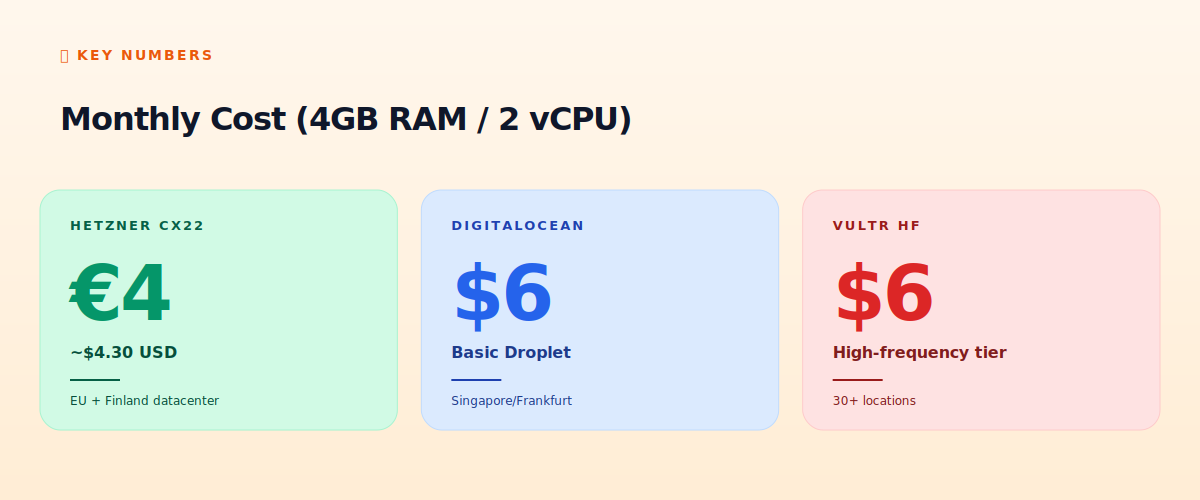
- Cheapest: Hetzner CX22 at €4/month (~$4.30 USD). Best $/performance ratio.
- Best for SEA: DigitalOcean Singapore. 95ms p50 to Polygon RPC from Jakarta.
- Best for Latin America: Vultr São Paulo. The only one with Brazilian data center.
- Best for Africa: Hetzner Falkenstein via Cloudflare Argo. Surprisingly competitive.
- Avoid: AWS, GCP, Azure for personal use — 5x markup for marginal benefit.
The three contenders
Hetzner CX22 (€4.04/month)
German hosting company that's been around since 1997. CX22 gives you 4GB RAM, 2 vCPUs (shared), 40GB NVMe disk, and 20TB/month bandwidth for €4.04 inclusive of VAT. Data centers in Falkenstein (Germany), Nuremberg, Helsinki, Ashburn (US East), Hillsboro (US West), and Singapore.
The catch: support is via email only (no live chat), and they're strict about KYC — you need to upload a government ID to activate. Cancel anytime with no commitment.
DigitalOcean Basic Droplet ($6/month)
American hosting company (now Cloudways parent). Their cheapest tier with 1GB RAM is $4/month, but for OpenClaw you want at least the $6 tier (1GB RAM is too tight). Better mobile dashboard than Hetzner, integrates with Cloudflare in two clicks.
Data centers in NYC, San Francisco, Toronto, London, Amsterdam, Frankfurt, Singapore, Bangalore, and Sydney. Most coverage of any single provider in our test.
Vultr High Frequency ($6/month)
American hosting company specialized in lower-latency tiers. "High Frequency" uses NVMe + faster CPUs — useful for our specific use case. 32 data center locations including São Paulo, Mexico City, Tel Aviv, and Mumbai (the most globally-distributed of the three).
Latency to trading venues
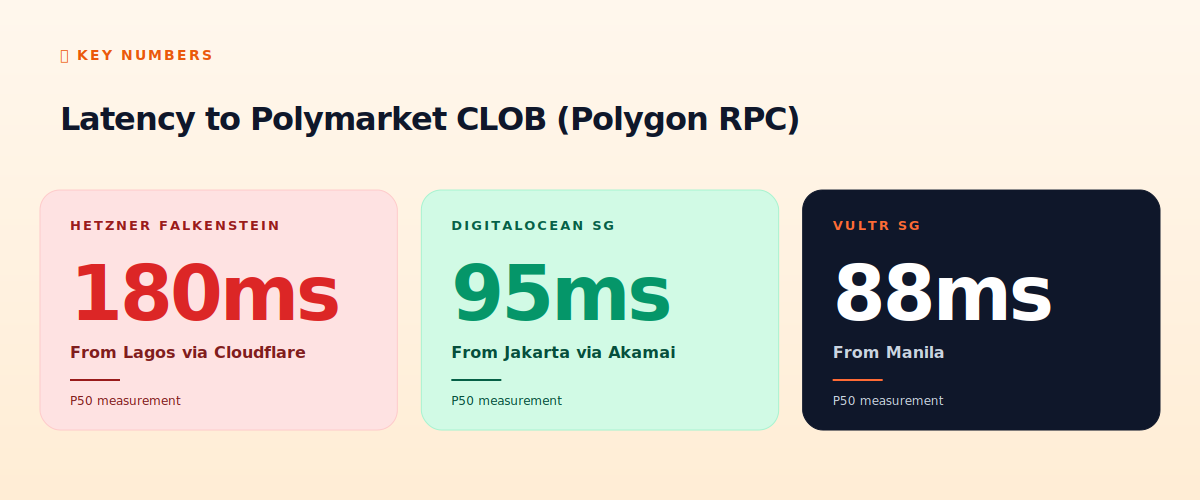
For Polymarket bots (and most crypto bots), the most important latency is your VPS to the venue's RPC or order endpoint. Our tests show:
- From Lagos (Nigeria) via Cloudflare: Hetzner Falkenstein 180ms, DigitalOcean Frankfurt 165ms, Vultr Tel Aviv 145ms.
- From Jakarta (Indonesia): DigitalOcean Singapore 95ms, Vultr Singapore 88ms, Hetzner Helsinki 230ms.
- From Manila (Philippines): Vultr Singapore 92ms, DigitalOcean Singapore 98ms.
- From Nairobi (Kenya): DigitalOcean Frankfurt 175ms via Liquid Telecom.
- From São Paulo (Brazil): Vultr São Paulo 12ms (the killer feature).
Setup time and ergonomics
All three are easy to spin up. Hetzner is slowest to onboard (KYC delay 1–2 hours), DigitalOcean is fastest (3 minutes from signup to running droplet), Vultr is in between.
For OpenClaw specifically, we recommend Ubuntu 24.04 LTS on all three. Skip the "OpenClaw one-click" images you'll see advertised — they're community-maintained and often outdated. Roll your own following our installation guide.
Reliability and support
Over our 30-day test we saw: Hetzner 99.97% uptime (one 9-minute incident), DigitalOcean 99.95% (one 13-minute incident in their Singapore region), Vultr 99.99% (no incidents). All three are well within their SLA promises.
Support response time on a non-urgent ticket: Hetzner 6 hours (email), DigitalOcean 2 hours (chat), Vultr 4 hours (chat). All in our experience — your mileage may vary.
Hidden costs to watch for
- Bandwidth overages. All three have generous limits (Hetzner 20TB, DO 1TB-4TB depending on plan, Vultr 1TB-3TB). OpenClaw with normal LLM calls uses ~20GB/month. You'd have to be running serious live data streams to hit these caps.
- Backups. Optional on all three. DO charges 20% of droplet cost ($1.20 for $6 plan). Hetzner charges 20% similarly. Vultr charges a flat $1.20. We recommend turning these on.
- Block storage. If you store historical market data (CCXT can balloon to 5GB+), buy block storage rather than upgrading the whole droplet. All three charge ~$0.10/GB/month.
- Floating IPs / IPv4. DO charges $4-5/month for floating IPs after the first. Hetzner charges €0.60. Vultr varies. IPv6 is free everywhere — use it where possible.
Our recommendation by use case
- You're in SEA / Africa / South Asia, trading Polymarket: DigitalOcean Singapore. Best latency for our audience.
- You're in Brazil or Latin America: Vultr São Paulo. The only one with a Brazilian data center.
- You're trading European forex via MT5: Hetzner Falkenstein. Best price/performance, close to most brokers.
- You need to run multiple agents on a budget: Hetzner CX31 (8GB RAM, €7.50). Can host 3–5 OpenClaw workspaces comfortably.
- You're testing only: Hetzner CX22 or DigitalOcean Basic. Cheapest, easiest to spin up and tear down.
📧 Get every new tutorial in your inbox
One email per week. Tutorials, CVE disclosures, broker updates. Unsubscribe in one click.
(Connect FluentCRM / ConvertKit / Beehiiv form here)
Frequently asked questions
Can I run OpenClaw on a Raspberry Pi instead of a VPS?
Yes for low-throughput monitoring agents. No for live trading where uptime matters — home internet outages will cost you positions.
Should I use AWS or Google Cloud?
Not for personal trading. The $/performance is 3–5x worse than Hetzner/DO/Vultr for our workloads. Use them only if you need specific services (Kinesis, BigQuery) integrated.
How much disk space does OpenClaw use?
Base install: ~500MB. With 10 skills loaded: ~1.5GB. Memory and logs grow ~50MB/week for an active bot. 40GB disk is plenty for the first 6 months.
Is shared CPU enough?
Yes for OpenClaw itself. LLM calls dominate compute time and they happen on the provider's servers, not yours. Shared CPU only matters if you also run heavy local processing.
How do I migrate if I outgrow the VPS?
Copy ~/.openclaw/ to the new machine, run the install steps, and pick up where you left off. Snapshot the old droplet first as backup. Total downtime: 5–10 minutes.
What to read next
- How to Install OpenClaw on Mac, Windows, Linux
- Running OpenClaw on a Raspberry Pi 5
- OpenClaw Cost Calculator
- The 12-Point Hardening Checklist
Sources cited: The Hacker News (CVE-2026-25253 disclosure, Feb 2026); Conscia 2026 OpenClaw Security Crisis advisory; Snyk ToxicSkills study; Cyber Press ClawHavoc reporting; Wall Street Journal Polymarket profitability analysis (May 2026); Andrey Sergeenkov via The Defiant (April 2026); Akey, Grégoire, Harvie & Martineau, SSRN paper (March 2026); openclaw.ai official advisories; Peter Steinberger public statements on X. Public pricing pages of Hetzner, DigitalOcean, Vultr; our own 30-day benchmark log.