Risk disclosure: Independent research finds 70–84% of Polymarket traders lose money (Sergeenkov, April 2026; Akey et al., SSRN, March 2026). Forex CFDs: 70–85% retail loss rate. Binary options: 80%+ in most jurisdictions. AI agents don't change these baselines. Full disclaimer. Security context: Three critical CVEs disclosed in OpenClaw in Q1 2026 (CVE-2026-25253, CVE-2026-32922) plus the ClawHavoc supply-chain attack (1,184 malicious skills). Always run v2026.4.12 or later. Full security assessment.
DeepSeek's models cost a fraction of Claude's, which raises an obvious question for OpenClaw bot operators watching their API bills: can you just use the cheap model? The answer is nuanced. For some tasks, DeepSeek is perfectly adequate and saves you 80-90% on costs. For others, Claude's superior reasoning is worth paying for. The art is knowing which is which.
We compare DeepSeek V3.2 and Claude for OpenClaw trading tasks, focusing on the cost/performance trade-off and how to route tasks to keep your monthly bill at $30 instead of $150.
TL;DR — The 30-second answer
- DeepSeek V3.2: roughly 10x cheaper per token than premium Claude.
- Claude: better reasoning, more reliable on complex judgment.
- DeepSeek is fine for: heartbeat checks, simple monitoring, routine scoring.
- Claude is worth it for: consequential decisions, hedging, news interpretation.
- Hybrid routing: DeepSeek for routine + Claude for decisions = ~$30/mo vs $150 Claude-only.
- Both hallucinate: guardrails required regardless.
The cost reality
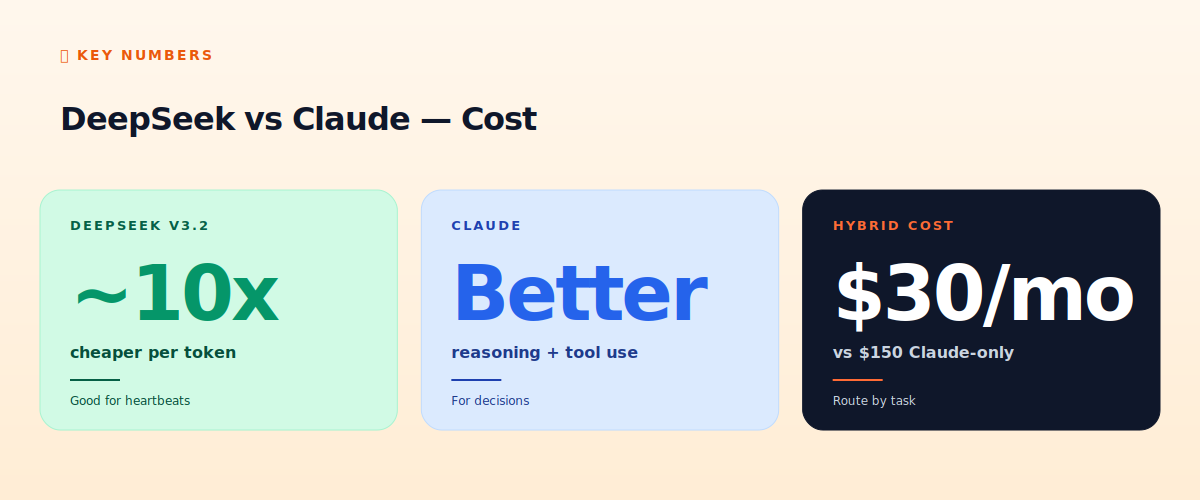
DeepSeek V3.2 costs roughly an order of magnitude less per token than premium Claude models. For a bot making thousands of LLM calls per month, this is the difference between a $30 and a $150+ monthly API bill. For operators running multiple bots or high-frequency monitoring loops, the gap is even larger. Cost alone makes DeepSeek tempting for high-volume, low-stakes tasks.
Where DeepSeek is good enough
DeepSeek V3.2 is a capable model. For many OpenClaw tasks, it's entirely adequate:
- Heartbeat checks: 'Is the market open? Any open positions? Any alerts triggered?' — routine status checks don't need premium reasoning.
- Simple monitoring: 'Is BTC above/below this threshold?' — straightforward conditions.
- Data formatting: parsing API responses, formatting alerts, logging — mechanical tasks.
- First-pass scoring: filtering many candidates down to a few for closer evaluation.
For these high-frequency, low-stakes tasks, paying premium Claude prices is wasteful. DeepSeek does them fine at a tenth of the cost.
Where Claude earns its premium
On complex, consequential decisions, Claude's reasoning advantage is worth paying for:
- Hedging logic: reasoning about how to offset risk across positions.
- Conflicting signals: when technicals say one thing and news says another, the judgment call matters.
- News interpretation: evaluating the trading implications of a central bank statement or a regulatory announcement.
- Position exit decisions: the call that directly affects P&L deserves the better reasoner.
In our testing, DeepSeek was more prone to shallow reasoning on these hard calls — not always wrong, but less consistently sound than Claude. For decisions where being wrong costs real money, Claude's reliability justifies the cost.
The hybrid routing pattern
OpenClaw's Model Resolver lets you assign different models to different tasks. The cost-optimal pattern:
- DeepSeek V3.2 for the 30-minute heartbeat loop (runs constantly, low stakes).
- DeepSeek V3.2 for routine monitoring and data formatting.
- Claude Sonnet 4.6 for moderate decisions (entry signals, routine position management).
- Claude Opus 4.7 for the highest-stakes calls (large position exits, hedging, news-driven decisions).
This routing typically cuts costs to around $30/month versus $150+ for a Claude-only setup, while preserving Claude's reasoning quality exactly where it matters. The routine 90% of calls go to DeepSeek; the consequential 10% go to Claude.
The verdict
It's not DeepSeek vs Claude — it's DeepSeek and Claude, routed by task stakes. Use DeepSeek for: high-frequency, low-stakes tasks (heartbeats, monitoring, formatting). Use Claude for: consequential decisions where reasoning quality affects P&L. The hybrid approach gives you Claude-quality decisions at near-DeepSeek costs. Both hallucinate, so hard-coded guardrails remain mandatory regardless of model.
📧 Get every new tutorial in your inbox
One email per week. Tutorials, CVE disclosures, broker updates. Unsubscribe in one click.
(Connect FluentCRM / ConvertKit / Beehiiv form here)
Frequently asked questions
Is DeepSeek good enough for trading bots?
For routine tasks (heartbeats, monitoring, formatting), yes. For consequential decisions, Claude's reasoning is more reliable. Route by stakes.
How much can I save with DeepSeek?
Routing routine tasks to DeepSeek typically cuts a $150/mo Claude-only bill to around $30/mo, preserving Claude for important decisions.
Is DeepSeek safe for trading?
As safe as any LLM — which is to say, it hallucinates and needs hard-coded guardrails. No LLM is safe to trust unsupervised.
Can I run DeepSeek locally?
Yes, via Ollama if you have the hardware. This eliminates per-token costs but adds latency and infrastructure complexity.
Which routing setup do you recommend?
DeepSeek for heartbeats/monitoring, Claude Sonnet for moderate decisions, Claude Opus for highest-stakes calls. OpenClaw's Model Resolver handles it.
What to read next
- Claude vs GPT-5 for Trading Bots
- What Is OpenClaw?
- OpenClaw Cost Calculator
- The 12-Point Hardening Checklist
Sources cited: The Hacker News (CVE-2026-25253 disclosure, Feb 2026); Conscia 2026 OpenClaw Security Crisis advisory; Snyk ToxicSkills study; Cyber Press ClawHavoc reporting; Wall Street Journal Polymarket profitability analysis (May 2026); Andrey Sergeenkov via The Defiant (April 2026); Akey, Grégoire, Harvie & Martineau, SSRN paper (March 2026); openclaw.ai official advisories; Peter Steinberger public statements on X. DeepSeek and Anthropic model documentation and pricing; our OpenClaw task testing.