Risk disclosure: Independent research finds 70–84% of Polymarket traders lose money (Sergeenkov, April 2026; Akey et al., SSRN, March 2026). Forex CFDs: 70–85% retail loss rate. Binary options: 80%+ in most jurisdictions. AI agents don't change these baselines. Full disclaimer. Security context: Three critical CVEs disclosed in OpenClaw in Q1 2026 (CVE-2026-25253, CVE-2026-32922) plus the ClawHavoc supply-chain attack (1,184 malicious skills). Always run v2026.4.12 or later. Full security assessment.
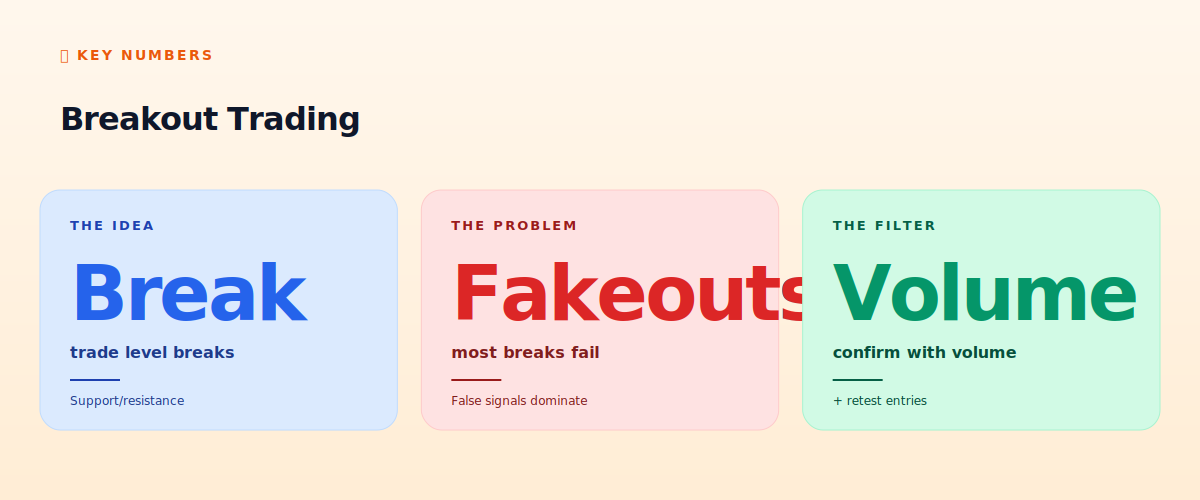
Breakout trading aims to catch the big move when price breaks through a key level — a resistance it couldn't pass before, or a support it held above. The appeal is obvious: get in right as a major move begins and ride it. The problem is equally real: most apparent breakouts are 'fakeouts' that reverse, trapping traders who jumped in. This guide covers breakout strategy, the filters that separate real breaks from false ones, and how to handle the fakeout problem.
Breakout trading is closely related to momentum (a breakout often starts a trend) but has its own specific challenge: the high rate of false signals. Managing fakeouts is the entire game.
TL;DR — The 30-second answer
- The idea: trade the move when price breaks a key support/resistance level.
- The appeal: catch a major move right as it begins.
- The problem: most breakouts are fakeouts — false breaks that reverse.
- Key filters: volume confirmation, retest entries, time confirmation.
- The discipline: false signals dominate; filtering and stops are everything.
- OpenClaw fit: good — the LLM can assess breakout quality and context.
The breakout and the fakeout
How breakout trading works
Price often respects key levels — a resistance it has bounced off repeatedly, or a support it has held above. These levels represent where buyers and sellers have battled before. A breakout occurs when price decisively pushes through such a level: breaking above resistance (bullish) or below support (bearish). The theory: once a level breaks, the move that broke it has momentum and continues, so you enter in the direction of the break to ride the new move. Breakouts often mark the start of trends, linking this strategy to momentum.
The fakeout problem
Here's the brutal reality: most apparent breakouts fail. Price pokes above resistance, traders pile in expecting continuation, and then price reverses back below the level — a 'fakeout' or 'false breakout.' Everyone who entered on the break is now trapped in a losing position. Fakeouts happen for several reasons: thin volume breaks that lack conviction, stop-hunting (larger players pushing price through a level to trigger stops, then reversing), and simple noise. In many markets, false breakouts outnumber real ones. A breakout strategy with no fakeout filter loses money on a steady diet of false signals.
The filters that help
Distinguishing real breakouts from fakeouts is the entire skill. The filters:
- Volume confirmation. A real breakout usually comes with a surge in volume — genuine conviction behind the move. A break on thin volume is suspect. Requiring above-average volume on the break filters out many fakeouts.
- Retest entry. Instead of entering the instant price breaks the level, wait for price to break, then pull back to 'retest' the level (now flipped from resistance to support), then bounce. A successful retest confirms the break is real. This misses some moves but avoids many fakeouts — a favorable tradeoff.
- Time/close confirmation. Require price to close beyond the level (on your chosen timeframe), not just wick through it intrabar. A daily close above resistance is far more meaningful than a brief intraday poke.
- Level significance. Breaks of major, long-tested levels are more meaningful than breaks of minor, recent ones.
Combining filters (volume + retest + close confirmation) dramatically improves the win rate at the cost of missing some fast moves. That's usually a good trade — avoiding fakeouts matters more than catching every move.
Where OpenClaw helps
Breakout quality assessment is a judgment task suited to an LLM. OpenClaw can evaluate a potential breakout across multiple dimensions at once: Is volume confirming? Is this a significant level or a minor one? Is there news driving genuine conviction, or is this thin-volume noise? Has price closed beyond the level or just wicked through? A conceptual OpenClaw breakout skill: on a level break, don't enter immediately — assess volume, level significance, and whether to wait for a retest; only enter when the filters align, with a stop just back inside the broken level (so a fakeout exits you quickly with a small loss). The LLM's contextual judgment helps avoid the low-conviction breaks that trap mechanical bots.
The stop placement is critical: a breakout entry should have a tight stop just inside the broken level. If it's a fakeout and price reverses back through, you exit fast with a small loss. This asymmetry — small loss on fakeouts, large gain on real breaks — is what makes the strategy work despite the high fakeout rate.
The honest verdict
Breakout trading is a legitimate strategy that catches real trends early — when it works, the rides can be large. But it's plagued by false signals, and a breakout strategy without rigorous fakeout filters (volume, retest, close confirmation) and tight stops is a losing one. The math works only because the wins (real breakouts that trend) are larger than the many small losses (fakeouts stopped out quickly). Discipline around filtering and stop placement is everything. With OpenClaw's contextual judgment helping assess breakout quality, and hard stops capping fakeout damage, it's a viable strategy — but never a high-win-rate one. Expect many small losses punctuated by occasional large wins, and size accordingly.
📧 Get every new tutorial in your inbox
One email per week. Tutorials, CVE disclosures, broker updates. Unsubscribe in one click.
(Connect FluentCRM / ConvertKit / Beehiiv form here)
Frequently asked questions
What is breakout trading?
Trading the move when price breaks decisively through a key support or resistance level, entering in the direction of the break to ride the new move.
Why do most breakouts fail?
Fakeouts — thin-volume breaks, stop-hunting, and noise cause price to poke through a level then reverse, trapping traders who entered. False breakouts often outnumber real ones.
How do I filter out fakeouts?
Volume confirmation (real breaks have volume surges), retest entries (wait for price to retest the broken level), and close confirmation (require a close beyond the level, not just a wick).
Where do I put my stop?
Just inside the broken level. If it's a fakeout and price reverses, you exit fast with a small loss. This asymmetry makes the strategy work despite the high fakeout rate.
How does OpenClaw help with breakouts?
It assesses breakout quality across volume, level significance, and context — helping avoid low-conviction breaks that trap mechanical bots.
What to read next
- Momentum Trading: Riding Trends
- Mean Reversion Strategies for Crypto Bots
- The Martingale Trap
- Building a Multi-Strategy Portfolio
Sources cited: The Hacker News (CVE-2026-25253 disclosure, Feb 2026); Conscia 2026 OpenClaw Security Crisis advisory; Snyk ToxicSkills study; Cyber Press ClawHavoc reporting; Wall Street Journal Polymarket profitability analysis (May 2026); Andrey Sergeenkov via The Defiant (April 2026); Akey, Grégoire, Harvie & Martineau, SSRN paper (March 2026); openclaw.ai official advisories; Peter Steinberger public statements on X. technical analysis literature on breakouts and false breakouts.