Risk disclosure: Independent research finds 70–84% of Polymarket traders lose money (Sergeenkov, April 2026; Akey et al., SSRN, March 2026). Forex CFDs: 70–85% retail loss rate. Binary options: 80%+ in most jurisdictions. AI agents don't change these baselines. Full disclaimer. Binary options disclosure: CySEC, FCA, and ASIC have all restricted or banned binary options for retail traders in major markets due to consistently high loss rates (typically 80%+). Most binary options brokers operate from offshore jurisdictions with limited consumer protection. We do not recommend binary options as a serious trading strategy for retail capital.
Across every regulator that requires disclosure, binary options retail loss rates land between 75% and 85%. The number is so consistent across brokers, jurisdictions, and time periods that it can't be explained by bad luck or one broker's malice. There's a structural reason 80%+ of retail loses, and understanding it is the difference between joining the statistic and walking away with your capital.
This post unpacks the four mechanisms that produce the loss rate: the math problem, the broker incentive structure, the psychological traps, and the time-frame issue. We'll then explain what it would take to be in the 20% — and why most can't.
TL;DR — The 30-second answer
- The math: 80% payout on win, 100% loss on loss. Need 55.6% win rate just to break even.
- The broker: when you bet against the broker, your loss is their profit. No incentive to help you win.
- The psychology: quick wins create overconfidence; quick losses trigger martingale doubling. Both destroy accounts.
- The time frame: 60-second to 5-minute movements are noise-dominated. No information edge possible.
- The 20% who don't lose: long expiries, tiny positions, narrow asset focus, mechanical rules, willingness to walk away.
- The reality: being in the 20% requires a personality that 80% of retail doesn't have.
The four mechanisms
Loss rates this consistent require structural causes. Let's go through each.
Mechanism 1 — The math problem
We covered this in the explainer but it bears repeating because most binary options education skips it entirely. If you win, you get 80% of stake. If you lose, you lose 100% of stake. Break-even win rate: 55.6%.
Random chance gives you 50% win rate (coin flip). To make money, you need to be right more than 56% of the time over many trades. In stock markets over 1-week windows, the best hedge funds achieve about 53-55% win rates. In 60-second windows on EUR/USD, where outcomes are dominated by noise, achieving 56%+ consistently is essentially impossible.
This alone — before adding any other factor — produces a loss rate close to what we observe. Random traders should lose about 5.6% of stake per trade on average. After 100 trades, they're down to ~16% of starting capital. The math forces the loss rate.
Mechanism 2 — The broker is the counterparty
In stock markets, when you buy Apple shares, you're trading with another person who's selling. The broker is just a middleman taking commission. Their incentive: keep you trading (more commissions) but they don't care if you win or lose individually.
In binary options, the broker IS your counterparty. When you bet that EUR/USD will be above 1.1000 at 3pm, the broker takes the opposite side. If you win, the broker pays you 80% of stake. If you lose, the broker keeps 100% of your stake. The broker's gross margin from each losing trade is your full stake; from each winning trade, the broker loses 0.8x stake.
This means: every losing trade is broker profit. Brokers have negative incentive to give you tools that improve your win rate. Some documented practices:
- Spread manipulation: showing slightly different prices to different users at the same moment.
- Slippage on losses but not on wins: winning trades execute at the requested price; losing trades execute at slightly worse prices.
- Delayed price updates: stalling price feed for milliseconds when retail is about to win.
- 'Hot streak' bonuses that pause withdrawals during winning runs.
- UI design that makes martingale-style position doubling one-click easy.
Some of these are documented in court cases against now-defunct brokers (Banc de Binary, Anyoption, others). The reputable regulated brokers (IQ Option) avoid the obvious tactics, but the structural incentive misalignment remains.
Mechanism 3 — The psychological trap
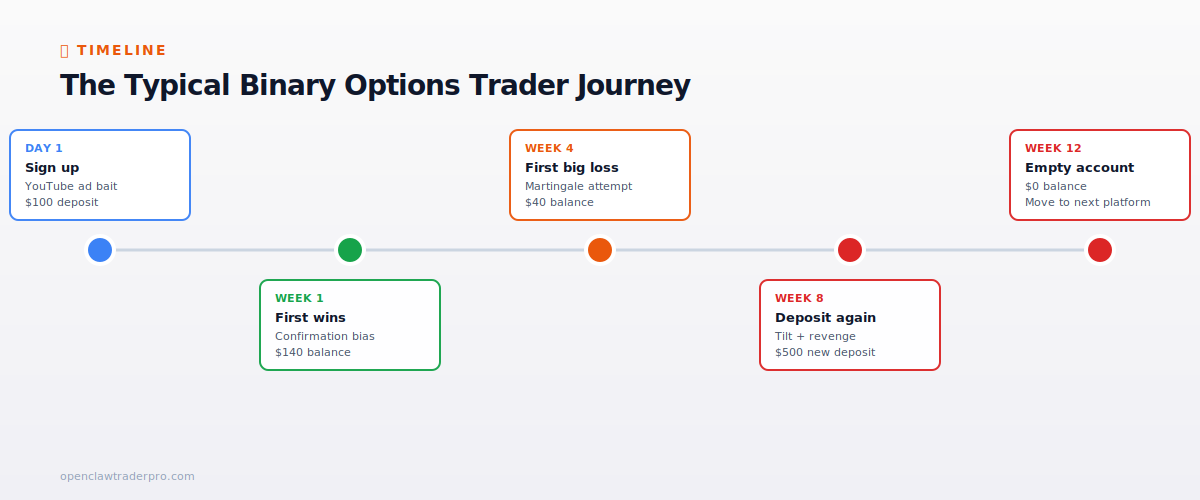
The 12-week journey shown in the timeline image is the typical trajectory. Each phase has a specific psychological hook:
- Day 1 (sign-up): attracted by YouTube ad showing wins. Believes they have an edge because the strategy 'looks simple.' Deposits $100.
- Week 1 (first wins): early wins by chance reinforce confidence. Confirmation bias activates. Account is up to $140. Now believes the strategy works.
- Week 4 (first big loss): hits a losing streak. Tries martingale (double stake after loss to 'win it back'). Loss bigger than expected. Account down to $40.
- Week 8 (revenge deposit): deposits $500 more, with mentality of 'recovering what I lost.' Emotional, larger stakes, less discipline.
- Week 12 (empty account): $0 balance. Moves to next broker in YouTube ads to start over.
This pattern is so well-documented in behavioral finance that you can predict it from sign-up demographics. Young men, mid-twenties, modest income, in markets without strong gambling regulation are the highest-risk demographic. Brokers target them in ad targeting.
Mechanism 4 — Time frame and noise
Most binary options trades expire in 60 seconds, 5 minutes, or 15 minutes. Over these windows, asset price movements are dominated by noise — random buying and selling that has nothing to do with fundamentals.
Concrete example: EUR/USD over a 60-second window typically moves ±1 pip from the start. That movement is essentially random. Any chart pattern you see in 60-second charts ("flags," "triangles," "head and shoulders") is statistical noise — the same patterns appear in random walks. The traders using these patterns on binary options are essentially gambling with extra steps.
For chart patterns to have predictive power, you typically need 4-hour or daily candles where actual information has time to be priced in. Binary options brokers offer longer expiries (4-hour, daily) but they're discouraged in the UI (less commission per unit time, less excitement). Most retail trades the short expiries because that's what the platform pushes.
What it takes to be in the 20%
The 15-20% who break even or profit share specific habits. None of them are secret — they're just unpopular:
- Trade longer expiries (1 hour minimum). Less noise, more information content. Boring compared to 60-second trades.
- Tiny position sizes. 0.5-1% of capital per trade. Most retail trades 5-10%.
- Narrow asset focus. 1-3 assets they know intimately, not 50 they're learning.
- Mechanical rules in writing. Entry, exit, and risk rules documented BEFORE the trade. Most retail decides at trade time.
- Daily review. Win or lose, every trade gets logged and reviewed at end of day. Most retail only reviews after big losses.
- Willingness to walk away. If 50 trades show negative results, the strategy doesn't work. Most retail doubles down.
- No martingale. Ever. Even small martingale eventually catches a streak that wipes you out.
- Capital separation. Trading account is not retirement savings. The amount in the account is the amount they accept losing.
Honest observation: most readers of this list will think "obvious, of course I'll do all that." Then they'll trade for two weeks, hit a losing streak, and break rules 5, 6, and 7 in the same evening. The 20% are 20% specifically because most people can't sustain discipline under emotional pressure.
Why we recommend skipping the category entirely
The structural factors against retail binary options are stacked enough that even traders who can be disciplined still face: asymmetric payouts (the math), broker incentive misalignment (the counterparty), and noise-dominated time frames. Discipline alone doesn't overcome those.
If you want short-term directional bets, spot crypto with stop-loss orders gives you symmetric payouts (you can win 100% and you can lose 100% — the asymmetry that hurts you in binaries doesn't exist). If you want fixed-payout structures, regulated prediction markets like Kalshi or Polymarket have price discovery and positive-sum potential. If you want algorithmic trading on never-closing markets, Deriv's synthetic indices have better mathematics than traditional binaries.
For 99% of readers, the optimal move is: skip binary options. Use the time you'd spend learning the broker's UI on actually learning trading fundamentals that transfer to better markets.
📧 Get every new tutorial in your inbox
One email per week. Tutorials, CVE disclosures, broker updates. Unsubscribe in one click.
(Connect FluentCRM / ConvertKit / Beehiiv form here)
Frequently asked questions
Aren't there profitable signal sellers?
A small number of legitimate signal services exist but the average performance gap between paid signals and random chance is small. Most signal sellers have negative ROI after their fees. The honest test: would they trade with their own money instead of selling signals? If not, why not?
Can AI improve my win rate?
Only marginally. The fundamental math problem (need 55.6%+ win rate) doesn't change. AI bots on binaries typically achieve 51-54% win rate — better than random, not enough to overcome the asymmetric payout.
Why are these statistics not common knowledge?
Brokers don't advertise the loss rates. Regulators publish them but mostly in obscure quarterly reports. Affiliates (YouTubers, influencers) earn commission on losses and have no incentive to share. The marketing dollars favor obscuring the statistics.
If 20% don't lose, isn't that proof some win?
Yes, but most of the 20% are 'don't lose,' not 'profit meaningfully.' Roughly 10-12% break even after fees, 5-8% profit a little, less than 1% profit significantly. The path to 'profit significantly' requires personality traits that most people don't have.
What about copy trading?
Same trap with extra steps. The leaders shown are top performers from millions; you're trading their selection bias. By the time you copy them, their alpha is usually gone or they shift strategy.
What to read next
- Binary Options: The Math Behind the Loss Rate
- IQ Option vs Pocket Option vs Quotex
- Deriv Synthetic Indices Explained
- Binary Options Scams: Field Guide
Sources cited: The Hacker News (CVE-2026-25253 disclosure, Feb 2026); Conscia 2026 OpenClaw Security Crisis advisory; Snyk ToxicSkills study; Cyber Press ClawHavoc reporting; Wall Street Journal Polymarket profitability analysis (May 2026); Andrey Sergeenkov via The Defiant (April 2026); Akey, Grégoire, Harvie & Martineau, SSRN paper (March 2026); openclaw.ai official advisories; Peter Steinberger public statements on X. ESMA 2018 product intervention measures; FCA Policy Statement PS19/11; CySEC broker disclosures 2024-2025; behavioral finance research on retail trading.