Risk disclosure: Independent research finds 70–84% of Polymarket traders lose money (Sergeenkov, April 2026; Akey et al., SSRN, March 2026). Forex CFDs: 70–85% retail loss rate. Binary options: 80%+ in most jurisdictions. AI agents don't change these baselines. Full disclaimer. Binary options disclosure: CySEC, FCA, and ASIC have all restricted or banned binary options for retail traders in major markets due to consistently high loss rates (typically 80%+). Most binary options brokers operate from offshore jurisdictions with limited consumer protection. We do not recommend binary options as a serious trading strategy for retail capital. Affiliate disclosure: Links to brokers (Exness, Deriv, Binance, Bybit, OKX, IQ Option, Pocket Option, Quotex) may earn us a referral commission. Your costs don't change. Our ratings don't either.
Three names dominate retail binary options advertising in 2026: IQ Option, Pocket Option, and Quotex. Each promises high payouts, easy interfaces, and "professional" trading tools. Each has dramatically different regulatory status, withdrawal records, and customer treatment.
This comparison covers what they actually are, what their regulators say (or don't say), how withdrawals work in practice, and our honest recommendation. Short version: we recommend none of them for serious trading. Long version: if you're going to use one anyway, here's how to minimize the damage.
TL;DR — The 30-second answer
- IQ Option: CySEC regulated. Best of a bad category. Available in EU with restrictions.
- Pocket Option: Marshall Islands, no serious regulator. Reports of withdrawal issues.
- Quotex: Offshore-only. Newer, fewer regulated complaints but also less data.
- For traders insisting on this category: IQ Option only, small stakes, paper trade first.
- For everyone else: skip the category. Use spot, CFDs, or prediction markets.
Regulation: the only thing that matters
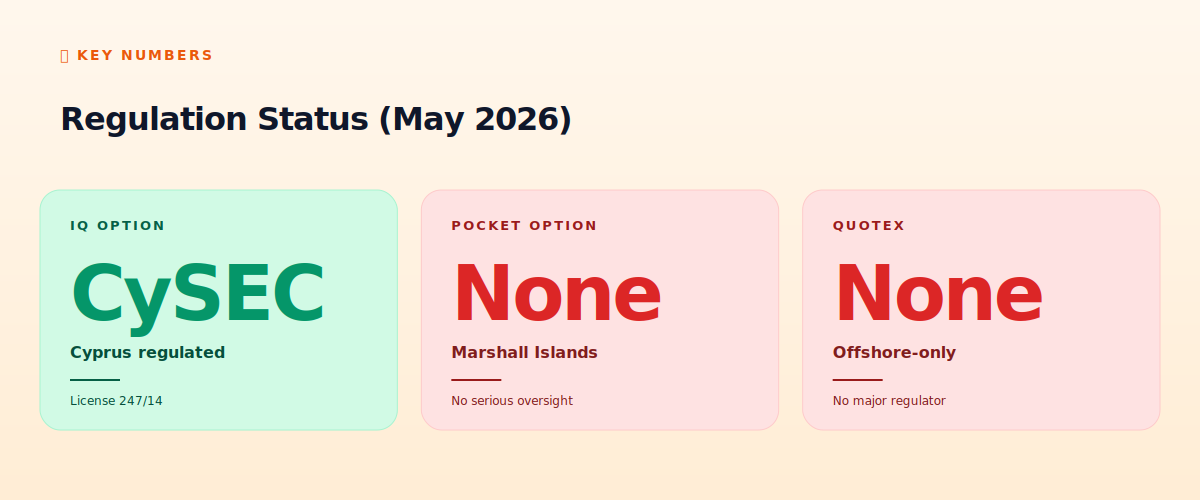
In binary options, regulation isn't a nice-to-have feature — it's the difference between recovering your funds when something goes wrong and writing them off. Let's go through each:
IQ Option (CySEC license 247/14)
Owned by IQ Option Europe Ltd, based in Cyprus, regulated by the Cyprus Securities and Exchange Commission. CySEC is a mid-tier European regulator — not as strict as the FCA or BaFin, but more rigorous than offshore jurisdictions. They require:
- Segregated client funds (your money is in a separate bank account from broker operations)
- Quarterly disclosure of retail loss rates
- Compliance with EU AML/KYC standards
- Member of the Investor Compensation Fund (up to €20K per client if broker fails)
Practical impact: if IQ Option freezes withdrawals or goes insolvent, you have a clear legal path to recovery through Cypriot courts and the compensation fund. Not perfect — CySEC has been criticized for slow enforcement — but materially better than no regulation.
Pocket Option (Marshall Islands)
Operated by an entity registered in the Marshall Islands — a jurisdiction with no meaningful financial regulator for retail derivatives. The Marshall Islands' role here is to provide a corporate registration that allows them to claim a legal entity exists, while doing essentially no consumer protection.
Reports of withdrawal issues are common but hard to verify. Pocket Option has aggressive affiliate marketing programs (some YouTubers receive 30-50% of net losses from referred customers as commission) which creates incentives for biased reviews. Their customer support is responsive but escalation paths for disputes are limited — there's no regulator to complain to.
Quotex (offshore)
Newer player, similar offshore structure to Pocket Option. Quotex has gained popularity in SEA and Latin America through affiliate marketing. They claim regulation in St. Vincent and the Grenadines — which functionally means no oversight. SVG's FSA explicitly does NOT regulate forex or binary options trading.
Less complaint data because they're newer, but the same structural problems as Pocket Option apply: broker is counterparty, no segregated funds requirement, no compensation fund, limited dispute resolution.
Payouts and asset coverage
All three offer similar payout structures: 70-85% on winning trades, 100% loss on losing trades. They compete on advertised "highest payout" but in practice the high payouts apply only to volatile assets at off-peak hours where wins are less likely. The effective payout, weighted by trade frequency, is around 75-78% across all three.
Asset coverage:
- IQ Option: ~250 assets including forex pairs, major stocks, indices, crypto, commodities. Also offers FX Options, Digital Options, and crypto CFDs as separate products.
- Pocket Option: ~100 assets, focus on forex and crypto. Quick options (5-second expiry) available.
- Quotex: ~50 assets, mostly forex pairs and crypto. Simpler interface than the other two.
Withdrawal speed and reliability
This is where the regulatory difference becomes concrete. Average user-reported withdrawal times (compiled from public reviews 2024-2025):
- IQ Option: 24-72 hours via crypto. 3-5 days via bank wire. Generally reliable. Occasional KYC delays for first withdrawal.
- Pocket Option: 24 hours to 14 days via crypto. Highly variable. Some users report needing to escalate via Trustpilot or chargebacks to get funds out.
- Quotex: 1-7 days via crypto. Limited data points but trending toward longer with increased volume.
For all three: the first withdrawal is the most likely to be delayed. Brokers often request additional KYC documents, photo verification, or in some cases proof of source of funds. This is partly legitimate AML compliance and partly a friction tactic to discourage withdrawals.
Bot and API support
For OpenClaw users, this matters: can you actually automate trading on these platforms?
- IQ Option: Has an unofficial Python API (iqoptionapi on GitHub) widely used. Not officially supported by IQ Option — they may close accounts using it, though enforcement is inconsistent. CCXT does not support them.
- Pocket Option: No official API. Some community-maintained automation tools exist via browser automation (Selenium/Playwright). Fragile, breaks frequently when UI updates.
- Quotex: No API. Similar browser-automation-only situation as Pocket Option.
None of these are bot-friendly the way Binance or Bybit are. If you want to run an OpenClaw bot on binary options-style products, Deriv (with its official DerivAPI) is dramatically better — see our Deriv setup guide.
Our honest recommendation
Don't trade binary options. The math is against you regardless of broker. If you've read the main explainer and are still going to trade:
- Use IQ Option if you must use one of these three. CySEC regulation is meaningful.
- Start with the demo account. IQ Option's is generous and not artificially friendly.
- If you move to live, deposit only what you accept losing. $50-200 maximum.
- Risk no more than 1% of stake per trade.
- Stop after 50 live trades and review honestly. If not profitable, walk away — the next 50 won't be different.
For most readers, the better path is: use the time you'd spend trading binaries on either spot crypto (Binance, Bybit) or prediction markets (Polymarket, Kalshi). Same impulse for short-term directional bets, dramatically better expected value.
📧 Get every new tutorial in your inbox
One email per week. Tutorials, CVE disclosures, broker updates. Unsubscribe in one click.
(Connect FluentCRM / ConvertKit / Beehiiv form here)
Frequently asked questions
Are these brokers scams?
Not in the legal sense — they do operate as advertised and pay out winners. The structural issues (broker is counterparty, asymmetric payouts) make them unsuitable for retail profit, but they're not classic scams like fake brokers that simply refuse withdrawals.
Why is IQ Option still operating in EU after the ban?
ESMA banned the marketing and sale to retail clients of binary options as defined narrowly. IQ Option restructured some products as 'FX Options' or 'Digital Options' to fall outside the strict definition. Whether this is legitimate compliance or regulatory arbitrage is debated.
Can I trust the 'demo to live' transition?
IQ Option's demo behaves similarly to live in our experience. Pocket Option and Quotex demos are reportedly more 'friendly' than live. Use the demo as a learning tool, not as a predictor of live performance.
What about Binarium, Olymp Trade, Binomo?
Similar to Pocket Option and Quotex: offshore, unregulated, mixed reviews on withdrawals. Same recommendation: avoid.
Where do I go to complain if I'm scammed?
If with IQ Option: CySEC complaints procedure. If with Pocket Option or Quotex: very limited options. Local law enforcement, your credit card chargeback if applicable, public review sites. Don't expect recovery.
What to read next
- Binary Options: The Math Behind the Loss Rate
- Why 80% of Binary Options Traders Lose
- Deriv Synthetic Indices: The OpenClaw Strategy Guide
- Binary Options Scams: Recognition Field Guide
Sources cited: The Hacker News (CVE-2026-25253 disclosure, Feb 2026); Conscia 2026 OpenClaw Security Crisis advisory; Snyk ToxicSkills study; Cyber Press ClawHavoc reporting; Wall Street Journal Polymarket profitability analysis (May 2026); Andrey Sergeenkov via The Defiant (April 2026); Akey, Grégoire, Harvie & Martineau, SSRN paper (March 2026); openclaw.ai official advisories; Peter Steinberger public statements on X. CySEC public license database; IQ Option's quarterly disclosures; user reports compiled from Trustpilot, Reddit r/Forex, ForexPeaceArmy.