Risk disclosure: Independent research finds 70–84% of Polymarket traders lose money (Sergeenkov, April 2026; Akey et al., SSRN, March 2026). Forex CFDs: 70–85% retail loss rate. Binary options: 80%+ in most jurisdictions. AI agents don't change these baselines. Full disclaimer. Binary options disclosure: CySEC, FCA, and ASIC have all restricted or banned binary options for retail traders in major markets due to consistently high loss rates (typically 80%+). Most binary options brokers operate from offshore jurisdictions with limited consumer protection. We do not recommend binary options as a serious trading strategy for retail capital.
Binary options are the simplest derivative in retail trading: bet on whether an asset will be above or below a price at a specific time. Win, you get your stake back plus 70-85%. Lose, you get nothing back. The math behind that asymmetry — combined with broker incentives and psychological traps — is why 80%+ of retail binary options accounts lose money, consistently, across every disclosed jurisdiction.
This guide explains what binary options actually are, where the loss rate comes from mathematically, why CySEC and FCA banned them for retail in major markets, and the small set of cases where they make any sense at all (which is mostly: never, for retail).
TL;DR — The 30-second answer
- What: Yes/No bet on price direction at a fixed future time. Fixed payout, fixed loss.
- The math: Typical 80% payout on win, 100% loss on loss. Break-even win rate: 55.6%.
- Loss rates: CySEC documented 83% retail loss for IQ Option in 2025.
- Regulation: Banned for retail in EU (ESMA 2018), restricted in UK, US.
- Available where: Offshore brokers in SEA, Africa, LATAM. Limited oversight.
- Honest answer: avoid this category. Use spot trading or regulated derivatives instead.
What binary options actually are
A binary option is a contract with two possible outcomes. You pick: (1) an asset (EUR/USD, BTC, Apple stock), (2) a direction ("price will be above X at time Y"), and (3) a stake amount. If you're right at expiry, you receive a fixed payout (typically 70-85% of your stake). If you're wrong, you lose 100% of your stake. There's no holding period in the traditional sense — expiry can be 60 seconds, 5 minutes, an hour, or a day, depending on the broker.
Binary options market themselves as "simple" trading because the outcome is binary and the maximum loss is fixed at your stake. This is technically true and practically misleading. The simplicity hides three structural problems that make consistent profit nearly impossible for retail.
The math problem
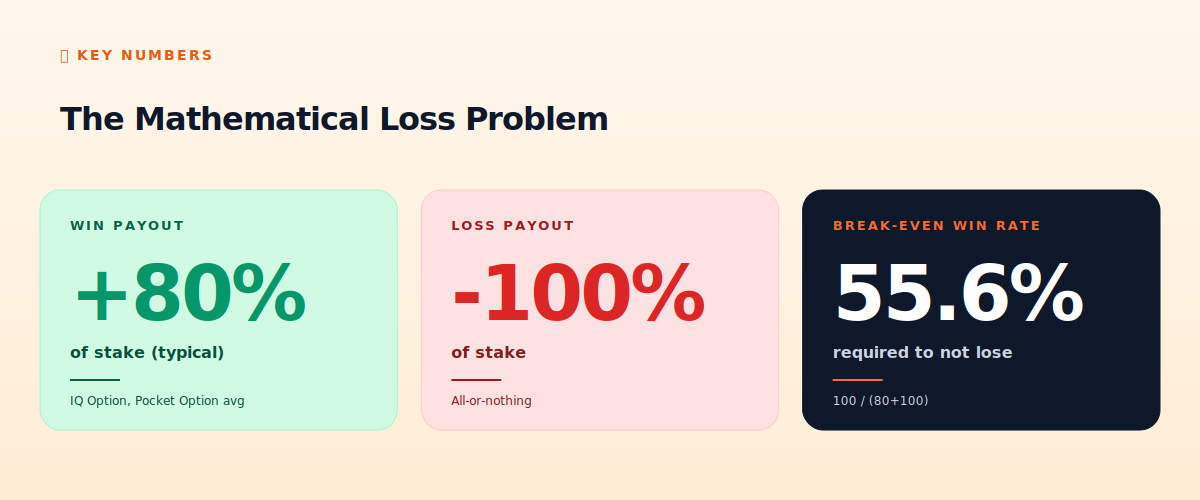
Here's the math that nobody in the YouTube ads explains. If you win, you get +80% of your stake. If you lose, you get -100% of your stake. To break even over many trades, you need your win rate to satisfy:
win_rate × 0.80 = (1 - win_rate) × 1.00
Solving: win_rate = 55.6%. You need to be right on more than 55.6% of trades just to not lose money. Random guessing on a coin flip nets you 50% win rate, which loses 5.6% of stake per trade on average. After 100 trades at random, you're down to about 16% of your starting capital.
To actually make money — say, 1% per trade in expectation — you need a win rate above 56%. To make 5% per trade, you need a win rate above 59%. This is much harder than it sounds in forex markets where movements over 60-second windows are dominated by noise.
The documented loss rates
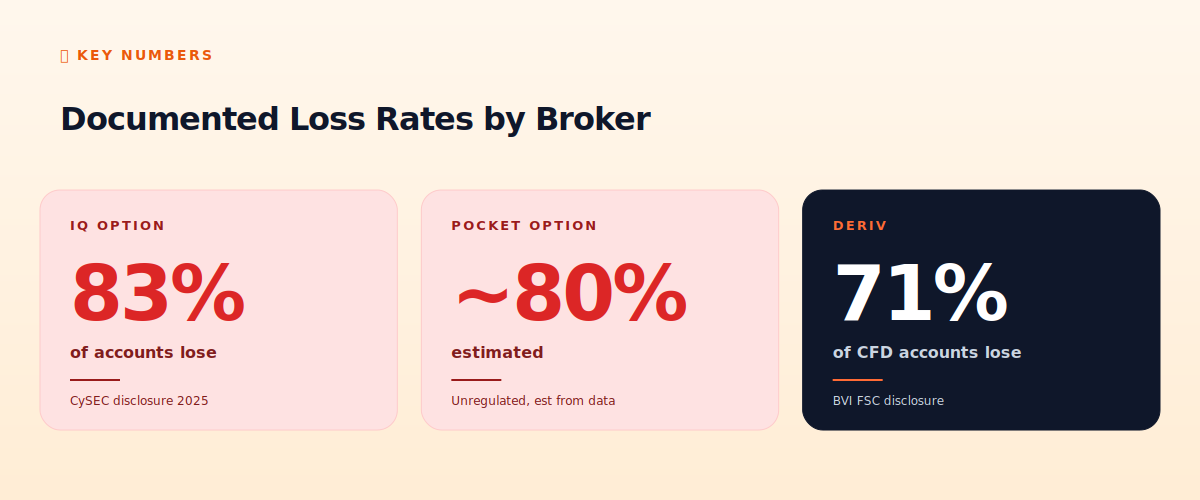
CySEC (Cyprus regulator) requires regulated binary options brokers to publish retail loss statistics. From their 2025 disclosures:
- IQ Option (CySEC license 247/14): 83% of retail accounts lose money over a 12-month period.
- Deriv (the binary-options-style products on Deriv): 71% loss rate per BVI FSC.
- Pocket Option, Quotex, Olymp Trade: unregulated, no public statistics. Independent estimates put losses at 80-90% based on customer churn rates.
- Ayrex, Spectre.ai: defunct as of 2024-2025. Customer losses were ~85% before closure.
For context: ESMA banned binary options for retail in 2018 specifically because the consistently high loss rates exceeded what they considered acceptable consumer protection. FCA followed in 2019. Australia restricted in 2021. US never allowed unregulated binary options for retail.
Why retail loses so consistently
Three structural reasons, beyond just the math:
- Broker is the counterparty. When you bet against the broker, your loss is their profit. Some brokers have been documented to manipulate spreads or prices in microseconds to push you onto the losing side of trades. Even ethical brokers have no incentive to give you tools that work.
- Short time frames are noise-dominated. Most binary trades expire in 60 seconds to 5 minutes. Over those windows, forex price movements are essentially random walk with noise. Edge-finding requires longer time frames where information has time to be processed.
- Psychology amplifies the math. Quick wins trigger overconfidence ("I have a system!"). Quick losses trigger martingale-style doubling ("I'll win it back!"). Most accounts blow up within 60-90 days because both reactions accelerate destruction.
What binary options are theoretically useful for
Honest answer: in very specific cases, binary options have a legitimate use. They're not categorically useless. The legitimate use cases:
- Hedging short-term event risk. If you have a large stock position and Apple reports earnings tomorrow, a binary put with hourly expiry can provide cheap insurance. This is what professional desks use.
- Tax-loss positioning in some jurisdictions. Bets on currency moves can be structured to harvest losses against gains. Complex; talk to a tax advisor.
- Academic research on market microstructure. Binary options expose pricing models in ways spot trading doesn't.
What binary options are not useful for: building wealth, replacing income, learning to trade, day-trading as a hobby. Anyone selling binary options on these premises is either misinformed or selling false hope to extract deposits.
The honest recommendation
For 99% of readers of this site: do not trade binary options. The math is against you, the brokers are mostly unregulated, the time frames are noise-dominated, and the psychology amplifies losses. If you want to trade short-term price movements, use:
- Spot trading with stop-loss/take-profit orders. Same directional bets, much better risk management, no payout asymmetry.
- Regulated CFDs on EUR/USD or major indices with 1:30 leverage. Still risky (70%+ loss rate) but at least the math is symmetric.
- Crypto perpetual futures on regulated exchanges. Even more leverage but pricing is fairer.
- Prediction markets like Kalshi or Polymarket. Same Yes/No structure with better liquidity and price discovery.
If you're still going to trade binary options — some people will read this and try anyway — the harm-reduction version: use only CySEC-regulated brokers (IQ Option is the main option), trade only 30-minute or longer expiries (less noise), risk no more than 1% of capital per trade, take detailed notes, and stop after 50 trades if you're not at break-even.
📧 Get every new tutorial in your inbox
One email per week. Tutorials, CVE disclosures, broker updates. Unsubscribe in one click.
(Connect FluentCRM / ConvertKit / Beehiiv form here)
Frequently asked questions
Is there any way to consistently win binary options?
Mathematically possible but extraordinarily difficult. Requires a genuine 56%+ win rate, which over short time frames is harder than it sounds. The documented winners are professional desks with information advantages, not retail traders.
Are binary options legal where I live?
Banned for retail in EU, UK, Australia. Restricted in US. Available in most of Africa, SEA, LATAM. Local regulators may have warnings.
Aren't they the same as Polymarket or Kalshi?
Structurally similar but mechanically different. Prediction markets have price discovery via order book; binary options have fixed payouts set by the broker. Prediction markets are positive-sum for traders; binary options are zero-sum or negative-sum because the broker is the counterparty.
Can OpenClaw bots help me win binary options?
No. The math problem doesn't change with AI. A bot following random signals at 50% accuracy still loses 5.6% per trade in expectation. OpenClaw can't fix the asymmetric payout structure.
Why do YouTube ads make it look so easy?
Selection bias plus actor performance plus paid testimonials. The ads show winners; the regulatory data shows 80%+ losers. Both are real; the second is more representative.
What to read next
- IQ Option vs Pocket Option vs Quotex Comparison
- Why 80% of Binary Options Traders Lose
- Deriv Synthetic Indices Explained
- Binary Options Scams: Recognition Guide
Sources cited: The Hacker News (CVE-2026-25253 disclosure, Feb 2026); Conscia 2026 OpenClaw Security Crisis advisory; Snyk ToxicSkills study; Cyber Press ClawHavoc reporting; Wall Street Journal Polymarket profitability analysis (May 2026); Andrey Sergeenkov via The Defiant (April 2026); Akey, Grégoire, Harvie & Martineau, SSRN paper (March 2026); openclaw.ai official advisories; Peter Steinberger public statements on X. CySEC quarterly disclosures; ESMA 2018 product intervention; FCA Policy Statement PS19/11; BVI FSC binary options data.