Risk disclosure: Independent research finds 70–84% of Polymarket traders lose money (Sergeenkov, April 2026; Akey et al., SSRN, March 2026). Forex CFDs: 70–85% retail loss rate. Binary options: 80%+ in most jurisdictions. AI agents don't change these baselines. Full disclaimer. Binary options disclosure: CySEC, FCA, and ASIC have all restricted or banned binary options for retail traders in major markets due to consistently high loss rates (typically 80%+). Most binary options brokers operate from offshore jurisdictions with limited consumer protection. We do not recommend binary options as a serious trading strategy for retail capital. Recovery scam warning: if you've lost money to a binary options scam, anyone offering to recover it for an upfront fee is almost certainly running a second-stage scam.
Binary options scams have stolen $7+ billion globally per year at peak, per the FBI and Israeli police investigations of the 2015-2018 boom. The category has been cleaned up significantly — ESMA banned retail binary options in EU, FCA banned them in UK, Israel criminalized the industry domestically — but the scams haven't disappeared. They've migrated to offshore jurisdictions, taken new forms, and continue to extract money from retail traders in SEA, Africa, and Latin America.
This guide is a field manual for recognizing the patterns. We cover the historical scam types, the current 2026 variants (including AI-themed scams), the recovery scam ecosystem, and a 12-point checklist for evaluating any binary options offer.
TL;DR — The 30-second answer
- Fake broker scams (2018-2020): cloned IQ Option sites, deposits accepted, withdrawals refused.
- Signal seller scams (2021-2023): paid Telegram VIP groups with survival-bias track records.
- AI bot scams (2024-): "95% accurate AI bots" sold for $200-2000.
- Recovery scams (2025-2026): second-stage frauds targeting previous victims.
- Affiliate-driven YouTube content: creators paid commission on your losses. Their reviews are not honest.
- Defense: 12-point checklist + skepticism + verification of regulator claims.
The scam ecosystem evolution
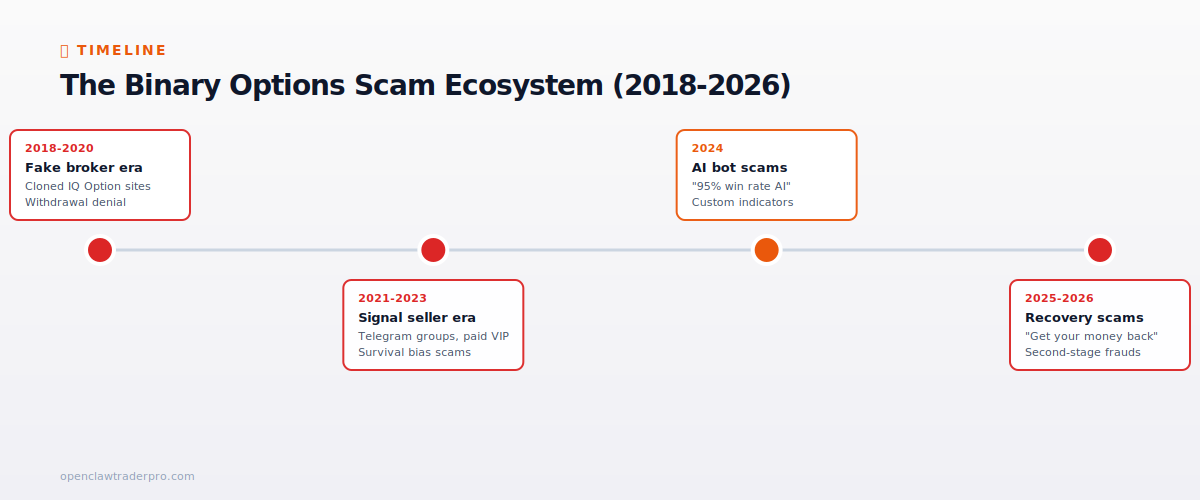
Binary options scams have evolved through four distinct eras. Understanding the history helps recognize current variants.
Era 1 (2018-2020) — Fake broker scams
Operators set up websites cloning IQ Option's design, often with similar domain names (iqoptions-pro.com, iq-options-trade.net). The site accepted deposits via credit card or crypto. Initially, trades "worked" — demo-quality interface, small wins permitted, withdrawals processed for small amounts. As deposits grew, withdrawals were denied with various excuses: KYC issues, terms violations, anti-money-laundering review.
Eventually the site disappeared. The operators set up under a new name. The same pattern repeated. Aggregate losses to this category were estimated at $4-7 billion globally before crackdowns by Israeli police (where many operators were based) and FBI.
How to recognize today: any binary options site you found through YouTube ads with no verifiable regulator, accepting only crypto deposits, with a domain less than 6 months old.
Era 2 (2021-2023) — Signal seller scams
After fake-broker crackdowns, operators pivoted to selling "trading signals" via Telegram. The pitch: "VIP group, 92% win rate, only $99/month." The structure:
- Create 100 Telegram channels, each broadcasting opposite signals.
- Some channels happen to be right 6 weeks in a row, by pure chance.
- Promote the winning channels heavily. Show track record.
- Charge $99-499 for VIP access.
- Once subscribed, signals revert to ~50% win rate.
- When subscribers complain, blame their "poor risk management."
- Sell new strategy/signal at higher price.
Survival bias makes this work. From the customer's perspective, the channel had a perfect track record before they joined. From the operator's perspective, they're running a chain letter with extra steps.
How to recognize today: any "signal service" with screenshot-only track record (no broker-verified statement), recent founding date, only crypto/Skrill payment options.
Era 3 (2024-) — AI bot scams
The latest variant: "AI-powered trading bots" sold for $200-2,000 one-time. Pitch: "Our proprietary AI achieves 95%+ accuracy on IQ Option binary options." Often marketed alongside the legitimate boom in AI tools like ChatGPT and Claude, conflating real AI advances with retail trading claims.
Common variants:
- "Lobster bot" (riding OpenClaw popularity): sites claiming "official OpenClaw binary options bot." None exist. OpenClaw is open-source software, not a product sold for fixed fees.
- "Custom MT5 indicator" bots: Pine Script or MQL5 code with hidden look-ahead bias in backtests. Looks great in backtest, loses in live.
- "Copy successful trader" services: mirror trades from a "top trader" who's actually a paid actor. The exposed trades are the losing 80%.
- Telegram bots that auto-trade based on "AI signals." Same survivor bias as signal sellers, plus the trader is automated so blame for losses shifts entirely to the user.
How to recognize today: any binary options bot sold as a product. Real bots are written by traders for their own use, not sold to retail. If someone has a 95%-accurate AI bot, they're not selling it for $499 — they're using it themselves.
Era 4 (2025-2026) — Recovery scams
Once enough victims existed, a new category emerged: recovery services. The pitch: "We can recover your binary options losses. Just pay an upfront fee for legal/blockchain investigation."
The mechanic:
- Target someone who's lost money to a previous scam (they're identifiable through forum posts, FTC complaints, Reddit).
- Cold contact via email or Telegram claiming to represent a "crypto recovery firm" or "legal team."
- Promise recovery for a percentage (10-30%) + upfront retainer ($500-5,000).
- After upfront payment: silence, or requests for more money to "complete the process."
- Eventually disappear with the upfront fees.
The cynical brilliance: victims of the first scam are pre-qualified as people with money who can be deceived. Recovery scammers buy lists of victims from each other. Many victims are scammed twice or three times.
If you've lost money to binary options: recovery services are 99%+ scams. The 1% legitimate ones (asset recovery firms) work on contingency, never upfront fees. If contacted: ignore. Don't pay. Don't engage. Don't provide any personal information.
The 12-point evaluation checklist
Before depositing money or paying for any binary options service:
- Verify the regulator claim. Search the CySEC, FCA, ASIC, or local regulator database directly for the broker's name. Not the link the broker provides.
- Check the domain age. WHOIS lookup. New domains (<1 year) are red flag.
- Search for the broker name + "scam" or "withdrawal". First page results matter; don't trust the first SEO-optimized review.
- Check Trustpilot honestly. Look at one-star reviews specifically. Multiple consistent complaints = signal.
- Check the social presence. Real brokers have years of social history with normal customer interaction. Scams have months of one-way marketing.
- Test withdrawal early. Deposit small ($50-100), trade briefly, withdraw immediately. If withdrawal is delayed or denied with excuses, leave.
- Beware aggressive marketing. Real brokers don't cold-call you. Real signal services don't DM you on Instagram.
- Be skeptical of 'guaranteed' returns. Anything promising fixed percentages is a Ponzi or a scam. Real trading has variance.
- Beware survival-bias track records. Signal services should provide broker-verified statements, not screenshots.
- Beware AI bot sales. Real profitable bots aren't sold for $499.
- Beware recovery offers. Anyone offering to recover your losses for an upfront fee is a scammer.
- Beware affiliate-influenced reviews. YouTubers reviewing brokers earn commission on your losses. Use them as one data point, not the deciding voice.
If you've already been scammed
- Don't panic-pay for recovery. See section above. Recovery services targeting you are second-stage scams.
- Document everything. Screenshots of communications, deposits, withdrawal attempts, broker responses.
- Report to your bank or credit card. If deposited via card, request chargeback. Time limit usually 60-120 days. Banks may help if fraud is clear.
- Report to your local police and to the broker's claimed jurisdiction's regulator (CySEC for Cyprus, FCA for UK, etc.). Builds the case file.
- Report to financial scam databases: the FBI's IC3 (US), Action Fraud (UK), ASIC's reporting form (Australia).
- Warn others. Honest reviews on Trustpilot, ForexPeaceArmy, Reddit help future victims avoid the same trap.
- Accept the loss psychologically. Most scammed funds are not recovered. The energy is better spent preventing the next loss than chasing the previous one.
📧 Get every new tutorial in your inbox
One email per week. Tutorials, CVE disclosures, broker updates. Unsubscribe in one click.
(Connect FluentCRM / ConvertKit / Beehiiv form here)
Frequently asked questions
Is IQ Option a scam?
No. IQ Option is CySEC-regulated, pays withdrawals, and operates legally. The PRODUCT (binary options) is unprofitable for 83% of users due to structural reasons, but the broker is not a fraud.
Are all binary options brokers scams?
Most offshore ones operate in a gray area between legitimate business and scam. The regulated brokers (IQ Option, Deriv) are legitimate businesses selling an unprofitable product. Worse than misleading marketing, better than outright fraud.
How do I verify a CySEC license?
Go to cysec.gov.cy, use their public license search, enter the broker name. Cross-reference license number and entity name. Scammers often claim CySEC licenses they don't have or use revoked numbers.
What if my country's regulator allows them?
Even regulated binary options have 70-85% loss rates by the structural math. Regulator approval means the broker meets minimum compliance standards (segregated funds, KYC, AML), not that the product is profitable for retail.
Who should I trust for binary options reviews?
No one fully. Cross-reference multiple sources. Independent academic research (Akey et al. SSRN, ESMA studies) is more reliable than affiliate-driven content. Apply skepticism uniformly.
What to read next
- Binary Options: The Math Behind the Loss Rate
- IQ Option vs Pocket Option vs Quotex
- Why 80% of Binary Options Traders Lose
- OpenClaw + Deriv: Bot Setup & Real Expectations
Sources cited: The Hacker News (CVE-2026-25253 disclosure, Feb 2026); Conscia 2026 OpenClaw Security Crisis advisory; Snyk ToxicSkills study; Cyber Press ClawHavoc reporting; Wall Street Journal Polymarket profitability analysis (May 2026); Andrey Sergeenkov via The Defiant (April 2026); Akey, Grégoire, Harvie & Martineau, SSRN paper (March 2026); openclaw.ai official advisories; Peter Steinberger public statements on X. FBI IC3 binary options fraud advisories; Israeli police investigations 2017-2020; ESMA 2018 product intervention; FCA Policy Statement PS19/11; documented court cases against Banc de Binary, Anyoption.