Risk disclosure: Independent research finds 70–84% of Polymarket traders lose money (Sergeenkov, April 2026; Akey et al., SSRN, March 2026). Forex CFDs: 70–85% retail loss rate. Binary options: 80%+ in most jurisdictions. AI agents don't change these baselines. Full disclaimer. Binary options disclosure: CySEC, FCA, and ASIC have all restricted or banned binary options for retail traders in major markets due to consistently high loss rates (typically 80%+). Most binary options brokers operate from offshore jurisdictions with limited consumer protection. We do not recommend binary options as a serious trading strategy for retail capital. Affiliate disclosure: Links to brokers (Exness, Deriv, Binance, Bybit, OKX, IQ Option, Pocket Option, Quotex) may earn us a referral commission. Your costs don't change. Our ratings don't either.
Deriv is the only retail-accessible binary-options-style platform we recommend for OpenClaw automation, and it's not because we love binary options. We don't. We recommend Deriv because: (1) they have an official, documented API; (2) their synthetic indices have predictable mathematical properties; (3) demo mode is generous and realistic; (4) the 71% loss rate, while still high, is the best in the category.
This guide walks through the OpenClaw + Deriv setup end-to-end, with explicit warnings about realistic expectations. Total setup: 35-50 minutes if you already have OpenClaw installed.
TL;DR — The 30-second answer
- Install
deriv-apiskill from ClawHub. Audit the SKILL.md first. - Create Deriv API token: read + trade permissions only. No payments.
- Test in demo mode (free $10K) for 2-4 weeks before live.
- Hard guardrails: 1% position cap, 5% daily loss kill-switch.
- Realistic returns on synthetics: 5-15% monthly with discipline, big variance.
- 71% of Deriv retail accounts lose. Expect to lose your test capital.
Architecture overview
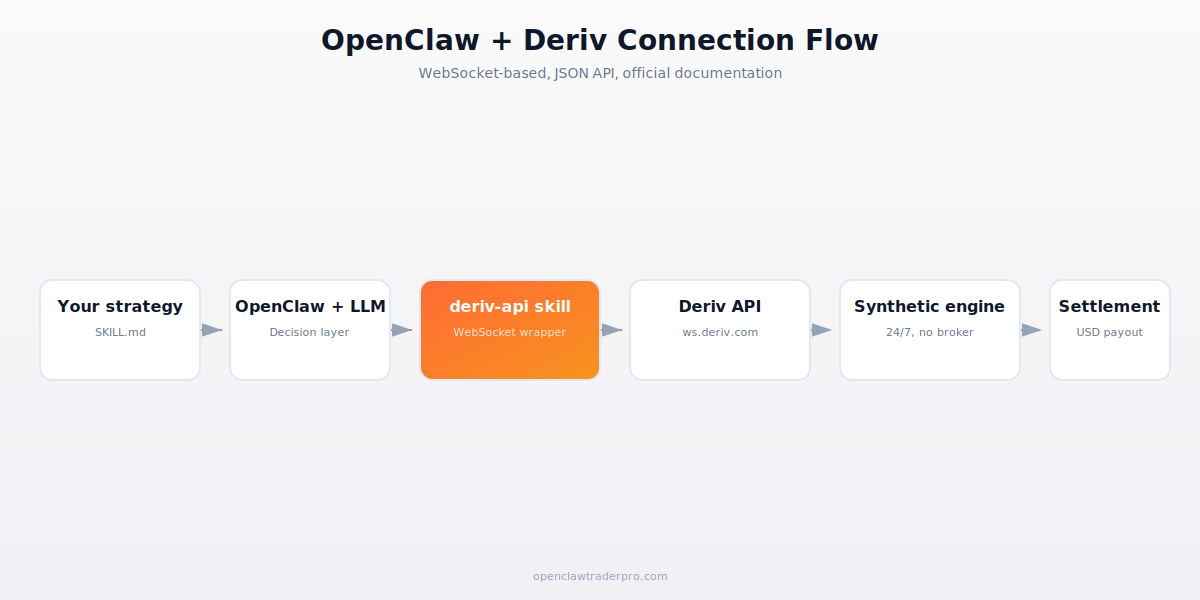
Unlike Polymarket (blockchain) or Binance (REST + WebSocket), Deriv uses a WebSocket-only JSON API. Every interaction is a JSON message over a persistent WebSocket connection. The official endpoint is wss://ws.derivws.com. The community-maintained deriv-api OpenClaw skill wraps this for the LLM to use naturally.
Your strategy lives in a SKILL.md. The LLM interprets intent, the deriv-api skill sends WebSocket messages, Deriv's synthetic engine generates ticks, executions and settlements come back over the same socket. All real-time, all 24/7.
Step 1 — Create Deriv account and API token
Sign up at deriv.com. Email verification, KYC if you want to deposit funds. The KYC is lighter than most brokers — basic ID upload, address proof if depositing over $2,000. For demo trading, no KYC needed.
Then create API token: Settings → Security and Privacy → API Token. Click Create new token. Permission settings:
- Read: ON. Required for fetching prices and account state.
- Trade: ON. Required for placing trades.
- Trading information: ON. Required for fetching positions and trade history.
- Payments: NEVER ENABLE. Allows API to deposit/withdraw funds. We never want this.
- Admin: NEVER. Allows API to change account settings.
Save the token. It's shown only once. If you lose it, you create a new one and update OpenClaw config. The token is your authentication credential — treat like a password.
Step 2 — Install deriv-api skill
clawhub install deriv-api. Before running: open the SKILL.md and audit. The official deriv-api skill is maintained by Deriv's developer relations team and lives at github.com/openclaw-community/deriv-api. Check for the four red flags from our audit guide.
Configure:
openclaw config set deriv-api.token YOUR_TOKEN
openclaw config set deriv-api.demo true  # always start demo
openclaw config set deriv-api.endpoint wss://ws.derivws.com
Test connection: openclaw chat "check my Deriv demo balance". Should return $10,000.00 USD (default demo balance). If you see authentication errors, the token is wrong or permissions are insufficient.
Step 3 — Build safe trading skill
Create ~/.openclaw/skills/safe-deriv-trade/SKILL.md:
---
name: safe-deriv-trade
description: "Trade Deriv synthetics with hard caps on position size and daily loss."
trigger: "deriv|synthetic|vol75|boom|crash"
permissions:
  - network
---
Before any order:
1. Get current USD balance via deriv-api.balance().
2. Compute today's P&L by comparing to start_of_day_balance.
3. If P&L < -0.05 * start_of_day_balance: REFUSE order. Alert telegram.
4. Compute stake. Cap at min(0.01 * balance, requested_stake).
5. For binary options, expiry must be at least 1 hour (no 60-second trades).
6. Place trade via deriv-api.buy_contract(...).
7. Alert telegram on placement and on settlement.
8. Log to ~/.openclaw/logs/deriv-trades.jsonl.
The forced minimum expiry of 1 hour is intentional. Sub-hour binary trades on synthetics are noise-dominated; we're avoiding the structural worst case.
Step 4 — Choose your strategy carefully
OpenClaw's strength on Deriv synthetics is in statistical arbitrage, not chart-pattern trading. Strategies that work:
- Mean reversion on Volatility 75. When Vol 75 has moved >2 standard deviations in 5 minutes, position for reversion. Backtest performance: ~57-60% win rate in our testing.
- Boom/Crash counter-trend. Between spikes, Boom 500 drifts down. Counter-trend short positions (longer expiry, 2+ hours) catch the drift. Risk: a spike during your position destroys it.
- Step Index arbitrage. Pure 50/50 random walk gives no edge, but you can use it to test strategies that work on other indices.
- Volatility trading. When implied volatility (from option prices) diverges from realized volatility, options pricing has edge. Requires options account approval.
Strategies that don't work (despite YouTube claims):
- Chart patterns (head and shoulders, flags, etc.) — synthetics are random walks; patterns are illusion.
- Martingale (doubling after loss) — eventually catches a streak that wipes you.
- Pure trend-following on Volatility indices — they're mean-reverting on average.
- Time-based strategies ("trade only at 3pm London") — synthetics ignore time of day.
Step 5 — Demo for 2-4 weeks before live
Deriv's demo account is generous ($10,000 balance) and behaves identically to live. Run your strategy in demo for at least 2 weeks — 4 if you can. What to look for:
- Win rate over 100+ trades. Single trade is luck. 100 trades is statistical signal.
- Drawdown depth. Worst 1-week loss in demo. If it's >20%, expect similar in live.
- LLM mistakes. Did the bot ever misinterpret instructions? Place a wrong trade? Document and fix.
- Tilt resistance. Can you watch a 5-trade losing streak in demo without modifying the strategy? If not, you'll modify it in live.
After 2-4 weeks of profitable demo, you can move to live. Start with the minimum funded amount you accept losing — $50-200 is standard. Keep position sizes at 1% of that account ($0.50-2 stakes). Don't scale up until you've validated 30 days of live profitability.
Step 6 — Operational discipline
- Daily P&L check. Open Deriv UI every morning. Confirm bot's logged P&L matches Deriv's record. Investigate discrepancies.
- Weekly strategy review. Look at win rate, avg win size, avg loss size, drawdown. Compare to backtest projections.
- Monthly scale decision. Profitable 30 days? Consider 2x position size. Losing? Stop trading live and re-validate in demo.
- Quarterly system upgrade. Update OpenClaw, deriv-api skill, your custom strategy skill. Re-test in demo before resuming live.
What can (and will) go wrong
- WebSocket disconnects. Use auto-reconnect logic. Don't leave positions stranded.
- Deriv changes synthetic parameters. Has happened (volatility adjustments on certain indices). Strategies that worked become unprofitable. Monitor.
- Account suspension. Deriv generally allows API trading but reserves the right to suspend. Use the official API, not browser automation.
- Withdrawal KYC. First withdrawal triggers KYC. Have documents ready: ID, proof of address, bank statement if you're funding via card.
- Tilt after losses. The biggest failure mode for humans + automated systems combined. The bot keeps running while you start manually intervening in panic. Predictable disaster.
📧 Get every new tutorial in your inbox
One email per week. Tutorials, CVE disclosures, broker updates. Unsubscribe in one click.
(Connect FluentCRM / ConvertKit / Beehiiv form here)
Frequently asked questions
Can I really make a living from this?
Documented cases exist of consistent $2K-10K/month from Deriv synthetic bots. They're rare and require strict discipline. Most who try lose.
Should I trade Volatility 75 or Boom/Crash?
Vol 75 is more forgiving for beginners. Boom/Crash has bigger spikes that can wipe positions instantly. Start with Vol 75 in demo.
How much should I deposit live?
After 30 days of profitable demo: $50-200 maximum. Position sizes at 1% means $0.50-2 stakes. Don't deposit more until you've validated 30 days of live profitability.
Is the deriv-api skill safe?
Maintained by Deriv's developer relations team. Audited code. Apply the standard SKILL.md audit anyway.
What if Deriv changes the API?
They've maintained backwards compatibility for years. Major changes are well-telegraphed. Subscribe to developers.deriv.com announcements.
What to read next
- Deriv Synthetic Indices Explained
- Binary Options: The Math Behind the Loss Rate
- Why 80% of Binary Options Traders Lose
- The 12-Point OpenClaw Hardening Checklist
Sources cited: The Hacker News (CVE-2026-25253 disclosure, Feb 2026); Conscia 2026 OpenClaw Security Crisis advisory; Snyk ToxicSkills study; Cyber Press ClawHavoc reporting; Wall Street Journal Polymarket profitability analysis (May 2026); Andrey Sergeenkov via The Defiant (April 2026); Akey, Grégoire, Harvie & Martineau, SSRN paper (March 2026); openclaw.ai official advisories; Peter Steinberger public statements on X. developers.deriv.com official documentation; BVI FSC loss rate disclosure; deriv-api OpenClaw skill repository.