Risk disclosure: Independent research finds 70–84% of Polymarket traders lose money (Sergeenkov, April 2026; Akey et al., SSRN, March 2026). Forex CFDs: 70–85% retail loss rate. Binary options: 80%+ in most jurisdictions. AI agents don't change these baselines. Full disclaimer. Security context: Three critical CVEs disclosed in OpenClaw in Q1 2026 (CVE-2026-25253, CVE-2026-32922) plus the ClawHavoc supply-chain attack (1,184 malicious skills). Always run v2026.4.12 or later. Full security assessment.
You blew up an account. Maybe a lot more than one. You stepped away, and now you're considering coming back — this time with OpenClaw, hoping automation helps. This walkthrough is for the returning trader, and it's going to be direct and supportive in equal measure. Coming back can be done well, but only if you honestly understand why you blew up the first time and rebuild differently. Automation alone won't save you; changed discipline will.
There's no shame in having blown up — a large majority of traders do, and many successful ones blew up before they succeeded. What matters is whether you return having learned the actual lesson, or whether you're about to repeat the same mistakes with a new tool.
TL;DR — The 30-second answer
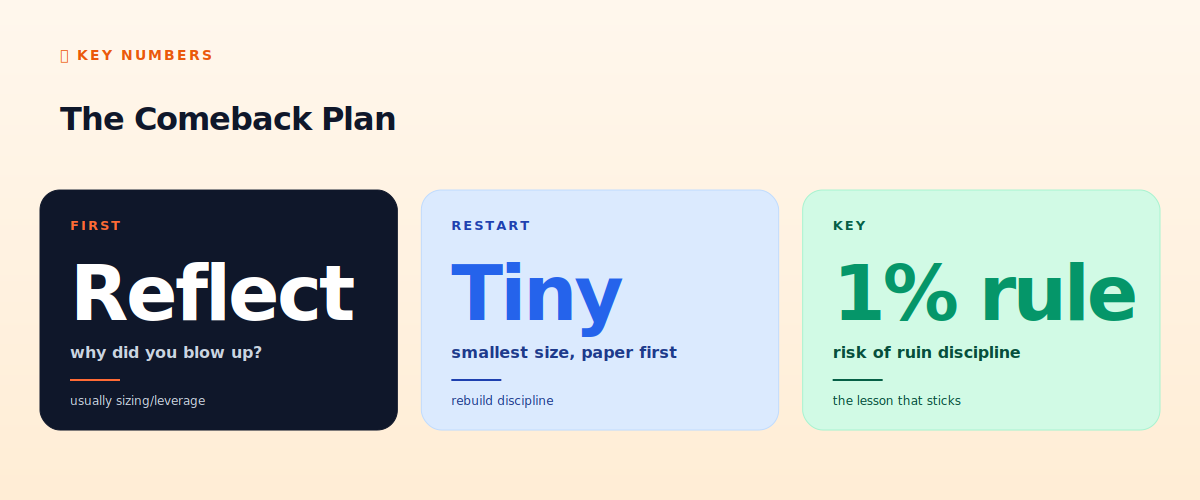
- First, reflect honestly: why did you blow up? Usually sizing/leverage, not bad picks.
- The hard truth: automation doesn't fix the discipline problem that blew you up.
- Restart tiny: paper first, then the smallest real size. Rebuild discipline.
- The key lesson: the 1% rule and risk-of-ruin discipline (probably what you lacked).
- What changed must be you, not just the tool. Same habits = same outcome.
- Coming back can work — if you return different, not just re-equipped.
The comeback plan
First, the honest reflection
Before touching OpenClaw, answer honestly: why did you blow up? This matters more than anything else, because if you don't understand the cause, you'll repeat it. In the overwhelming majority of blowups, the cause is not bad trade selection — it's risk management: too much leverage, position sizes too large, no stop-losses (or stops moved/ignored), revenge trading after losses, or doubling down (martingale). People rarely blow up from picking the wrong direction occasionally; they blow up from risking too much so that a normal losing streak wipes them out (see our risk of ruin guide). Be brutally honest about which of these got you. The answer is your real lesson.
The hard truth about automation
You might hope OpenClaw is the answer — that automation removes the emotional mistakes that blew you up. There's truth here: a well-built bot doesn't revenge-trade, doesn't move stops out of fear, doesn't double down emotionally. But here's the catch: you configure the bot. If you build it with the same reckless sizing and leverage that blew you up, it'll blow up faster and more efficiently than you did manually. Automation amplifies whatever discipline (or lack of it) you encode. It's not a substitute for the changed mindset; it's a tool that's only as disciplined as the rules you give it. The discipline still has to come from you — you just get to enforce it mechanically once you have it.
Restart tiny — rebuild the discipline
The comeback path is deliberately humble:
- Paper trade first. Yes, again, even though you're experienced. You're rebuilding discipline and proving (to yourself) that your new approach works without the emotional weight of real money. Run OpenClaw in paper mode for weeks.
- Restart with the smallest real size. When you go live, use far less than before — the smallest amount that feels real. You're proving you've changed, not trying to recover losses fast (that urge is exactly what causes re-blowups).
- Hard-code the 1% rule. Build your OpenClaw bot so it physically cannot risk more than 1% per trade, cannot exceed position limits, and halts on a daily-loss kill-switch (see the hardening checklist). Make your past mistakes structurally impossible.
- No leverage, or minimal. If leverage contributed to your blowup (it usually does), eliminate or drastically reduce it (see leverage guide).
The psychological trap to avoid
The most dangerous impulse for a returning trader is the urge to win it back fast. You lost money; you want to recover it; so you're tempted to size up, use leverage, take aggressive trades — exactly the behavior that blew you up, now supercharged by the emotional need to recover. This is how returning traders blow up a second time, often worse. Recognize this urge as the enemy. The money you lost is gone; treat the comeback as a fresh start with a fresh (tiny) account and zero pressure to recover the past. The trader who returns calm and humble survives; the one who returns desperate to win it back repeats the disaster. If you feel the 'win it back' pressure strongly, that's a sign to start smaller, not bigger.
What must actually change
The core insight: what changed must be you, not just your equipment. Switching from manual trading to OpenClaw is changing the tool. If your sizing, leverage, and discipline are the same as before, the tool change won't save you — you'll blow up automatically instead of manually. The real change is internal: genuinely internalizing risk-of-ruin discipline, accepting small losses without revenge-trading, sizing so no streak can ruin you, and trading a validated approach rather than hoping. OpenClaw then becomes a way to enforce your new discipline mechanically — which is genuinely valuable — but the discipline must exist first. Returning re-equipped but unchanged is just rebooking the same crash.
The honest verdict
Coming back after a blowup can absolutely work — many successful traders blew up before they succeeded — but only if you return genuinely different. Reflect honestly on why you blew up (almost always risk management, not trade selection), understand that automation amplifies your discipline rather than replacing it, restart tiny with the 1% rule hard-coded into your bot, eliminate the leverage that likely hurt you, and ruthlessly resist the urge to win it back fast. What must change is you, not just the tool. Use OpenClaw to mechanically enforce the discipline you now possess — and if you've truly learned the lesson, the comeback is a fresh, humble, survivable start rather than a faster repeat of the crash.
📧 Get every new tutorial in your inbox
One email per week. Tutorials, CVE disclosures, broker updates. Unsubscribe in one click.
(Connect FluentCRM / ConvertKit / Beehiiv form here)
Frequently asked questions
I blew up an account — should I come back?
You can, and many successful traders blew up first. But only if you return genuinely different — having understood why you blew up and rebuilt your discipline, not just changed tools.
Will automation fix what blew me up?
Not by itself. A bot doesn't revenge-trade or move stops — but you configure it. Build it with the same reckless sizing and it blows up faster. Automation amplifies your discipline; it doesn't replace it.
Why did I probably blow up?
Almost always risk management — too much leverage, oversized positions, no/ignored stops, revenge trading, or martingale. Rarely bad trade selection. Be honest about which got you; that's your lesson.
How should I restart?
Tiny and humble. Paper trade first (again), then the smallest real size, with the 1% rule hard-coded into your bot and leverage eliminated or minimal. Prove you've changed; don't try to recover fast.
What's the biggest danger for a returning trader?
The urge to win it back fast — sizing up and using leverage out of desperation, exactly the behavior that blew you up. Treat the comeback as a fresh start with zero pressure to recover the past.
What to read next
- Risk of Ruin: The Math Every Trader Must Know
- The Martingale Trap
- What Is Leverage?
- The 12-Point Hardening Checklist
Sources cited: The Hacker News (CVE-2026-25253 disclosure, Feb 2026); Conscia 2026 OpenClaw Security Crisis advisory; Snyk ToxicSkills study; Cyber Press ClawHavoc reporting; Wall Street Journal Polymarket profitability analysis (May 2026); Andrey Sergeenkov via The Defiant (April 2026); Akey, Grégoire, Harvie & Martineau, SSRN paper (March 2026); openclaw.ai official advisories; Peter Steinberger public statements on X. risk management and trading psychology literature.