Risk disclosure: Independent research finds 70–84% of Polymarket traders lose money (Sergeenkov, April 2026; Akey et al., SSRN, March 2026). Forex CFDs: 70–85% retail loss rate. Binary options: 80%+ in most jurisdictions. AI agents don't change these baselines. Full disclaimer.
Leverage is the single most misunderstood concept in trading, and the one that destroys more beginner accounts than anything else. It lets you control a large position with a small amount of money — which sounds like a superpower until you realize it amplifies your losses exactly as much as your gains. This guide explains leverage in plain language, shows the math of how it liquidates beginners, and gives you the honest framework for using it (or not).
If you read only one beginner guide before trading, make it this one. Misunderstanding leverage is the fastest way to lose everything.
TL;DR — The 30-second answer
- Leverage lets you control a big position with a small deposit (margin).
- It amplifies both gains AND losses — the part marketing omits.
- The liquidation math: 10x leverage means a 10% adverse move wipes you out.
- Higher leverage = faster ruin: 100x means a 1% move liquidates you.
- Beginners should use 1-2x or none until they've proven a strategy.
- The '100x' marketing is designed to make the exchange money, not you.
Leverage in one image
What leverage actually is
Leverage means borrowing money to control a position larger than your own capital. With 10x leverage, $1,000 of your money controls a $10,000 position — the exchange effectively lends you the other $9,000. Your $1,000 is the 'margin' backing the trade. The appeal is obvious: a 5% price move on a $10,000 position is $500, which is a 50% return on your $1,000. Leverage turns small moves into big percentage gains on your capital.
That's the half the marketing shows you. Here's the other half: leverage amplifies losses identically. A 5% move against you on that $10,000 position is a $500 loss — 50% of your capital gone from a 5% market move. Leverage is symmetric: it multiplies wins and losses by the same factor. There is no free lunch.
The liquidation math
Here's the part that destroys beginners: liquidation. When your losses approach your margin, the exchange force-closes your position to prevent you owing them money. The leverage determines how small a move triggers this:
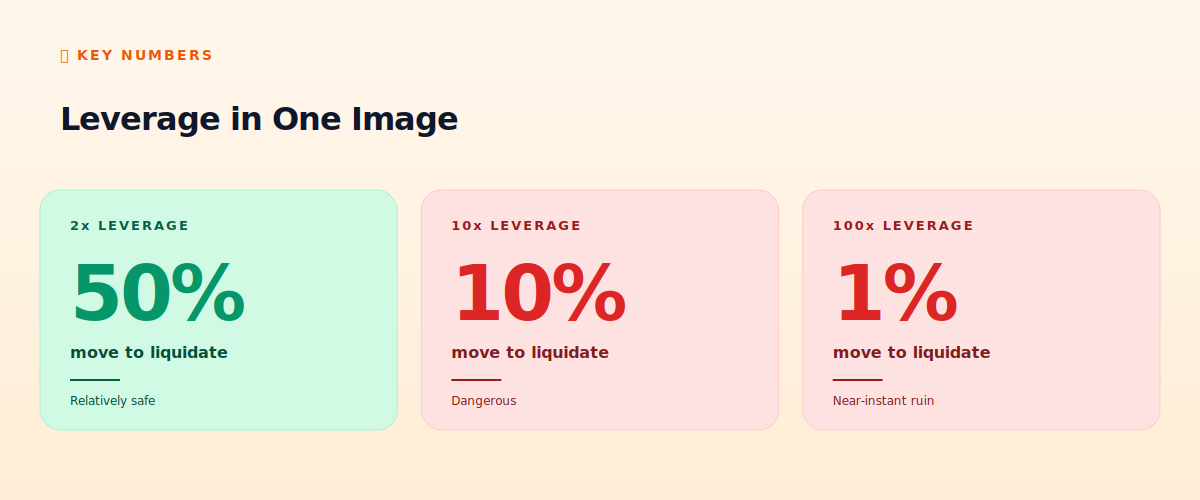
- 2x leverage: a 50% adverse move liquidates you. Relatively safe — you'd have to be very wrong.
- 5x leverage: a 20% move. Crypto does this in days during volatility.
- 10x leverage: a 10% move. Crypto does this in hours sometimes.
- 25x leverage: a 4% move. Possible in minutes.
- 100x leverage: a 1% move. One ordinary fluctuation ends you.
The simple rule: liquidation distance = 100% / leverage. At 100x, you have 1% of room before liquidation. Crypto routinely moves 1% in minutes, so 100x positions are liquidated constantly. The traders chasing '100x gains' are statistically signing up to lose their margin fast.
Why exchanges offer such high leverage
If high leverage liquidates traders so reliably, why do exchanges offer 100x? Because it makes them money. Liquidations generate fees, and the rapid trading that high leverage encourages generates more fees. Some of the value from liquidated positions flows to the exchange and to insurance funds. The '100x leverage' banner isn't a generous feature for you — it's a profit center for them. Understanding whose interest the feature serves is part of trading literacy.
Isolated vs cross margin
Two margin modes matter for managing leverage risk. Isolated margin limits a position's risk to the margin you assigned to it — if it liquidates, you lose only that allocated margin, not your whole account. Cross margin uses your entire account balance as backing, so a single bad position can liquidate everything. For beginners using any leverage, isolated margin is far safer — it contains the damage of any single mistake to a slice of your capital.
The honest framework for beginners
- Start with no leverage (spot trading). Learn to trade without the liquidation gun to your head. See our spot vs futures guide.
- If you use leverage, start at 2-3x maximum. The liquidation distance (33-50%) gives room to be wrong without instant ruin.
- Always use isolated margin so one bad trade can't wipe the account.
- Always use a stop-loss (see our guide) inside your liquidation distance, so you exit on your terms, not the exchange's.
- Ignore the 25x-100x options entirely. They exist to liquidate you. No serious trader uses them on directional bets.
The honest verdict
Leverage is a tool, not a cheat code. Used conservatively (2-3x, isolated margin, stops) by an experienced trader with a proven strategy, it can amplify a genuine edge. Used by a beginner at 50x chasing quick riches, it's the fastest known way to lose everything — the liquidation math guarantees it. The traders who survive started without leverage, learned the craft on spot, and added modest leverage only after proving they had an edge. The traders who blow up rushed into high leverage believing the upside without understanding the symmetric downside. Be the first kind.
📧 Get every new tutorial in your inbox
One email per week. Tutorials, CVE disclosures, broker updates. Unsubscribe in one click.
(Connect FluentCRM / ConvertKit / Beehiiv form here)
Frequently asked questions
What does 10x leverage mean?
Your $1,000 controls a $10,000 position; the exchange lends the rest. A 10% adverse move liquidates you (loses your $1,000).
What is liquidation?
When losses approach your margin, the exchange force-closes your position. Liquidation distance = 100% / leverage. At 10x, a 10% move triggers it.
What leverage should a beginner use?
None (spot) to start. If using leverage, 2-3x maximum with isolated margin. Avoid 25x-100x entirely — they exist to liquidate you.
Why do exchanges offer 100x leverage?
Because it makes them money — liquidations and rapid trading generate fees. It's a profit center for the exchange, not a gift to you.
Isolated or cross margin?
Isolated for beginners. It limits a position's risk to its allocated margin, so one bad trade can't wipe your whole account.
What to read next
- Spot vs Futures for Beginners
- Stop-Loss & Take-Profit
- Risk of Ruin: The Math Every Trader Must Know
- Forex Lot Sizing & Risk Management
Sources cited: The Hacker News (CVE-2026-25253 disclosure, Feb 2026); Conscia 2026 OpenClaw Security Crisis advisory; Snyk ToxicSkills study; Cyber Press ClawHavoc reporting; Wall Street Journal Polymarket profitability analysis (May 2026); Andrey Sergeenkov via The Defiant (April 2026); Akey, Grégoire, Harvie & Martineau, SSRN paper (March 2026); openclaw.ai official advisories; Peter Steinberger public statements on X. exchange leverage and liquidation mechanics; risk management literature.