Affiliate disclosure: Links to brokers (Exness, Deriv, Binance, Bybit, OKX, IQ Option, Pocket Option, Quotex) may earn us a referral commission. Your costs don't change. Our ratings don't either. Risk disclosure: Independent research finds 70–84% of Polymarket traders lose money (Sergeenkov, April 2026; Akey et al., SSRN, March 2026). Forex CFDs: 70–85% retail loss rate. Binary options: 80%+ in most jurisdictions. AI agents don't change these baselines. Full disclaimer. Security context: Three critical CVEs disclosed in OpenClaw in Q1 2026 (CVE-2026-25253, CVE-2026-32922) plus the ClawHavoc supply-chain attack (1,184 malicious skills). Always run v2026.4.12 or later. Full security assessment.
Spot and futures are the two ways to trade crypto, and the choice has enormous consequences for risk. Spot means you own the asset; futures means you trade a leveraged contract on its price. Leverage amplifies both gains and losses — and for beginners, that amplification is almost always destructive. This comparison makes the honest case for why beginners should start with spot.
We compare spot and futures on ownership, leverage, liquidation risk, fees, and suitability for different experience levels.
TL;DR — The 30-second answer
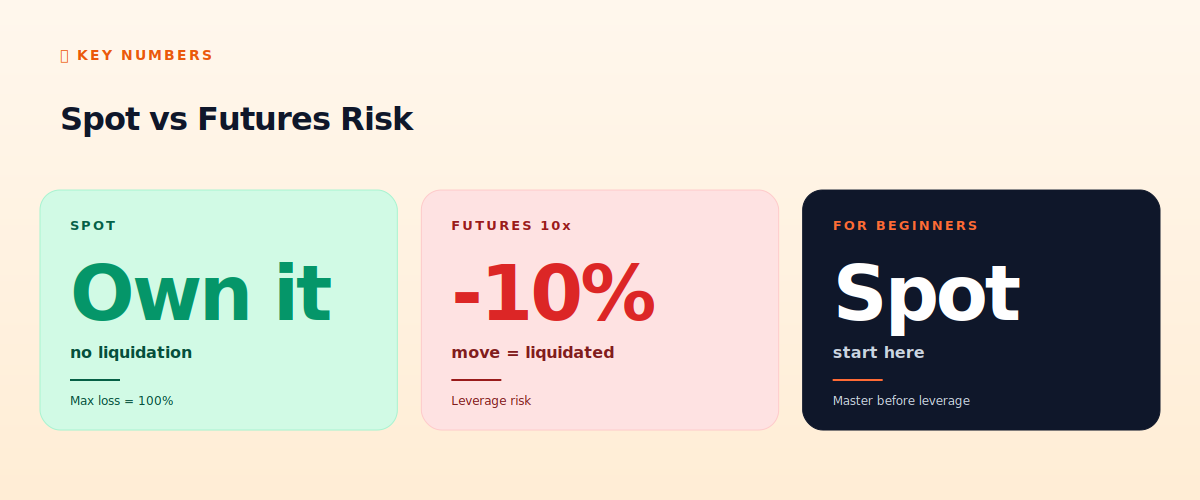
- Spot: you own the asset. Max loss = 100% (if it goes to zero). No liquidation.
- Futures: leveraged contract. Liquidation can wipe you on small moves.
- Liquidation math: 10x leverage = a 10% adverse move liquidates you.
- Fees: futures often cheaper per trade, but funding rates add ongoing cost.
- For beginners: spot, decisively. Master it before touching leverage.
- Futures suit: experienced traders with strict risk management.
The risk difference
What spot is
Spot trading means buying and owning the actual asset. Buy 1 BTC on spot, you own 1 BTC. If the price halves, you still own 1 BTC — now worth half as much, but you're not forced to sell. You can hold indefinitely. Your maximum loss is 100% (if the asset goes to zero, which for major cryptos is unlikely but not impossible). There's no liquidation, no margin call, no leverage-driven catastrophe. Spot is the simple, lower-risk way to trade.
What futures is
Futures (specifically perpetual futures, the dominant crypto type) means trading a leveraged contract on the price without owning the underlying. With 10x leverage, $1,000 controls a $10,000 position. If the price moves 10% against you, your entire $1,000 margin is liquidated — the exchange force-closes your position and you lose everything you put up. We cover the mechanics in our Bybit futures tutorial.
The liquidation math
This is the crux. Leverage determines how small an adverse move wipes you out:
- 2x leverage: 50% adverse move to liquidate. Relatively safe.
- 5x leverage: 20% adverse move. BTC moves this in days during volatility.
- 10x leverage: 10% adverse move. BTC moves this in hours sometimes.
- 25x leverage: 4% adverse move. Possible in minutes.
- 100x leverage: 1% adverse move. One spike kills you.
Crypto is volatile enough that even 10x leverage frequently catches liquidations. Beginners attracted to high leverage (the '100x' marketing) are statistically signing up to lose their margin fast. Spot has no equivalent failure mode.
Fees
Futures often have lower per-trade fees than spot (0.02-0.06% vs 0.10%), which attracts active traders. But futures add funding rates — periodic payments between longs and shorts (typically every 8 hours) that can cost 10-30% annualized when holding positions. Over time, funding can erode returns significantly. Spot has no funding cost; you just own the asset.
Who should trade which
Beginners: spot, decisively. Learn to trade without the liquidation gun to your head. Master entry, exit, position sizing, and emotional discipline on spot, where mistakes cost slowly rather than catastrophically. Most traders who blow up accounts do so on leveraged futures within their first months.
Experienced traders: futures, carefully. Once you have a proven strategy and ironclad risk management, futures' leverage can amplify returns and futures' lower fees plus shorting ability add flexibility. But only with strict guardrails: low leverage (2-3x), isolated margin, hard stop-losses, and daily loss limits. We cover these in the hardening checklist.
The verdict
Start with spot. For beginners, this isn't close — spot's lack of liquidation risk makes it the only sane starting point. Build your skills, prove your strategy, develop emotional discipline, all without leverage amplifying every mistake. Graduate to futures only when you have a proven edge and the discipline to use low leverage with hard risk controls. The traders who last started slow on spot; the ones who blew up rushed into leverage.
📧 Get every new tutorial in your inbox
One email per week. Tutorials, CVE disclosures, broker updates. Unsubscribe in one click.
(Connect FluentCRM / ConvertKit / Beehiiv form here)
Frequently asked questions
Should beginners trade futures?
No. Start with spot. Futures' liquidation risk amplifies every beginner mistake into a potential account wipeout.
What leverage is safe?
Lower is safer. 2-3x for experienced traders with risk controls. Avoid the 25x-100x marketing — those accounts blow up fast.
Are futures fees lower?
Per-trade, often yes (0.02-0.06% vs 0.10% spot). But funding rates add ongoing cost that can exceed the fee savings.
Can I lose more than my deposit on futures?
On most exchanges, no — liquidation closes you at zero margin. But you lose 100% of the margin on that position, which spot never forces.
Can OpenClaw trade both?
Yes, via CCXT (spot and futures on Binance/Bybit/OKX). Start with spot bots; add futures only with strict guardrails.
What to read next
- OpenClaw + Bybit Futures Tutorial
- OpenClaw + Binance Setup Guide
- Forex Lot Sizing & Risk Management
- The 12-Point Hardening Checklist
Sources cited: The Hacker News (CVE-2026-25253 disclosure, Feb 2026); Conscia 2026 OpenClaw Security Crisis advisory; Snyk ToxicSkills study; Cyber Press ClawHavoc reporting; Wall Street Journal Polymarket profitability analysis (May 2026); Andrey Sergeenkov via The Defiant (April 2026); Akey, Grégoire, Harvie & Martineau, SSRN paper (March 2026); openclaw.ai official advisories; Peter Steinberger public statements on X. exchange futures documentation; liquidation mechanics from Binance/Bybit/OKX.