Risk disclosure: Independent research finds 70–84% of Polymarket traders lose money (Sergeenkov, April 2026; Akey et al., SSRN, March 2026). Forex CFDs: 70–85% retail loss rate. Binary options: 80%+ in most jurisdictions. AI agents don't change these baselines. Full disclaimer.
If you learn only one risk-management tool as a beginner, make it the stop-loss. A stop-loss automatically exits a losing trade before it becomes catastrophic; a take-profit automatically locks in a winning trade at your target. Together, they remove emotion from your exits and protect you from the two ways traders self-destruct: letting losses run and cutting winners short. This guide explains both, how to set them sensibly, and the risk:reward thinking that ties them together.
These aren't advanced techniques — they're the seatbelt of trading. Trading without a stop-loss is the single most common beginner mistake, and the most expensive.
TL;DR — The 30-second answer
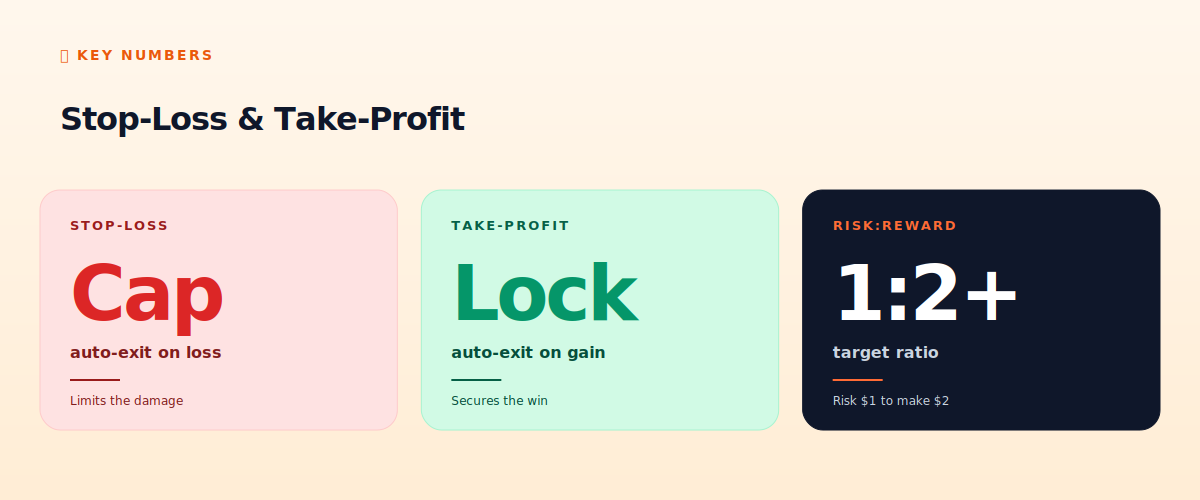
- Stop-loss: an order that auto-exits your trade if it loses a set amount. Caps the damage.
- Take-profit: an order that auto-exits at your profit target. Locks in the win.
- Why they matter: they remove emotion from exits — the hardest part of trading.
- Risk:reward: aim to risk $1 to make $2+ (a 1:2 ratio or better).
- The biggest beginner mistake is trading without a stop-loss.
- Bots make these automatic — build them into every strategy.
Your safety net
What a stop-loss does
A stop-loss is an order you set in advance that automatically closes your position if the price moves against you to a specified level. Say you buy BTC at $100,000 and set a stop-loss at $95,000. If BTC falls to $95,000, your position closes automatically, capping your loss at $5,000 (5%). Without it, you might watch BTC fall to $90,000, $85,000, $80,000 — hoping it recovers — turning a manageable loss into a devastating one. The stop-loss enforces the exit your rational pre-trade self planned, before your panicking in-trade self can talk you out of it.
Why this is the hardest part of trading
Here's the psychological truth: exiting losing trades is the hardest thing in trading, and humans are terrible at it. When a trade goes against you, hope kicks in — 'it'll come back,' 'I'll exit when I break even,' 'it can't fall further.' This is how small losses become account-destroying ones. The loss-averse human brain would rather hold a losing position (avoiding the pain of realizing the loss) than accept a small defeat. A stop-loss removes this choice: the exit is automatic, decided when you were calm and rational, not in the heat of watching money evaporate. It's a commitment device against your own worst instincts.
What a take-profit does
A take-profit is the mirror image: an order that automatically closes your position when it reaches a profit target. Buy BTC at $100,000, set a take-profit at $110,000, and if BTC rises there, you automatically lock in the $10,000 gain. Why automate this? Because the opposite emotional trap also exists: greed. When a trade is winning, the temptation is to hold for more — and often the winner reverses, turning a solid gain into a small one or a loss. Take-profit enforces discipline on the upside, securing gains at a level you decided was good enough.
Some traders prefer to let winners run (using a trailing stop instead of a fixed take-profit, especially in momentum strategies), but for beginners, a defined take-profit instills the discipline of actually banking wins rather than watching them evaporate.
Risk:reward ratio
Stop-loss and take-profit together define your risk:reward ratio — how much you're risking versus how much you're aiming to make. If your stop-loss risks $100 and your take-profit targets $200, that's a 1:2 risk:reward ratio (risk $1 to make $2). This ratio is crucial because it determines how often you need to be right to be profitable:
- 1:1 ratio: you need to win more than 50% of trades to profit.
- 1:2 ratio: you can win only ~34% of trades and still break even — winners are twice the losers.
- 1:3 ratio: you can be wrong 70% of the time and still profit.
This is why experienced traders obsess over risk:reward: a good ratio means you don't need to be right often, just right enough that your wins outweigh your losses. Aiming for 1:2 or better is a sound beginner default. It also naturally enforces 'cut losses short, let winners run' — the opposite of the losing instinct.
Setting them sensibly
Common mistakes and how to avoid them:
- Don't set stops too tight. A stop right next to your entry gets hit by normal noise. Place it beyond the normal fluctuation range — below a support level for a long, for instance.
- Don't set stops too wide. A stop so far away that hitting it means a catastrophic loss defeats the purpose. Size your position so the stop distance equals an acceptable risk (e.g. 1% of account — see risk of ruin).
- Base stops on structure, not round numbers. Place them where being stopped out actually means your trade thesis was wrong, not at arbitrary price levels.
- Use a market order for the stop exit (stop-market), so you actually get out in a fast move, rather than a stop-limit that might not fill (see order types).
Stops in OpenClaw bots
For automated trading, stop-loss and take-profit should be hard-coded into every strategy — not optional. An OpenClaw trading skill places a stop-loss and take-profit with (or immediately after) every entry, so no position ever sits unprotected. This is part of the guardrail philosophy in our hardening checklist: a bot should never hold a position without a defined exit on both sides. The automation advantage is real here — the bot never 'hopes,' never hesitates, never moves a stop out of the way to avoid taking a loss. It just executes the plan.
The honest verdict
Stop-loss and take-profit are the seatbelt and the discipline of trading. The stop-loss protects you from the catastrophic loss that ends accounts; the take-profit (or trailing stop) banks your wins before greed gives them back; and a sound risk:reward ratio (1:2+) means you profit without needing to be right most of the time. The single most important habit you can build as a beginner is never enter a trade without knowing your exit on both sides. Trading without a stop-loss isn't brave — it's the most reliable way to lose everything on the one trade that doesn't come back.
📧 Get every new tutorial in your inbox
One email per week. Tutorials, CVE disclosures, broker updates. Unsubscribe in one click.
(Connect FluentCRM / ConvertKit / Beehiiv form here)
Frequently asked questions
What is a stop-loss?
An order that automatically closes your position if price moves against you to a set level, capping your loss. It enforces the exit your calm pre-trade self planned, before panic talks you out of it.
What is a take-profit?
An order that automatically closes your position at a profit target, locking in the gain before greed tempts you to hold and watch it reverse.
What is risk:reward ratio?
How much you risk vs aim to make. At 1:2 (risk $1 to make $2), you can win only ~34% of trades and still break even. A good ratio means you don't need to be right often.
Why is a stop-loss so important?
Exiting losing trades is the hardest thing in trading — hope makes humans hold losers until they're catastrophic. A stop-loss removes the choice, automating the rational exit.
Should bots use stop-losses?
Always — hard-coded into every strategy. A bot should never hold a position without defined exits on both sides. The automation never hopes or hesitates.
What to read next
- Risk of Ruin: The Math Every Trader Must Know
- What Is Leverage?
- Limit vs Market Orders
- The Martingale Trap
Sources cited: The Hacker News (CVE-2026-25253 disclosure, Feb 2026); Conscia 2026 OpenClaw Security Crisis advisory; Snyk ToxicSkills study; Cyber Press ClawHavoc reporting; Wall Street Journal Polymarket profitability analysis (May 2026); Andrey Sergeenkov via The Defiant (April 2026); Akey, Grégoire, Harvie & Martineau, SSRN paper (March 2026); openclaw.ai official advisories; Peter Steinberger public statements on X. risk management literature; behavioral finance on loss aversion.