Risk disclosure: Independent research finds 70–84% of Polymarket traders lose money (Sergeenkov, April 2026; Akey et al., SSRN, March 2026). Forex CFDs: 70–85% retail loss rate. Binary options: 80%+ in most jurisdictions. AI agents don't change these baselines. Full disclaimer.
The order book is where price actually comes from. Behind every chart and every trade is a list of buy and sell orders waiting to be matched — the order book. Understanding it demystifies how markets work: why the spread exists, what 'liquidity' really means, and how large orders move price. This guide explains the order book from scratch and why it matters for your trading.
Once you understand the order book, concepts like slippage, liquidity, and market vs limit orders all click into place. It's the foundation beneath the surface.
TL;DR — The 30-second answer
- The order book lists all pending buy (bid) and sell (ask) orders for an asset.
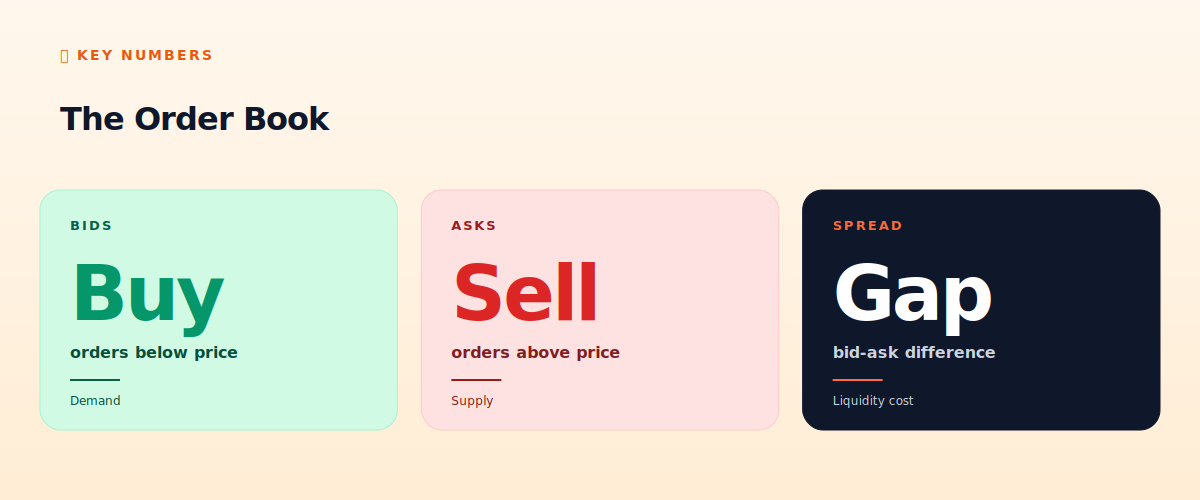
- Bids are buy orders below the current price; asks are sell orders above it.
- The spread is the gap between the highest bid and lowest ask.
- Liquidity/depth: how many orders sit near the current price.
- Thin books mean big spreads and slippage; deep books mean smooth fills.
- Large orders 'eat' through book levels, moving the price.
The order book structure
What the order book is
Every exchange maintains an order book for each trading pair: a continuously updated list of all the limit orders people have placed but that haven't yet executed. It has two sides:
- The bid side: buy orders, listed by price. These are people wanting to buy at various prices below the current market. The highest bid is the most someone is currently willing to pay.
- The ask side (or 'offer'): sell orders, listed by price. These are people wanting to sell at various prices above the current market. The lowest ask is the least someone is currently willing to accept.
A trade happens when a buyer and seller agree on price — when someone is willing to buy at the lowest ask, or sell at the highest bid. The 'current price' you see is essentially the price of the most recent match between these two sides.
The spread
Between the highest bid and the lowest ask is a gap: the spread. For example, if the highest bid for BTC is $95,000 and the lowest ask is $95,010, the spread is $10. This gap exists because buyers want to pay less and sellers want to receive more — they meet in the middle only when one side accepts the other's price. The spread is effectively a cost of trading: if you buy at the ask and immediately sell at the bid, you lose the spread. Liquid markets have tiny spreads; illiquid ones have wide spreads. This connects directly to our fees guide — the spread is a real cost even when there's no explicit fee.
Liquidity and depth
Liquidity (or market depth) refers to how many orders sit in the book near the current price. A deep book has large amounts of orders stacked at each price level near the market — lots of buyers and sellers ready to trade. A thin book has sparse orders. Depth matters enormously:
- Deep book: you can buy or sell large amounts without moving the price much. Tight spreads, smooth fills, minimal slippage.
- Thin book: even modest orders move the price significantly. Wide spreads, poor fills, high slippage.
This is why major pairs on big exchanges (BTC/USDT on Binance) are easy to trade in size, while obscure tokens on small exchanges are treacherous — the thin book means your order itself moves the price against you.
How large orders move price
Here's the mechanism behind price movement. Suppose you place a large market buy order — bigger than the orders available at the lowest ask. Your order fills the lowest ask completely, then 'walks up' the book, filling the next ask level, and the next, until your full order is satisfied. Each level you consume is at a higher price, so your average fill price is worse than the starting ask — that's slippage. And you've just pushed the price up by consuming the lower asks. This is how large orders move markets: they eat through book levels. In a thin book, even a modest order does this; in a deep book, it takes a huge order.
Why this matters for your trading
Understanding the order book explains several practical things: why you should trade liquid pairs (deep books = better fills), why market orders can fill at worse prices than expected (they walk the book), why limit orders give you price control (you set your level in the book rather than taking what's there), and why splitting a large order into smaller pieces reduces slippage (you don't eat through as many levels at once). For bot traders especially, reading depth helps size orders appropriately — a bot that places orders larger than the book can absorb will get terrible fills. This connects to our market making guide, where providing liquidity (adding to the book) is the whole strategy.
The honest verdict
The order book is the engine beneath every chart: bids and asks waiting to match, the spread as the gap between them, depth as the cushion that absorbs orders. Understanding it makes the rest of trading legible — you'll grasp why liquidity matters, why slippage happens, why order type matters, and how your own orders affect price. You don't need to stare at the order book constantly to trade well, but understanding how it works transforms you from someone who sees mysterious price movements into someone who understands the mechanism producing them.
📧 Get every new tutorial in your inbox
One email per week. Tutorials, CVE disclosures, broker updates. Unsubscribe in one click.
(Connect FluentCRM / ConvertKit / Beehiiv form here)
Frequently asked questions
What is an order book?
A continuously updated list of all pending buy (bid) and sell (ask) limit orders for an asset. Trades happen when a buyer and seller agree on price.
What are bids and asks?
Bids are buy orders (below current price, the highest is the most someone will pay). Asks are sell orders (above current price, the lowest is the least someone will accept).
What is the spread?
The gap between the highest bid and lowest ask. It's effectively a trading cost — buy at the ask, sell at the bid, and you lose the spread. Liquid markets have tiny spreads.
What is market depth/liquidity?
How many orders sit near the current price. Deep books absorb large orders with little price movement; thin books move sharply on modest orders.
How do large orders move price?
A large market order fills the best level, then 'walks' through successive levels at worse prices — consuming the book and pushing price. This is also the cause of slippage.
What to read next
Sources cited: The Hacker News (CVE-2026-25253 disclosure, Feb 2026); Conscia 2026 OpenClaw Security Crisis advisory; Snyk ToxicSkills study; Cyber Press ClawHavoc reporting; Wall Street Journal Polymarket profitability analysis (May 2026); Andrey Sergeenkov via The Defiant (April 2026); Akey, Grégoire, Harvie & Martineau, SSRN paper (March 2026); openclaw.ai official advisories; Peter Steinberger public statements on X. market microstructure literature; exchange order book documentation.