Risk disclosure: Independent research finds 70–84% of Polymarket traders lose money (Sergeenkov, April 2026; Akey et al., SSRN, March 2026). Forex CFDs: 70–85% retail loss rate. Binary options: 80%+ in most jurisdictions. AI agents don't change these baselines. Full disclaimer. Security context: Three critical CVEs disclosed in OpenClaw in Q1 2026 (CVE-2026-25253, CVE-2026-32922) plus the ClawHavoc supply-chain attack (1,184 malicious skills). Always run v2026.4.12 or later. Full security assessment.
Most beginners only know how to make money when prices rise — buy low, sell high. But markets fall as often as they rise, and traders can profit from both directions. Going 'long' profits from rising prices; going 'short' profits from falling prices. This guide explains both clearly, how shorting actually works mechanically, and the crucial asymmetric risk that makes shorting more dangerous than going long.
Understanding both directions doubles your opportunities — but shorting carries a unique risk that beginners must respect. We'll be clear about it.
TL;DR — The 30-second answer
- Long: buy expecting price to rise. Profit if it goes up. The familiar direction.
- Short: sell (borrowed) expecting price to fall. Profit if it goes down.
- Shorting mechanics: borrow the asset, sell it, buy it back cheaper, return it.
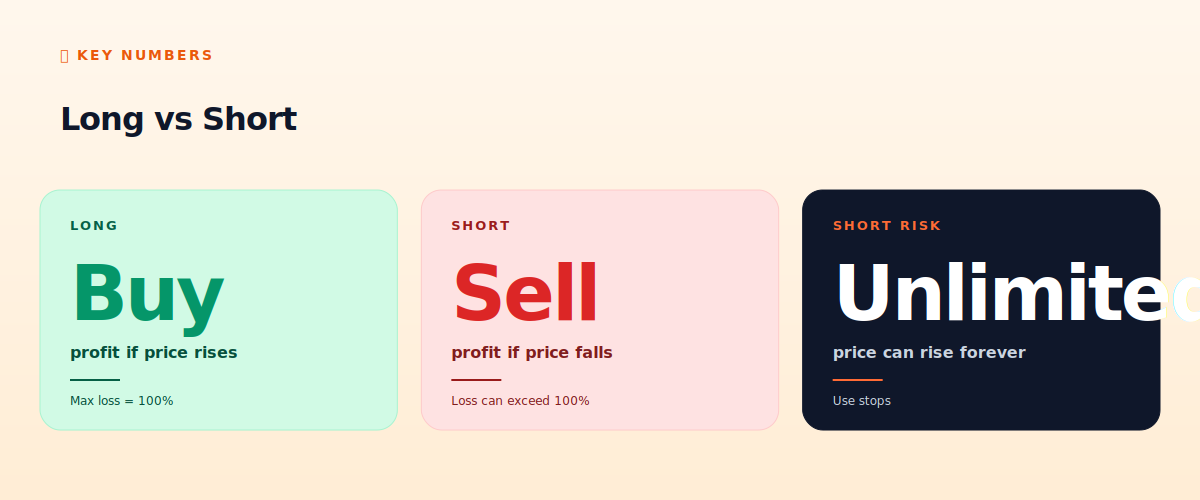
- Asymmetric risk: long max loss is 100%; short loss can exceed 100%.
- Why: a price can rise infinitely (unlimited short loss) but only fall to zero.
- Shorting needs tight stops — the unlimited-loss risk is real.
Long vs short
Going long: the familiar direction
Going 'long' is what most people think of as investing: you buy an asset expecting its price to rise, and you profit when it does. Buy BTC at $90,000, it rises to $100,000, you sell and pocket the difference. Your maximum loss is bounded: if BTC goes to zero, you lose 100% of what you put in — bad, but finite. You can't lose more than you invested. Long is intuitive and lower-risk in the sense that your downside is capped.
Going short: profiting from falls
Going 'short' lets you profit when prices fall — counterintuitive at first, but mechanically straightforward. The idea: sell something you don't own (by borrowing it), then buy it back later at a lower price, keeping the difference. Step by step:
- You believe BTC (at $100,000) will fall.
- You borrow 1 BTC (from the exchange/broker) and immediately sell it for $100,000.
- BTC falls to $90,000 as you expected.
- You buy back 1 BTC for $90,000.
- You return the borrowed BTC, keeping the $10,000 difference as profit.
In practice, on most crypto and forex platforms, this happens automatically when you 'sell' or 'open a short' — you don't manually borrow and return. With perpetual futures (see our spot vs futures guide), shorting is as simple as clicking 'short.' But the underlying mechanic — profiting from a price decline by effectively selling high and buying back low — is what's happening.
The critical asymmetric risk
Here's what every beginner must understand before shorting: the risk is asymmetric and far more dangerous than going long.
- When you go long, the worst case is the price falls to zero — you lose 100%. Painful, but bounded. The price can't go below zero.
- When you go short, the worst case is the price rises — and a price can rise without limit. If you short BTC at $100,000 and it rises to $200,000, you've lost $100,000 (100%). If it rises to $300,000, you've lost $200,000 (200%). There's no upper bound on how much you can lose.
This is the crucial asymmetry: long losses are capped at 100%; short losses are theoretically unlimited. A short position that goes wrong in a sharp rally (a 'short squeeze') can lose far more than your initial capital, especially with leverage. This is why short positions absolutely require stop-losses (see our guide) — you cannot leave an unlimited-loss position unmanaged.
The short squeeze
A particular danger when shorting: the short squeeze. When many traders are short an asset and its price starts rising, those shorts begin losing money. To cut losses, they buy back the asset to close their shorts — but that buying pushes the price up further, forcing more shorts to cover, pushing price up more, in a cascade. The price can spike violently. Shorts caught in a squeeze face rapid, severe losses. This is a real phenomenon (famously in some stock and crypto episodes) and another reason shorting demands tight risk control.
When and how beginners should short
Honest guidance: beginners should master going long first, and approach shorting cautiously. When you do short:
- Always use a stop-loss. Non-negotiable. The unlimited-loss risk makes an unmanaged short reckless.
- Use low or no leverage. Leverage amplifies the already-dangerous short risk (see leverage guide).
- Size small. Short positions should be smaller than your long positions until you're experienced.
- Be aware of squeeze risk on heavily-shorted, low-float, or hype-driven assets.
The honest verdict
Being able to trade both directions is genuinely valuable — markets fall as often as they rise, and limiting yourself to long-only means sitting out half the opportunities (and being unable to profit from or hedge downturns). But shorting carries an asymmetric, potentially unlimited risk that going long doesn't. Respect that asymmetry: always use stops on shorts, keep leverage low, size conservatively, and watch for squeeze risk. Master long trading first, add shorting carefully once you understand risk management. Done with discipline, both directions expand your toolkit; done carelessly, shorting is how traders lose more than they put in.
📧 Get every new tutorial in your inbox
One email per week. Tutorials, CVE disclosures, broker updates. Unsubscribe in one click.
(Connect FluentCRM / ConvertKit / Beehiiv form here)
Frequently asked questions
What's the difference between long and short?
Long: buy expecting price to rise, profit if it goes up (max loss 100%). Short: sell borrowed asset expecting price to fall, profit if it goes down (loss can exceed 100%).
How does shorting work?
You borrow the asset, sell it, buy it back later at a lower price, and return it — keeping the difference. On most platforms this happens automatically when you 'open a short.'
Why is shorting riskier than going long?
Asymmetric risk. Long losses are capped at 100% (price can't go below zero). Short losses are unlimited — a price can rise infinitely, so a rally can cost you more than your capital.
What is a short squeeze?
When rising prices force shorts to buy back to cut losses, pushing price up further in a cascade. Caught shorts face rapid, severe losses. A real danger on heavily-shorted assets.
Should beginners short?
Master going long first. When shorting: always use a stop-loss (non-negotiable given unlimited-loss risk), low/no leverage, small size, and watch for squeeze risk.
What to read next
- What Is Leverage?
- Stop-Loss & Take-Profit
- Spot vs Futures for Beginners
- Risk of Ruin: The Math Every Trader Must Know
Sources cited: The Hacker News (CVE-2026-25253 disclosure, Feb 2026); Conscia 2026 OpenClaw Security Crisis advisory; Snyk ToxicSkills study; Cyber Press ClawHavoc reporting; Wall Street Journal Polymarket profitability analysis (May 2026); Andrey Sergeenkov via The Defiant (April 2026); Akey, Grégoire, Harvie & Martineau, SSRN paper (March 2026); openclaw.ai official advisories; Peter Steinberger public statements on X. short selling mechanics; market structure literature.