Risk disclosure: Independent research finds 70–84% of Polymarket traders lose money (Sergeenkov, April 2026; Akey et al., SSRN, March 2026). Forex CFDs: 70–85% retail loss rate. Binary options: 80%+ in most jurisdictions. AI agents don't change these baselines. Full disclaimer.
If you're getting into forex, 'pip' is one of the first words you'll encounter, and it's foundational to understanding how profit, loss, and position size work. A pip is simply the standard small unit of price movement in forex. This guide explains pips, how they relate to lot sizes, and how to calculate what a pip is worth for your position — the basic arithmetic of forex trading.
It's a short, practical guide. Once pips and lots click, forex position sizing stops being mysterious.
TL;DR — The 30-second answer
- A pip is the standard smallest price move in forex — usually the 4th decimal (0.0001).
- Exception: for JPY pairs, a pip is the 2nd decimal (0.01).
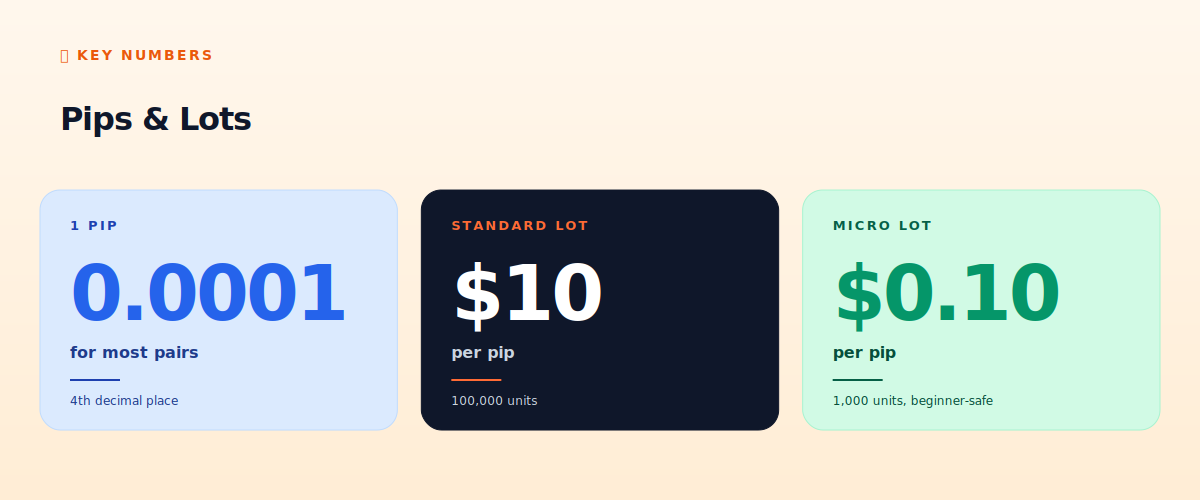
- Pip value depends on your lot size: standard lot ≈ $10/pip, micro lot ≈ $0.10/pip.
- Lot sizes: standard (100,000 units), mini (10,000), micro (1,000).
- Beginners should use micro lots — small pip value means survivable mistakes.
- Pips measure movement; pip value × pips = your profit or loss.
Pips and lots
What a pip is
A 'pip' (percentage in point) is the standard unit of price movement in forex. For most currency pairs, it's the fourth decimal place. If EUR/USD moves from 1.1000 to 1.1001, that's a one-pip move. From 1.1000 to 1.1050 is a 50-pip move. Pips give traders a consistent way to talk about price movement without saying 'it moved 0.0001' — you just say 'one pip.'
The main exception is pairs involving the Japanese yen (like USD/JPY), where a pip is the second decimal place (0.01), because the yen trades at much larger numbers (around 150 rather than around 1). So USD/JPY moving from 150.00 to 150.01 is one pip. Some brokers also quote a fifth decimal (a 'pipette' or fractional pip) for extra precision, but the pip itself is the standard unit.
Lot sizes
In forex you trade in 'lots' — standardized position sizes. The three you'll see:
- Standard lot: 100,000 units of the base currency.
- Mini lot: 10,000 units (one-tenth of a standard lot).
- Micro lot: 1,000 units (one-hundredth of a standard lot).
The lot size determines how much each pip is worth to you. The bigger your position, the more each pip movement is worth in profit or loss. This is the key relationship to understand.
Pip value
For a pair quoted against USD (like EUR/USD), the approximate pip values are:
- Standard lot: ~$10 per pip. A 50-pip move = $500.
- Mini lot: ~$1 per pip. A 50-pip move = $50.
- Micro lot: ~$0.10 per pip. A 50-pip move = $5.
Your profit or loss on a trade is simply: pips moved × pip value. If you're long one mini lot of EUR/USD and it rises 30 pips, you've made 30 × $1 = $30. If it falls 30 pips, you've lost $30. This simple multiplication is the arithmetic behind every forex trade.
Why beginners should use micro lots
Here's the practical safety point. At a micro lot, each pip is worth about $0.10, so even a large adverse move (say 100 pips) costs only ~$10. At a standard lot, that same 100-pip move costs ~$1,000. For a beginner still learning — and inevitably making mistakes — micro lots make those mistakes survivable. You can learn the craft, take losses, and not blow up your account. Starting with standard lots is how beginners lose serious money fast on normal market moves. Start small; scale up only as you prove consistency.
Connecting to position sizing
Pips and pip value are the building blocks of proper position sizing. The core risk-management question — 'how large should my position be?' — is answered using pips: you decide how many pips away your stop-loss is, how much money you're willing to risk (e.g. 1% of your account), and then size your position so that (stop distance in pips × pip value) equals your risk amount. We work through this in detail in our lot sizing guide. Understanding pips is the prerequisite for understanding risk control.
The honest verdict
Pips are simple once they click: the standard unit of forex price movement (4th decimal for most pairs, 2nd for yen pairs), and pip value scales with your lot size. Your P&L is just pips moved times pip value. For beginners, the single most important takeaway is to trade micro lots — the small pip value keeps your inevitable early mistakes survivable. Master this arithmetic, then build position sizing and risk management on top of it. It's the foundation everything else in forex rests on.
📧 Get every new tutorial in your inbox
One email per week. Tutorials, CVE disclosures, broker updates. Unsubscribe in one click.
(Connect FluentCRM / ConvertKit / Beehiiv form here)
Frequently asked questions
What is a pip?
The standard smallest price move in forex — usually the 4th decimal place (0.0001). For yen pairs (like USD/JPY), it's the 2nd decimal (0.01).
What is a pip worth?
It depends on lot size. For USD-quoted pairs: standard lot ≈ $10/pip, mini lot ≈ $1/pip, micro lot ≈ $0.10/pip. P&L = pips moved × pip value.
What lot size should a beginner use?
Micro lots (~$0.10/pip). Even a large 100-pip adverse move costs only ~$10, making early mistakes survivable. Standard lots risk serious money fast.
How are pips used for position sizing?
Decide your stop distance in pips and your risk amount (e.g. 1% of account), then size so stop-pips × pip-value = your risk. Pips are the building block of risk control.
What's a pipette?
A fractional pip — a fifth decimal place some brokers quote for extra precision. The pip itself (4th decimal) is the standard unit.
What to read next
- Forex Lot Sizing & Risk Management
- What Is Leverage?
- Stop-Loss & Take-Profit
- Forex Trading with OpenClaw 2026
Sources cited: The Hacker News (CVE-2026-25253 disclosure, Feb 2026); Conscia 2026 OpenClaw Security Crisis advisory; Snyk ToxicSkills study; Cyber Press ClawHavoc reporting; Wall Street Journal Polymarket profitability analysis (May 2026); Andrey Sergeenkov via The Defiant (April 2026); Akey, Grégoire, Harvie & Martineau, SSRN paper (March 2026); openclaw.ai official advisories; Peter Steinberger public statements on X. forex trading fundamentals; broker contract specifications.