Risk disclosure: Independent research finds 70–84% of Polymarket traders lose money (Sergeenkov, April 2026; Akey et al., SSRN, March 2026). Forex CFDs: 70–85% retail loss rate. Binary options: 80%+ in most jurisdictions. AI agents don't change these baselines. Full disclaimer. Forex CFD disclosure: ESMA, ASIC, and FCA broker disclosures consistently show 70-85% retail loss rates. Leverage amplifies losses. Most retail traders lose money trading CFDs regardless of tooling.
The foreign exchange market is the largest financial market on Earth: $7.5 trillion in daily volume (BIS Triennial Survey 2025). It runs 24/5, has the deepest liquidity available, and is the most studied market in financial academia. It is also where retail traders lose money at a 70-85% rate across every regulated broker that publishes disclosures.
This guide is the entry point for traders considering OpenClaw-assisted forex bots. We cover what OpenClaw can and can't do for forex specifically, the realistic returns for the strategies that still work, the broker landscape in 2026, and the four-week onboarding path we recommend for anyone serious about not blowing up an account.
TL;DR — The 30-second answer
- Forex is the largest market on Earth: $7.5T/day, deepest liquidity available.
- Retail loss rate: 70-85% across regulated brokers (ESMA/ASIC/FCA disclosures).
- OpenClaw works for forex via MT5 bridge (mt5-httpapi skill). 45-minute setup.
- Realistic returns for profitable bots: 1-3% per month, low volatility.
- Anyone promising 20%+ monthly is selling something or got lucky once.
- Best brokers for SEA/Africa/LATAM: Exness, IC Markets (ECN), Pepperstone.
Why forex is different from crypto and Polymarket
Three structural differences shape every forex strategy:
- Liquidity is enormous and homogeneous. EUR/USD trades at the same price (within a fraction of a pip) across every major broker. Pure inter-broker arbitrage doesn't exist for retail. Whatever edge you find must come from timing, news, or correlation — not price discrepancies.
- The market never closes (during weekdays). 24/5 trading from Sunday 5pm ET to Friday 5pm ET. Three overlapping sessions: Asian, European, US. Volume and volatility cluster around session opens.
- Leverage is baked in. Standard retail leverage is 30:1 (ESMA), 50:1 (US), 200:1 (offshore). The carry cost of holding positions overnight (swap rates) becomes a strategy in itself.
The retail loss rate — what the data actually shows
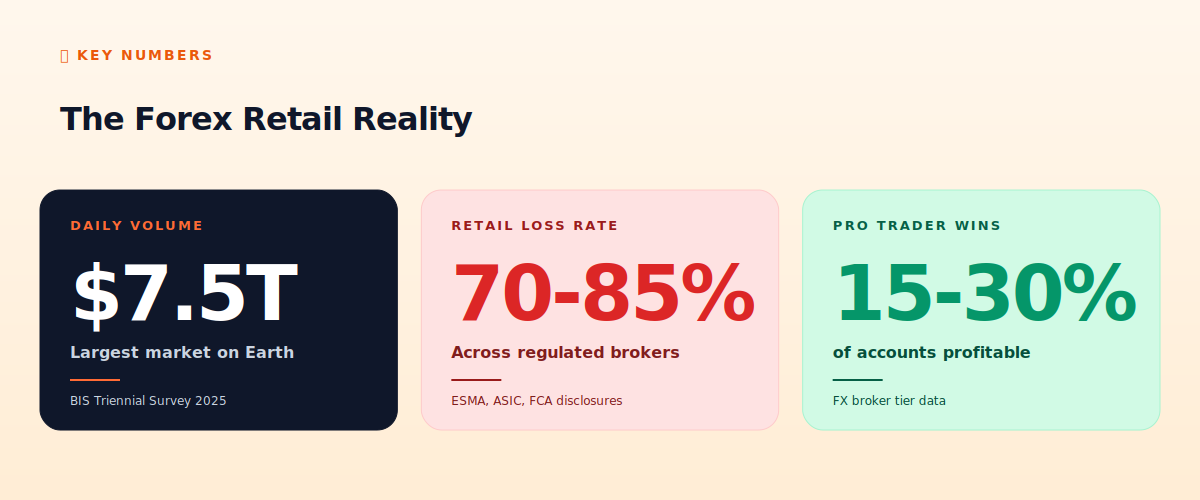
European regulator ESMA requires every CFD broker to publish quarterly statistics on retail account losses. The numbers are publicly available, consistent across years, and consistent across brokers. Typical results from major brokers' Q1 2026 disclosures:
- Pepperstone: 74% of retail CFD accounts lose money.
- IC Markets: 71% lose.
- Exness (under CySEC entity): 73% lose.
- Plus500: 82% lose.
- eToro: 76% lose.
- Smaller offshore brokers: typically 80-90% lose, but they don't publish data so it's harder to verify.
This is the most-documented loss statistic in any financial market. If you're going to trade forex, you must internalize that you're in the 30% who don't blow up — not the 70% who do — or you'll be a statistic. The 30% share specific habits: small position sizes (1-2% per trade max), willing to walk away from losing strategies, hard stop-losses, narrow asset focus, daily review discipline.
What OpenClaw adds (and doesn't add) for forex
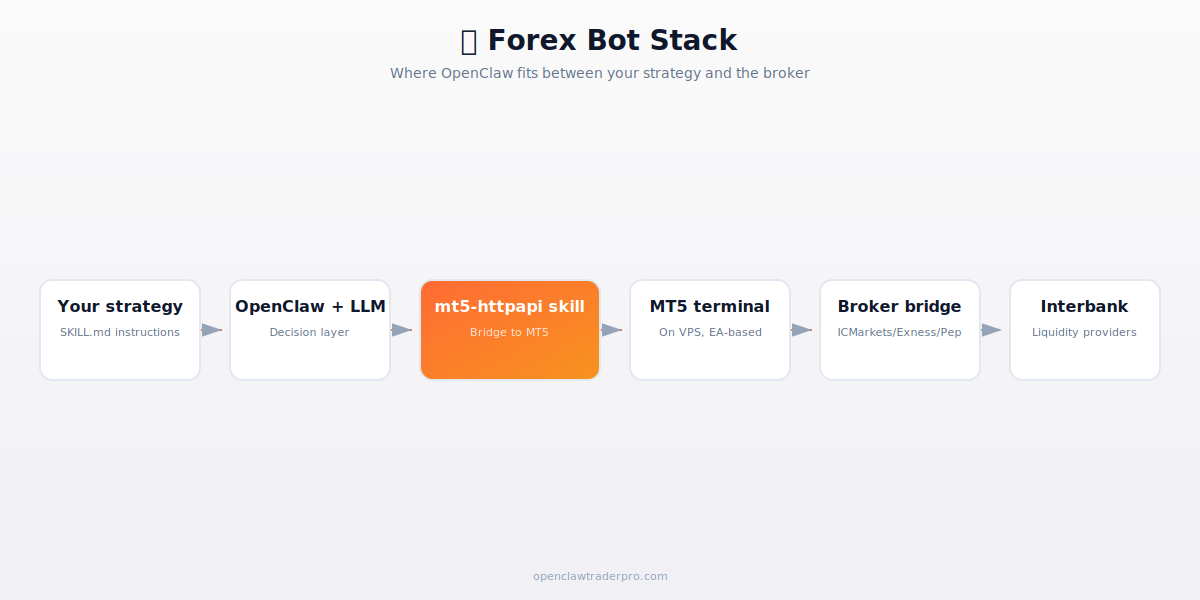
OpenClaw is useful for forex in these specific ways:
- News parsing. Central bank statements, NFP releases, geopolitical events. Claude/GPT-5 read the text and surface implications faster than a human can. Useful for fundamental traders.
- Pattern recognition at session opens. The Asian range break, the London-NY overlap behavior — standard patterns that can be coded as SKILL.md instructions.
- Multi-pair monitoring. Watching 8-12 currency pairs simultaneously is impractical for humans. Bots do it trivially.
- Correlation alerts. When EUR/USD and GBP/USD diverge from their 0.85 correlation, that's a signal — OpenClaw can monitor and alert.
- Backtest generation. Write a strategy in natural language; OpenClaw generates MQL5 code to backtest on MT5 historical data.
What it does NOT add:
- Latency edge. LLM inference at 1.5-3 seconds means scalping bots will beat you to every fill. OpenClaw is not for sub-second strategies.
- Predictive power. The LLM doesn't know what EUR/USD will do tomorrow. It's a fast pattern-recognizer, not a forecaster.
- Risk management substitution. The 1% rule must be in hard code, not in LLM instructions. Hallucinations on position size are documented and dangerous.
The 4 strategies that still work in 2026
From our experience and the documented profitable accounts:
- Carry trade with hedging. Long high-yield currency (MXN, ZAR, TRY) vs short low-yield (JPY, CHF). Earn swap rate. Hedge with options or smaller counter-position. Returns: 6-12% per year with proper sizing.
- Asian session range trades. Between Tokyo close and London open (roughly 02:00-08:00 GMT), EUR/USD and GBP/USD often trade in tight ranges. Fade extremes, exit at midpoint. Returns: 8-15% per year, low variance.
- NFP fade. Monthly US employment data release at 13:30 GMT first Friday. Initial spike often reverses within 30-90 minutes. Returns: 15-25% per year but high variance and monthly only.
- Cross-broker statistical arbitrage. When the same pair quotes differ between two brokers by >0.5 pips for >30 seconds, opportunity exists. Requires accounts at 2-3 brokers and fast execution. Returns: 5-10% per year, mostly idle.
We have a full breakdown in The 4 Forex Strategies That Actually Work (and 8 That Don't).
The broker landscape for our audience
If you're in SEA, Africa, LATAM, or the Middle East — the three brokers most OpenClaw users converge on:
- Exness: best in SEA + Africa. Fast withdrawals (6h average), low minimum deposit ($10), supports MT5, regulated by CySEC and FSA Seychelles.
- IC Markets: ECN execution, lowest raw spreads (0.1 pip EUR/USD), strong reputation. Better for high-volume traders. ASIC regulated.
- Pepperstone: similar to IC Markets, slightly better educational materials. ASIC and FCA regulated.
For US residents: forex CFDs are restricted. Use Oanda or FOREX.com for spot. None of the three above accept US clients.
Full comparison in ICMarkets vs Exness vs Pepperstone.
The 4-week onboarding path
From zero to first live trade. Skip steps at your peril.
- Week 1 — Setup and demo. Open broker account (demo mode). Install OpenClaw on VPS. Install mt5-httpapi skill. Place 50+ paper trades manually on the demo account. Goal: understand mechanics, not profit.
- Week 2 — First bot in paper. Write a single strategy as SKILL.md. Run for the week. Log every trade. Daily review: did the bot do what you intended?
- Week 3 — Refine and stress-test. Identify weaknesses from Week 2. Adjust SKILL.md. Add hard guardrails: 1% position size, 5% daily loss kill-switch, no trades during news (configurable). Run again in paper.
- Week 4 — Smallest possible live. Fund $200-500. Run the same bot. Position size 0.01-0.02 lots (micro lots). Goal: confirm fills match paper-trade simulation. NOT trying to make money.
- Month 2+: Only after Week 4 is profitable in real fills, consider scaling to $1K-5K live capital with 0.1 lot sizing. Higher only after 30 days of demonstrated profitability at the lower tier.
What goes wrong (most common failure modes)
- Over-leveraging. 200:1 leverage feels free until the first 50-pip adverse move wipes your account.
- Bot hallucinating during news. Major releases (FOMC, NFP, ECB) cause spreads to widen 5-20x. Bots that don't pause during news get filled at terrible prices.
- Strategy that worked in backtest fails forward. Most strategies are curve-fit. Forward-testing on paper for 30 days catches 90% of this.
- Withdrawal denied. Offshore brokers sometimes invent reasons. Stay with regulated entities even if spreads are slightly worse.
- Bot continues during outages. Broker server outages cause orders to fail silently. Telegram heartbeat alerts catch this.
📧 Get every new tutorial in your inbox
One email per week. Tutorials, CVE disclosures, broker updates. Unsubscribe in one click.
(Connect FluentCRM / ConvertKit / Beehiiv form here)
Frequently asked questions
Can I really make consistent money with forex bots?
Yes, with realistic expectations (1-3% monthly, low volatility) and proper discipline. No to the YouTube ads promising 30-50%.
How much capital do I need?
$200-500 for live learning during Week 4. $1K-5K for serious bot trading. Anything below $200 gets eaten by spreads and the minimum lot sizes.
Should I use a prop firm instead?
Prop firms (FTMO, MyForexFunds) offer capital but charge fees and have rules that hurt bot strategies. Worth it only if you've already validated a strategy on your own capital.
Can OpenClaw beat human traders?
On consistency (no emotional trades), yes. On predictive power, no. Use it as discipline enforcement, not as oracle.
What about copy trading?
Almost universally bad for retail. Top performers in copy trading platforms have huge survivorship bias. Their drawdowns are often hidden.
What to read next
- OpenClaw + MT5: Complete Setup Tutorial
- ICMarkets vs Exness vs Pepperstone
- Forex Lot Sizing & Risk Management
- 4 Forex Strategies That Actually Work
Sources cited: The Hacker News (CVE-2026-25253 disclosure, Feb 2026); Conscia 2026 OpenClaw Security Crisis advisory; Snyk ToxicSkills study; Cyber Press ClawHavoc reporting; Wall Street Journal Polymarket profitability analysis (May 2026); Andrey Sergeenkov via The Defiant (April 2026); Akey, Grégoire, Harvie & Martineau, SSRN paper (March 2026); openclaw.ai official advisories; Peter Steinberger public statements on X. BIS Triennial Survey 2025; ESMA, ASIC, FCA broker disclosure documents; broker public reports from Q1 2026.