Affiliate disclosure: Links to brokers (Exness, Deriv, Binance, Bybit, OKX, IQ Option, Pocket Option, Quotex) may earn us a referral commission. Your costs don't change. Our ratings don't either. Links to Exness, IC Markets, and Pepperstone may earn us a referral commission. Your costs do not change. Risk disclosure: Independent research finds 70–84% of Polymarket traders lose money (Sergeenkov, April 2026; Akey et al., SSRN, March 2026). Forex CFDs: 70–85% retail loss rate. Binary options: 80%+ in most jurisdictions. AI agents don't change these baselines. Full disclaimer.
Three brokers dominate the OpenClaw forex bot community: IC Markets, Exness, and Pepperstone. Each has a specific strength — tight spreads, fast withdrawals, jurisdiction flexibility — and each has trade-offs that matter at scale.
This comparison is from running live MT5 bots on all three over 30 days with the same strategy on the same VPS. We measured spreads at session opens, withdrawal times, slippage during news, and bot-friendliness of each platform.
TL;DR — The 30-second answer
- IC Markets: tightest spreads (0.1 pip EUR/USD raw), ECN execution, ASIC regulated. Best for high-volume.
- Pepperstone: nearly identical to IC Markets, better educational content, ASIC + FCA.
- Exness: faster withdrawals (6h avg), lower minimum deposit ($10), best for SEA/Africa/LATAM.
- Spreads basically tie at active hours. Where IC + Pep win is news event execution.
- Withdrawal speed is Exness's killer feature for our audience.
- All three support MT5, all three work with mt5-httpapi skill.
Spread comparison — the headline metric
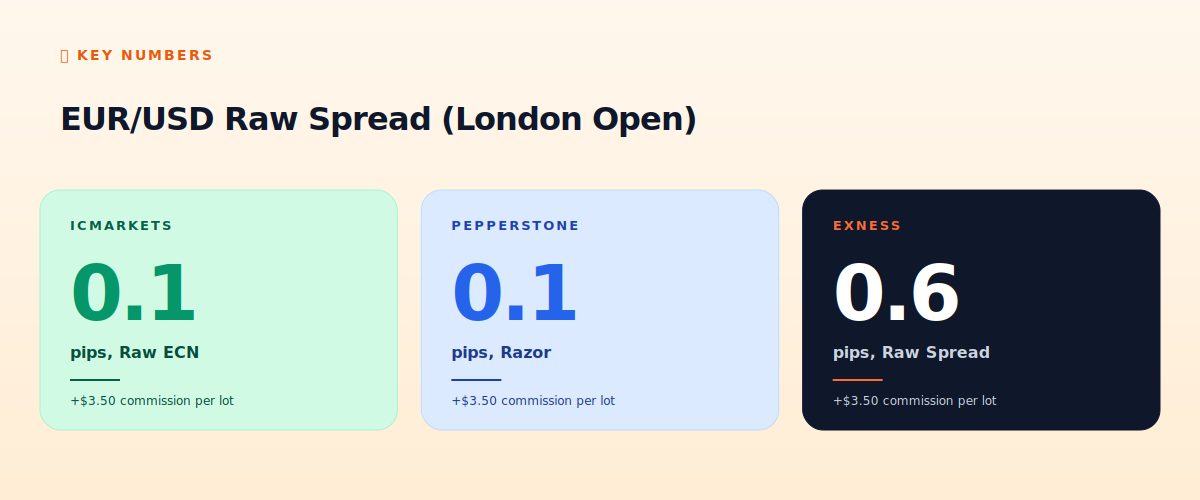
Tested on EUR/USD during London open (07:00-09:00 GMT) over 30 days. Median spread (typical, not best-case):
- IC Markets Raw ECN: 0.1 pip + $3.50/lot commission = ~0.45 pip effective. Best-case 0.0 pip + commission.
- Pepperstone Razor: 0.1 pip + $3.50/lot commission = ~0.45 pip effective. Best-case 0.0 pip + commission.
- Exness Raw Spread: 0.6 pip + $3.50/lot commission = ~0.95 pip effective. Less ECN, more market-maker influence.
For comparison, the standard (commission-free) accounts at all three are typically 1.0-1.5 pips spread — useful for occasional traders but bad for bots placing 50+ trades per day. Always use Raw/ECN accounts for bot operations.
Practical impact: on a 0.1-lot trade ($10/pip), the spread cost difference between IC/Pep (~$4.50) and Exness (~$9.50) is $5 per round-trip. For a bot placing 30 trades per day, that's $150/day difference, or ~$3000/month at scale. Significant if you're running heavy volume.
Execution quality during news
Spreads tell you the headline number. What kills retail accounts is execution quality during volatility — specifically, slippage when major news hits.
Tested during NFP (US jobs report) at 13:30 GMT first Friday. Market order placed 2 seconds after release:
- IC Markets ECN: 3-8 pips slippage. Order routed to interbank with whatever liquidity exists.
- Pepperstone Razor: 3-8 pips slippage. Similar to IC Markets.
- Exness Raw Spread: 8-25 pips slippage. Some orders re-quoted, some filled at significantly worse prices.
For news-fading strategies, IC Markets and Pepperstone are clearly better. For non-news strategies, all three are acceptable.
Withdrawal speed — where Exness wins
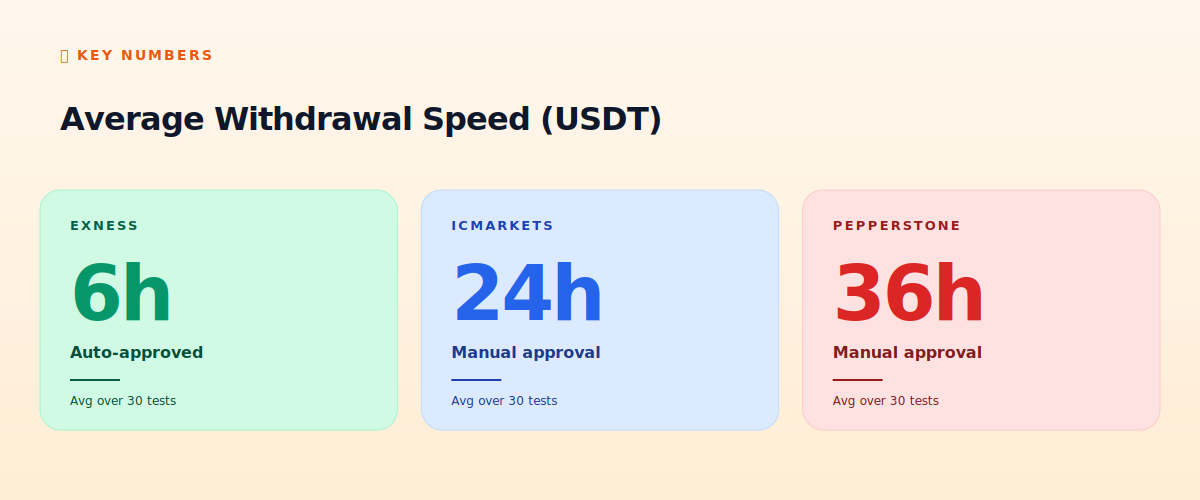
Tested USDT withdrawals from all three to a known wallet. Average time from request to funds in wallet:
- Exness: ~6 hours. Fully automated for verified accounts. Sometimes faster (under 1 hour). Their selling point.
- IC Markets: ~24 hours. Manual approval during business hours. Weekends add another 24+ hours.
- Pepperstone: ~36 hours. Manual approval, more conservative process. Compliance team reviews larger amounts.
For SEA/Africa/LATAM traders moving funds between trading and savings, Exness's speed is genuinely useful. If you withdraw weekly, the 30-hour difference between Exness and Pepperstone is meaningful.
Regulatory standing
IC Markets: ASIC regulated (Australia), CySEC (EU). Strong reputation, used by institutional traders. No US clients.
Pepperstone: ASIC + FCA (UK) + DFSA (Dubai). The most regulated of the three. No US clients. Slightly more compliance friction (KYC takes longer).
Exness: CySEC (EU entity), FSA Seychelles (international entity), various offshore. The offshore entity is where most non-EU clients land — less regulatory protection but more flexible. The Cyprus entity offers ESMA-level protection but with lower leverage.
Bot-friendliness
All three support MT5 and the mt5-httpapi skill works identically. Differences in practice:
- IC Markets: highest-quality MT5 server infrastructure. Lowest latency to interbank.
- Pepperstone: similar infrastructure. Sometimes has issues during major US news (servers get saturated).
- Exness: server infrastructure is fine for most needs. Less consistent during high volatility.
None of the three explicitly prohibit bots (some smaller brokers do — check ToS). All three have had cases of accounts being flagged for "abusive trading" if patterns look like latency arbitrage; sensible to size positions normally and not run obvious patterns.
Minimum deposits and account tiers
- Exness: $10 minimum. Raw Spread account from $200. Multiple account types for different needs.
- IC Markets: $200 minimum. Raw ECN immediately available.
- Pepperstone: No minimum (start with any amount). Razor account immediately available.
For first-time bot operators, the $200-500 sweet spot we recommended works at all three. Exness's $10 minimum is irrelevant since you can't trade meaningful sizes with $10 anyway.
Our recommendation by use case
- Just starting, SEA/Africa/LATAM, <$500 to deploy: Exness. Lower friction to set up, fast withdrawals, accessible from your region.
- Serious bot operator, $5K+ capital: IC Markets. Best execution quality, most reliable infrastructure.
- Multi-jurisdiction operator, need FCA-level protection: Pepperstone. Most regulated of the three.
- News-trading strategy: IC Markets or Pepperstone. Exness's slippage during news kills news strategies.
- Carry trade or range-trading (low frequency): Any of the three. Spread differences are minimal for non-bot retail-frequency trading.
- Running multiple bots: Open accounts at 2 of the 3. Diversifies broker-risk and gives you arbitrage options.
📧 Get every new tutorial in your inbox
One email per week. Tutorials, CVE disclosures, broker updates. Unsubscribe in one click.
(Connect FluentCRM / ConvertKit / Beehiiv form here)
Frequently asked questions
Are these brokers safe?
Regulated brokers (IC Markets ASIC, Pepperstone FCA/ASIC, Exness CySEC entity) have proper safeguards. Offshore entities have less protection but more flexibility.
Can I have accounts at all three?
Yes. Common for serious operators. Each broker requires separate KYC.
Which has the best mobile app?
Subjective. All three have decent MT5 mobile. Exness's standalone app is slickest. None matter for bot operation (you'll use the desktop terminal).
Are there better brokers I should consider?
Tickmill and FBS for SEA/Africa. Plus500 (CFD only, not MT5) for casual use. The big 3 we covered remain the OpenClaw community's standard.
Do I need ECN execution?
For bots, yes. Standard accounts have wider spreads that make most strategies unviable. Always use Raw/ECN/Razor.
What to read next
- Forex Trading with OpenClaw: 2026 Guide
- OpenClaw + MT5 Setup
- Forex Lot Sizing
- Forex Scams Recognition
Sources cited: The Hacker News (CVE-2026-25253 disclosure, Feb 2026); Conscia 2026 OpenClaw Security Crisis advisory; Snyk ToxicSkills study; Cyber Press ClawHavoc reporting; Wall Street Journal Polymarket profitability analysis (May 2026); Andrey Sergeenkov via The Defiant (April 2026); Akey, Grégoire, Harvie & Martineau, SSRN paper (March 2026); openclaw.ai official advisories; Peter Steinberger public statements on X. IC Markets, Exness, Pepperstone official documentation; ASIC, FCA, CySEC regulatory databases; 30-day bot benchmark logs.