Risk disclosure: Independent research finds 70–84% of Polymarket traders lose money (Sergeenkov, April 2026; Akey et al., SSRN, March 2026). Forex CFDs: 70–85% retail loss rate. Binary options: 80%+ in most jurisdictions. AI agents don't change these baselines. Full disclaimer.
The forex industry has the highest scam density of any retail trading vertical. Unregulated brokers run bucket shops where your losses are their profits. Signal sellers run pyramid schemes. "Prop firms" charge fees for evaluations that 95% of candidates fail. EA shops sell strategies that crumble in live trading.
This guide is the field manual. We'll cover the six red flags that identify a bucket shop in 60 seconds, the four types of forex scams currently operating, and what to do if you've already been scammed (because most people reading this have been or know someone who has).
TL;DR — The 30-second answer
- Bucket shops profit when you lose. They re-quote, slip, refuse withdrawals.
- Signal services sell access to losing strategies dressed up as winning ones.
- Prop firm scams: 95%+ fail evaluations, fees fund the operation.
- EA / robot scams: backtested-only systems sold as autopilot to wealth.
- Recovery scams: second-stage fraudsters preying on scam victims.
- 6 red flags that identify any of these in 60 seconds.
The six red flags of a bucket shop
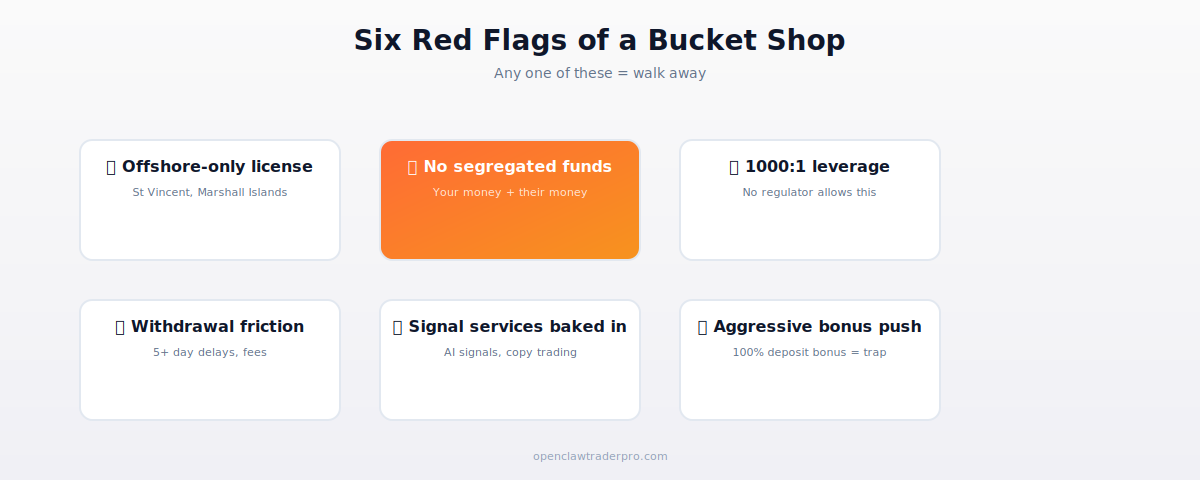
🚩 Flag 1 — Offshore-only license
Licensed in St. Vincent and the Grenadines, Marshall Islands, Vanuatu, or similar zero-oversight jurisdictions. These licenses cost ~$1,500 to obtain and require no real compliance. Brokers regulated only by these can do anything they want; you have no real recourse.
Compare to: ASIC (Australia), FCA (UK), CySEC (Cyprus, EU), MAS (Singapore), JFSA (Japan), CFTC/NFA (US). These licenses require capital reserves, segregated client funds, regular audits, and meaningful complaint handling.
🚩 Flag 2 — No segregated funds
Legitimate brokers hold client funds in segregated bank accounts — legally separate from the broker's operating money. If the broker goes bankrupt, client funds are protected. Bucket shops commingle client money with operating money; if they run into trouble (or decide to), they can use your deposits to pay other clients' withdrawals.
Check: the broker's ToS or About page should explicitly state "client funds are held in segregated bank accounts." Absence of this language = absence of segregation.
🚩 Flag 3 — 1000:1 leverage offered
No serious regulator allows above 30:1 (EU/UK), 50:1 (US), 200:1 (Australia/Japan). Offshore brokers offer 500:1, 1000:1, even "unlimited" leverage as marketing. The math: 1000:1 means a 0.1% adverse move (10 pips on EUR/USD) wipes your account. This is mathematically incompatible with serious trading; it exists only to extract deposits from gambling-mindset traders.
If you see >200:1 advertised: do not deposit. Period.
🚩 Flag 4 — Withdrawal friction
Legitimate brokers withdraw in 6-72 hours. Bucket shops use endless friction: "verification required," "compliance review," "6-month account age requirement," "minimum trading volume not met," "choose different withdrawal method." Each layer of friction is a delay tactic; eventually some traders give up and forfeit their balance.
Test before depositing significant amounts: deposit $100, trade a tiny bit, immediately attempt withdrawal. If it takes more than 72 hours or requires odd documentation, abort. You've learned the answer; don't deposit more.
🚩 Flag 5 — Signal services baked in
Brokers that offer "AI signals," "copy trading from top traders," "VIP analyst recommendations," or "managed accounts" inside their platform are usually generating signals designed to churn your account (high turnover = more commissions for the broker = more spread captured).
Real brokers offer execution, not advice. They might point you at educational materials but won't tell you what to trade. Signals from your broker = conflict of interest.
🚩 Flag 6 — Aggressive bonus push
"100% deposit bonus!" "Free $50 to start trading!" These bonuses are legally creative ways to lock your money in. The terms usually require you to trade 30-100x the bonus amount in volume before you can withdraw any of your own money. Most traders blow up trying to meet the volume requirement; the bonus is bait.
Regulated brokers in EU/UK/Australia are forbidden from offering deposit bonuses to retail traders precisely because of this trap. Offshore brokers feature them prominently.
The four scam types currently operating
Type 1 — The bucket shop broker
How it works: the broker is the counterparty to your trade. When you lose, they win. When you win, they re-quote, slip you, or refuse withdrawals to keep the money. There's no interbank routing; quotes are internal.
How to spot: all 6 red flags above. Also: search the broker name + "withdrawal problems" on forums. Multiple recent complaints = avoid.
Type 2 — The signal seller / VIP group
How it works: Telegram or Discord group selling subscriptions ($50-500/month) for "professional signals." Backed by fake screenshots of profitable trades. Often markets via "free signals first month" to lure subscribers.
How to spot: ask for verified track record. Real traders don't need to sell signals; they trade their own capital. The handful of legitimate signal services are publicly audited via Myfxbook or similar.
Type 3 — The prop firm scam
How it works: "trade our capital, keep 80% of profits!" To qualify, pay $50-500 evaluation fee. Pass a difficult evaluation (10% profit in 30 days with max 5% drawdown). 95%+ of candidates fail. The evaluation fees fund the operation.
How to spot: some prop firms are legitimate (FTMO has a real track record). Most are scams. Test: how many funded traders do they actually have? Reputable firms publish this. Scams hide the number because it's tiny.
Type 4 — The EA / robot shop
How it works: "Auto-trading EA with 95% win rate! Lifetime license $497." Beautiful backtests, sometimes real-looking live screenshots. In live trading, the EA either churns the account or stops trading after taking initial losses.
How to spot: ask for a verified Myfxbook account showing 12+ months of live results. Most scammers refuse or provide manipulated data. Backtests alone mean nothing — any strategy can be curve-fit to historical data.
The recovery scam — the second-stage fraud
After you've been scammed by any of the above, a new scammer reaches out claiming they can "recover your stolen funds." They ask for an upfront fee ($500-5000) and your personal information. They take the fee and disappear — or worse, use your info for identity theft.
Truth: 99%+ of forex scam losses are unrecoverable. Legitimate recovery services don't ask for upfront fees. If someone DMs you offering recovery, they're a second-stage scammer.
What to do if you've been scammed
- Don't pay anyone for recovery. The original loss is the loss. Adding a recovery scam doubles it.
- File a chargeback if you used a credit card. Credit card companies sometimes reverse fraudulent transactions within 60-120 days.
- Report to your country's financial regulator. Even if recovery is impossible, the data helps protect future victims. ASIC, FCA, CySEC, CFTC all have complaint forms.
- Post a detailed account on ForexPeaceArmy and Trustpilot. Reduces future victims.
- If significant amount, file with local police. They often won't pursue cross-border fraud but the report can support insurance claims if you have fraud coverage.
- Move on. Treat it as expensive tuition. Don't go back. Don't try to win it back at a different broker.
How to verify a broker is legitimate
- Check their license number on the regulator's website directly. Don't trust the broker's claim — verify with the regulator. ASIC:
asic.gov.au. FCA:register.fca.org.uk. CySEC:cysec.gov.cy. - Test withdrawal with a small amount before depositing meaningful capital.
- Read recent reviews. Filter for last 6 months — older reviews may reflect a different management or different ownership.
- Check whether the broker has multiple licenses (the more the better — you want them regulated in countries with strong enforcement).
- Look for negative news in financial press — not their own marketing. If they've been sanctioned or had license issues, that's serious.
📧 Get every new tutorial in your inbox
One email per week. Tutorials, CVE disclosures, broker updates. Unsubscribe in one click.
(Connect FluentCRM / ConvertKit / Beehiiv form here)
Frequently asked questions
Are all offshore brokers scams?
Not all, but most. Some legitimate brokers (including parts of Exness) operate offshore entities for clients in non-regulated regions. Difference: their parent has serious regulation. Pure-offshore-only is the red flag.
What about FTMO and similar prop firms?
FTMO has a verified track record with thousands of funded traders. Most other prop firms don't. Verify before paying any evaluation fee.
Can I trust auto-trading EAs from reputable shops?
Treat all EAs as 95% scam by default. The 5% that work require months of forward-testing. Never deploy live without 30+ days of paper trading first.
How much does a real broker cost to use?
Spread + commission. For ECN/Raw accounts: ~0.5 pip total cost on EUR/USD ($5 per round-trip per 0.1 lot). No deposit fees, no withdrawal fees (usually), no "hidden" charges.
My broker is licensed by IFSC Belize. Is that good?
Belize IFSC is a minor regulator with limited enforcement. Acceptable for non-Western brokers but not as protective as ASIC/FCA/CySEC. Treat as one tier below "safe."
What to read next
- Forex Trading with OpenClaw
- ICMarkets vs Exness vs Pepperstone
- Binary Options Scams Recognition
- The Fake CLAWD Token Scam
Sources cited: The Hacker News (CVE-2026-25253 disclosure, Feb 2026); Conscia 2026 OpenClaw Security Crisis advisory; Snyk ToxicSkills study; Cyber Press ClawHavoc reporting; Wall Street Journal Polymarket profitability analysis (May 2026); Andrey Sergeenkov via The Defiant (April 2026); Akey, Grégoire, Harvie & Martineau, SSRN paper (March 2026); openclaw.ai official advisories; Peter Steinberger public statements on X. ForexPeaceArmy reports; ASIC, FCA, CySEC enforcement databases; Investor Protection Bureau publications.