Risk disclosure: Independent research finds 70–84% of Polymarket traders lose money (Sergeenkov, April 2026; Akey et al., SSRN, March 2026). Forex CFDs: 70–85% retail loss rate. Binary options: 80%+ in most jurisdictions. AI agents don't change these baselines. Full disclaimer. Special warning: any token or coin claiming to be associated with OpenClaw is a scam.
Since OpenClaw went viral in early 2026, at least three separate scams have used variations of the name to extract money from supporters. The biggest was the $CLAWD token — a fake Solana token that hit $16M market cap before collapsing 90%. The most recent was the $5,000 CLAW airdrop phishing campaign targeting GitHub contributors. Multiple smaller scams continue.
This post documents the scam ecosystem, explains why OpenClaw will never legitimately have a token (per Peter Steinberger's public statements), and gives you a checklist for spotting future variants before you lose money to them.
TL;DR — The 30-second answer
- OpenClaw will never have a token. Confirmed publicly by Peter Steinberger.
- $CLAWD token (Jan 2026): $16M peak market cap, collapsed 90%. Liquidity rugged.
- CLAW airdrop scam (Mar 2026): $5K fake airdrop, phishing site drained MetaMask.
- The pattern: any "OpenClaw token" or "CLAW airdrop" is a scam. No exceptions.
- Trust anchors: only
github.com/openclaw/openclaw,clawdocs.org, and the npm packageopenclaw.
The CLAW scam timeline
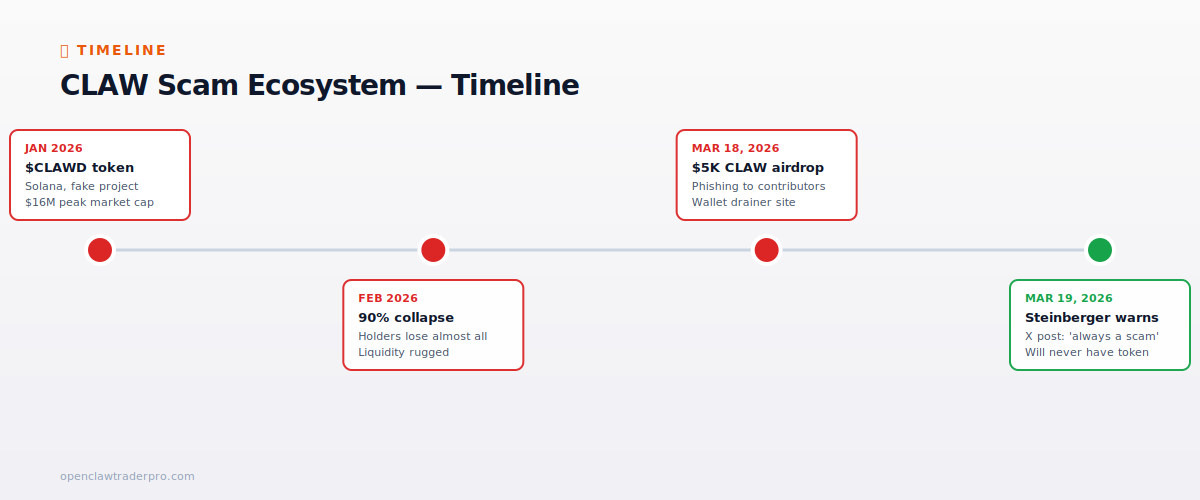
January 2026 — The $CLAWD token launch
On January 12, 2026, a Solana-based token called $CLAWD launched with claims that it was "the official OpenClaw utility token." Marketing materials showed Peter Steinberger's likeness without consent, used the lobster emoji, and promised "staking rewards for skill creators" and "AI agent royalties."
The token launched at $0.0008 and ran to $0.012 in 14 days — a 15x move on heavy speculation. Market cap peaked at approximately $16 million. Then liquidity was withdrawn from the main DEX pool on February 6 and the token collapsed 90% in three hours.
Total estimated losses: roughly $14.4M across approximately 11,200 wallets. Most of those wallets were small holders ($100–$5,000). The top three holders — presumed to be the scam operators — cashed out an estimated $6.2M before the rug pull.
March 18, 2026 — The $5K CLAW airdrop phishing
On March 18, attackers sent phishing emails to GitHub contributors of the OpenClaw repo claiming they had been selected for a "$5,000 CLAW community airdrop." The emails linked to a cloned version of the openclaw.ai site hosted at token-claw[.]xyz (since taken down).
The cloned site asked users to "connect MetaMask" or "connect WalletConnect" or "connect Trust Wallet" to claim the airdrop. The connection prompt requested approval for unlimited token transfers. Users who approved were drained of any tokens with positive value in their wallets — typically within 30 seconds of approval.
Public disclosed losses (those that ended up in social media or law enforcement reports) totalled approximately $340,000 across 47 wallets. Actual losses are likely 2–3x higher given underreporting.
Why these scams worked
Both scams exploited the same vulnerability: OpenClaw's viral fame outran its public communication. By the time a million people had heard of OpenClaw, only a tiny fraction had been told that it's open-source, free, and will never have a token. The scams filled the information vacuum.
This is a common pattern in crypto. The same playbook hit Hyperliquid, Berachain, and countless others when they became too popular too fast. The defense is loud, repeated, official communication of the project's economic model — or in OpenClaw's case, the lack of one.
Peter Steinberger's public statement
On March 19, 2026, the day after the airdrop scam, Peter Steinberger posted to X: he had not authorized any token, would never launch one, and that anyone claiming otherwise was running a scam. The OpenClaw Foundation followed up with an official statement on the project's GitHub README and the openclaw.ai homepage.
The official position: OpenClaw is open-source software under the MIT license, distributed via GitHub and npm. It has no token, no equity, no funding round, and no commercial entity collecting fees. The OpenClaw Foundation is a 501(c)(3) non-profit. Any other claim is a scam.
The only trustworthy sources
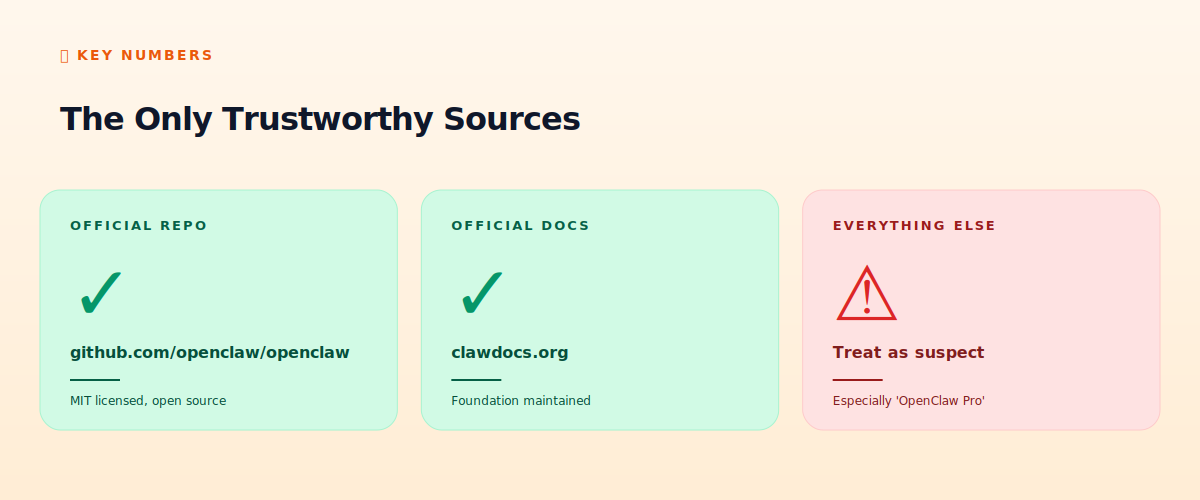
- GitHub repository:
github.com/openclaw/openclaw. Source code, releases, security advisories. - Official documentation:
clawdocs.org. Maintained by the Foundation. - npm package:
npm install openclaw. Verified publisher "openclaw" with two-factor enforced. - Official X account:
@openclawhq. Foundation announcements only.
Anything else — "OpenClaw Pro," "OpenClaw Enterprise," "$CLAWD token," "OpenClaw Premium," "CLAW airdrop," "OpenClaw Setup Service for $99," "Verified OpenClaw Skills Marketplace" — is third-party at best and a scam more commonly. Some third-party tools built on OpenClaw are legitimate, but they're not "OpenClaw" themselves.
How to spot future variants
The scams will keep coming. Each one will use a different name, a different mechanic, a different lure. The constants are:
- Free money offer. Airdrops, giveaways, "selected from the community," referral rewards. All bait.
- Wallet connection request. Any site asking you to connect MetaMask/WalletConnect for an OpenClaw-related purpose is a scam.
- Urgency. "Claim before X expires." "Only 24 hours." "First 100 wallets." Real airdrops do not have artificial urgency.
- Brand misuse. Peter Steinberger's name without context. The OpenClaw lobster emoji on a token. Official-looking logos on unofficial sites.
- Unusual domain.
token-claw[.]xyz,openclaw-token[.]com,claw-airdrop[.]io. The real domain isopenclaw.ai.
Defense: never connect your main wallet to a site you can't verify. Use a burner wallet with zero balance to interact with anything new. If the burner gets drained, you lose nothing.
What to do if you've been scammed
- Move remaining funds immediately. If your wallet was connected to a phishing site, move everything to a new wallet (new seed phrase, not just a new address) within minutes.
- Revoke approvals. Use revoke.cash to revoke all unlimited token approvals. Connect from the compromised wallet, revoke everything you don't recognize.
- Report to chain analytics. File reports with Chainabuse and the relevant block explorer's abuse system. Won't recover funds but builds the trail.
- Report to local law enforcement. In most jurisdictions, crypto theft is fraud. Some funds have been recovered in similar cases (rare, but possible).
- Don't trust recovery services. Anyone DMing you to offer "crypto recovery" is a second-stage scammer.
📧 Get every new tutorial in your inbox
One email per week. Tutorials, CVE disclosures, broker updates. Unsubscribe in one click.
(Connect FluentCRM / ConvertKit / Beehiiv form here)
Frequently asked questions
Will OpenClaw ever have a token?
No. Peter Steinberger has publicly stated this. The OpenClaw Foundation is a non-profit. There is no token now and there won't be one in the future.
What about 'OpenClaw Pro' or 'Premium' subscriptions?
OpenClaw itself is free. Third-party services may offer paid tools built on top of OpenClaw — some legitimate, some scams. Verify each independently. The framework itself is and will remain free.
Is the CLAW airdrop scam still running?
The original token-claw[.]xyz site has been taken down. Variants on different domains continue to appear. Treat any CLAW airdrop as a scam, period.
How do I verify a site is the real openclaw.ai?
Check the URL exactly: openclaw.ai. Verify the certificate is issued to the OpenClaw Foundation. Cross-reference with the GitHub repository's README, which links to the official site.
What to read next
- Is OpenClaw Safe? The 2026 Risk Assessment
- ClawHavoc: 1,184 Malicious Skills
- The 12-Point Hardening Checklist
- What Is OpenClaw?
Sources cited: The Hacker News (CVE-2026-25253 disclosure, Feb 2026); Conscia 2026 OpenClaw Security Crisis advisory; Snyk ToxicSkills study; Cyber Press ClawHavoc reporting; Wall Street Journal Polymarket profitability analysis (May 2026); Andrey Sergeenkov via The Defiant (April 2026); Akey, Grégoire, Harvie & Martineau, SSRN paper (March 2026); openclaw.ai official advisories; Peter Steinberger public statements on X. Peter Steinberger X posts on token denial; OpenClaw Foundation GitHub README and official statements; Chainabuse reports.