Risk disclosure: Independent research finds 70–84% of Polymarket traders lose money (Sergeenkov, April 2026; Akey et al., SSRN, March 2026). Forex CFDs: 70–85% retail loss rate. Binary options: 80%+ in most jurisdictions. AI agents don't change these baselines. Full disclaimer.
Every trade you place is either a market order or a limit order (or a variation of one). Choosing the right type for each situation affects your fill price, your fees, and whether your order executes at all. This guide explains both clearly, with the practical rules for when to use each — and why bots usually favor limit orders.
It's a foundational concept that takes five minutes to understand and saves you money on every trade for the rest of your trading life.
TL;DR — The 30-second answer
- Market order: executes immediately at the best available price. Speed and certainty.
- Limit order: executes only at your specified price or better. Control, but may not fill.
- Market orders pay the taker fee and suffer slippage; limit orders earn maker rebates.
- Use market when you need to get in/out NOW (exiting a losing trade fast).
- Use limit when price matters more than speed (most bot trades).
- Bots usually favor limit orders for fee savings and price control.
The two order types
Market orders: speed and certainty
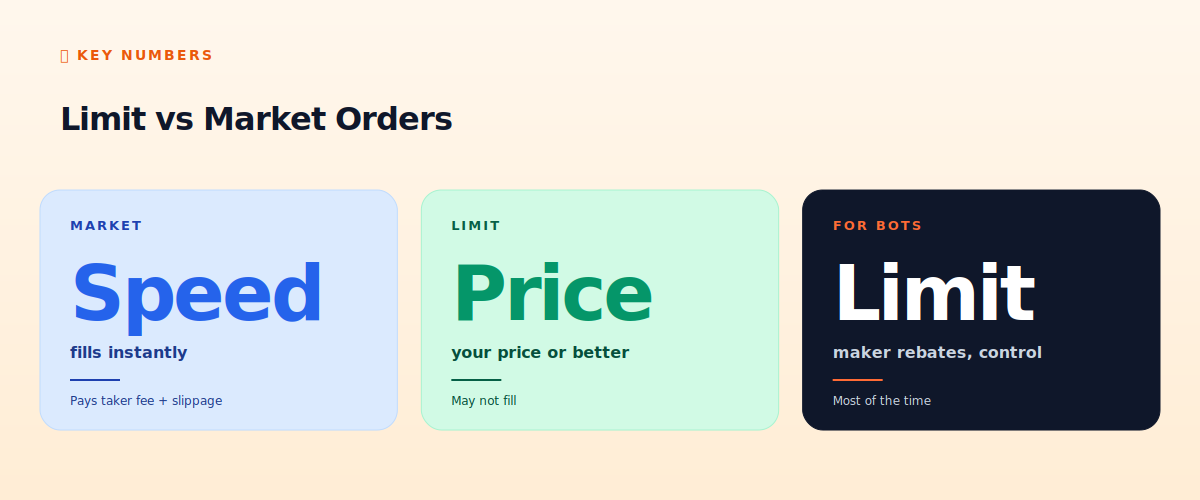
A market order says 'buy (or sell) right now, at whatever the best available price is.' It executes immediately and almost always fills completely. The trade-off: you take whatever price the market offers, which may be worse than the price you saw a moment ago (this gap is slippage). And because you're 'taking' liquidity from the order book, you pay the higher taker fee.
Market orders are right when execution certainty matters more than the exact price — most importantly, when you need to exit a losing position fast. If a trade is going against you and you want out, a market order guarantees you're out now. Quibbling over a fraction of a percent while a position bleeds is how small losses become large ones.
Limit orders: price control
A limit order says 'buy at $X or lower' (or 'sell at $X or higher'). It executes only if the market reaches your price — giving you control over your fill price — but it may never fill if the market doesn't reach it. Because a resting limit order 'makes' (adds) liquidity to the order book, you pay the lower maker fee, and on many exchanges you actually earn a maker rebate.
Limit orders are right when price matters more than speed: entering a position you're patient about, taking profit at a target, or any situation where you'd rather not fill than fill at a bad price. The risk is non-execution — if you set a limit buy below the market and price runs away upward, you miss the trade entirely.
The fee difference adds up
The maker/taker fee gap seems small per trade (often 0.02-0.10% difference) but compounds enormously for active traders and bots. A bot making hundreds of trades daily pays that difference hundreds of times. Over a month, consistently using limit orders (maker) instead of market orders (taker) can be the difference between a profitable and unprofitable strategy. We cover this fully in our trading fees guide. For high-frequency strategies, fees are often the deciding factor — and order type is your main lever.
Why bots usually favor limit orders
For OpenClaw bots and automated strategies, limit orders are usually the default for two reasons: the fee savings (maker rebates compound), and price control (the bot specifies exactly what it'll accept rather than taking whatever the market gives). The exception is exits — when a stop-loss triggers or a position needs to close fast, a market order's execution certainty wins. A common pattern: limit orders for entries and take-profits (price matters, you can wait), market orders for stop-loss exits (speed matters, you must get out).
Order variations to know
- Stop-market: becomes a market order when a trigger price is hit. Used for stop-losses where you must exit.
- Stop-limit: becomes a limit order at a trigger. More control, but risks not filling in a fast move — dangerous for stops.
- Post-only: a limit order that cancels if it would execute immediately (as a taker). Guarantees you pay maker fees. Useful for bots optimizing fees.
- Fill-or-kill / IOC: execute fully immediately or cancel. For specific execution needs.
The honest verdict
The rule of thumb: limit when price matters and you can wait; market when speed matters and you must act. For most planned entries and take-profits, use limit orders — you save on fees and control your price. For urgent exits, especially stop-losses on a losing trade, use market orders — getting out reliably beats getting out at a perfect price. For bots, default to limit (maker rebates compound) but always exit losing positions with market orders. Master this and you'll never overpay on fills or get stuck unable to exit when it counts.
📧 Get every new tutorial in your inbox
One email per week. Tutorials, CVE disclosures, broker updates. Unsubscribe in one click.
(Connect FluentCRM / ConvertKit / Beehiiv form here)
Frequently asked questions
What's the difference between limit and market orders?
Market executes immediately at the best available price (speed, certainty, taker fee). Limit executes only at your price or better (control, lower fee, may not fill).
Which should I use to exit a losing trade?
Market order. Execution certainty matters more than price when you need out. Quibbling over a fraction while a position bleeds turns small losses into large ones.
Why are limit orders cheaper?
A resting limit order adds (makes) liquidity, so you pay the lower maker fee — sometimes earning a rebate. Market orders take liquidity and pay the higher taker fee.
Do bots use limit or market orders?
Usually limit for entries and take-profits (fee savings, price control), but market for stop-loss exits (speed). The fee savings compound across many trades.
What is a post-only order?
A limit order that cancels if it would execute immediately as a taker — guaranteeing you pay maker fees. Useful for fee-optimizing bots.
What to read next
- What Is Slippage?
- What Are Trading Fees?
- Stop-Loss & Take-Profit
- Understanding the Order Book & Market Depth
Sources cited: The Hacker News (CVE-2026-25253 disclosure, Feb 2026); Conscia 2026 OpenClaw Security Crisis advisory; Snyk ToxicSkills study; Cyber Press ClawHavoc reporting; Wall Street Journal Polymarket profitability analysis (May 2026); Andrey Sergeenkov via The Defiant (April 2026); Akey, Grégoire, Harvie & Martineau, SSRN paper (March 2026); openclaw.ai official advisories; Peter Steinberger public statements on X. exchange order type documentation; trading mechanics literature.