Risk disclosure: Independent research finds 70–84% of Polymarket traders lose money (Sergeenkov, April 2026; Akey et al., SSRN, March 2026). Forex CFDs: 70–85% retail loss rate. Binary options: 80%+ in most jurisdictions. AI agents don't change these baselines. Full disclaimer. Affiliate disclosure: Links to brokers (Exness, Deriv, Binance, Bybit, OKX, IQ Option, Pocket Option, Quotex) may earn us a referral commission. Your costs don't change. Our ratings don't either.
Fees are the silent killer of trading returns. Each individual fee seems trivial — a fraction of a percent — but across many trades they compound into the difference between profit and loss, especially for active bots. This guide explains every fee type you'll encounter: maker and taker fees, the spread, swap/funding fees, and withdrawal fees. Understanding them is essential, because for high-frequency strategies, fees are often the deciding factor.
Brokers and exchanges don't hide fees, but they don't emphasize how they add up either. Knowing the full picture lets you choose venues and order types that keep more of your returns.
TL;DR — The 30-second answer
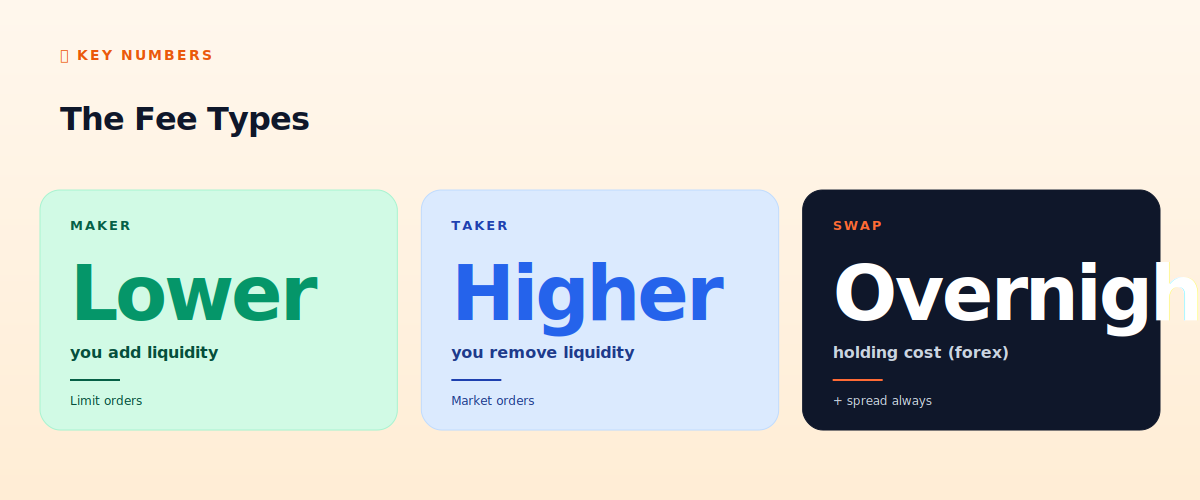
- Maker fee: charged when you add liquidity (limit orders). Lower, sometimes a rebate.
- Taker fee: charged when you remove liquidity (market orders). Higher.
- The spread: the bid-ask gap — a cost even with no explicit fee.
- Swap/funding: overnight holding costs (forex swaps, perpetual funding).
- Withdrawal fees: charged to move funds off the platform.
- For active bots, fees often decide profitability — optimize relentlessly.
The fee types
Maker vs taker fees
The core trading fee on most exchanges is split into two rates based on whether your order adds or removes liquidity (a concept rooted in the order book):
- Maker fee: charged when you 'make' liquidity — placing a limit order that rests in the book waiting to fill. You're adding to the book's depth, which exchanges value, so the maker fee is lower. Some exchanges even pay you a rebate for making liquidity.
- Taker fee: charged when you 'take' liquidity — placing a market order (or a limit order that fills immediately) that removes existing orders from the book. The taker fee is higher.
The difference is usually small per trade (often 0.02-0.10%), but it's a direct lever on your costs. This is a major reason bots favor limit orders (see our order types guide) — the maker fee saving compounds across thousands of trades.
The spread (the hidden fee)
Even when an exchange advertises 'zero commission,' there's almost always a cost: the spread, the gap between the bid (highest buy) and ask (lowest sell) price. If you buy at the ask and immediately sell at the bid, you lose the spread — that's a real cost, just not labeled as a 'fee.' Many 'commission-free' brokers (especially in forex and some stock apps) make their money on a wider spread instead of an explicit commission. The spread is effectively a fee; always factor it in. Liquid markets have tiny spreads; illiquid ones have wide ones, which is part of why trading obscure assets is expensive.
Swap and funding fees (overnight costs)
If you hold leveraged positions overnight, there are time-based costs:
- Forex swap (rollover): holding a leveraged forex position overnight incurs a swap fee (or occasionally a credit) based on the interest rate differential between the two currencies. Hold a position for weeks and swaps add up significantly.
- Perpetual funding: in crypto perpetual futures, the funding rate is paid between longs and shorts every 8 hours (this is the basis of our funding rate arbitrage strategy). Depending on your position and the rate, you pay or receive it.
These matter for any strategy holding positions beyond a day. A strategy that looks profitable on price moves alone can be unprofitable once weeks of swap fees are counted.
Withdrawal and other fees
Other fees to know: withdrawal fees (charged to move crypto or fiat off the platform — crypto network fees especially can be significant), deposit fees (less common, but some payment methods carry them), and inactivity fees (some brokers charge dormant accounts). For our audience, withdrawal/network fees matter when moving funds between venues or to wallets — factor them into any strategy that moves money around frequently.
Why fees decide bot profitability
Here's the critical point for automated trading: the more frequently a strategy trades, the more fees dominate its economics. A long-term DCA bot making one trade a week barely notices fees. A high-frequency strategy making hundreds of trades a day pays the fee on every single one — and a strategy with a thin per-trade edge can have that entire edge consumed by fees. This is why:
- Grid trading (many small trades) lives or dies on fee structure — see our grid guide.
- Arbitrage strategies often fail for retail because fees exceed the tiny discrepancies — see triangular arbitrage.
- Using maker orders (lower fees) instead of taker can flip a strategy from unprofitable to profitable.
When designing or evaluating any active strategy, calculate the all-in fee cost per round-trip trade and ask: does my edge exceed my fees? If not, the strategy loses money no matter how good the signals look.
How to minimize fees
- Use limit orders (maker fees/rebates) instead of market orders where possible.
- Choose low-fee venues for active trading — compare fee schedules (our exchange comparison covers this).
- Use fee discounts — many exchanges offer lower fees for holding their token or hitting volume tiers.
- Factor in the spread, not just the headline commission — 'zero commission' often means wider spreads.
- Account for swaps/funding on positions held overnight.
- Minimize unnecessary withdrawals to avoid network fees.
The honest verdict
Fees are small individually and lethal in aggregate. For passive, infrequent strategies they barely matter; for active bots they're often the single biggest factor in profitability — the difference between an edge that compounds and one that's eaten alive. Understand every fee type (maker, taker, spread, swap, withdrawal), favor maker orders and low-fee venues, and always test whether your strategy's edge exceeds its all-in fee cost. The traders and bots that survive treat fee optimization as seriously as signal generation, because a brilliant strategy with bad fee discipline is just a slow way to donate to the exchange.
📧 Get every new tutorial in your inbox
One email per week. Tutorials, CVE disclosures, broker updates. Unsubscribe in one click.
(Connect FluentCRM / ConvertKit / Beehiiv form here)
Frequently asked questions
What's the difference between maker and taker fees?
Maker fees apply when you add liquidity (limit orders that rest in the book) — lower, sometimes a rebate. Taker fees apply when you remove liquidity (market orders) — higher.
Is the spread a fee?
Effectively yes. The bid-ask gap is a real cost — buy at the ask, sell at the bid, and you lose the spread. Many 'zero commission' brokers make money on wider spreads instead.
What are swap and funding fees?
Overnight holding costs. Forex swaps are based on interest rate differentials; crypto perpetual funding is paid between longs and shorts every 8 hours. They add up over time.
Why do fees matter so much for bots?
The more frequently a strategy trades, the more fees dominate. A thin per-trade edge can be entirely consumed by fees. For active strategies, fees often decide profitability.
How do I minimize fees?
Use limit orders (maker), choose low-fee venues, use volume/token discounts, factor in the spread, account for swaps, and minimize unnecessary withdrawals.
What to read next
- Limit vs Market Orders
- Understanding the Order Book & Market Depth
- Binance vs Bybit vs OKX for Bots
- Grid Trading with OpenClaw
Sources cited: The Hacker News (CVE-2026-25253 disclosure, Feb 2026); Conscia 2026 OpenClaw Security Crisis advisory; Snyk ToxicSkills study; Cyber Press ClawHavoc reporting; Wall Street Journal Polymarket profitability analysis (May 2026); Andrey Sergeenkov via The Defiant (April 2026); Akey, Grégoire, Harvie & Martineau, SSRN paper (March 2026); openclaw.ai official advisories; Peter Steinberger public statements on X. exchange and broker fee schedules; trading cost analysis.