Affiliate disclosure: Links to brokers (Exness, Deriv, Binance, Bybit, OKX, IQ Option, Pocket Option, Quotex) may earn us a referral commission. Your costs don't change. Our ratings don't either. Risk disclosure: Independent research finds 70–84% of Polymarket traders lose money (Sergeenkov, April 2026; Akey et al., SSRN, March 2026). Forex CFDs: 70–85% retail loss rate. Binary options: 80%+ in most jurisdictions. AI agents don't change these baselines. Full disclaimer.
Picking the right exchange for an OpenClaw bot matters less than getting the strategy right, but it matters more than most beginners realize. The wrong API rate limits force you to throttle. The wrong fee tier shaves 0.05% off every trade. The wrong jurisdiction puts you in a regulatory mess.
This comparison covers Binance, Bybit, and OKX — the three exchanges where 90%+ of OpenClaw crypto bots run. We tested API rate limits, latency, fees, supported regions, and customer support over 30 days.
TL;DR — The 30-second answer
- Binance: highest volume, most liquid, most jurisdictions. 1200 req/min API.
- Bybit: best futures liquidity outside Binance, simpler UI. 600 req/min.
- OKX: slightly lower fees, good in SEA/Africa. 900 req/min.
- For beginners: Binance. The default for a reason.
- For futures bots: Bybit or OKX. Less crowded than Binance.
- For SEA + Africa: OKX has cleanest local on-ramps.
The API rate limits
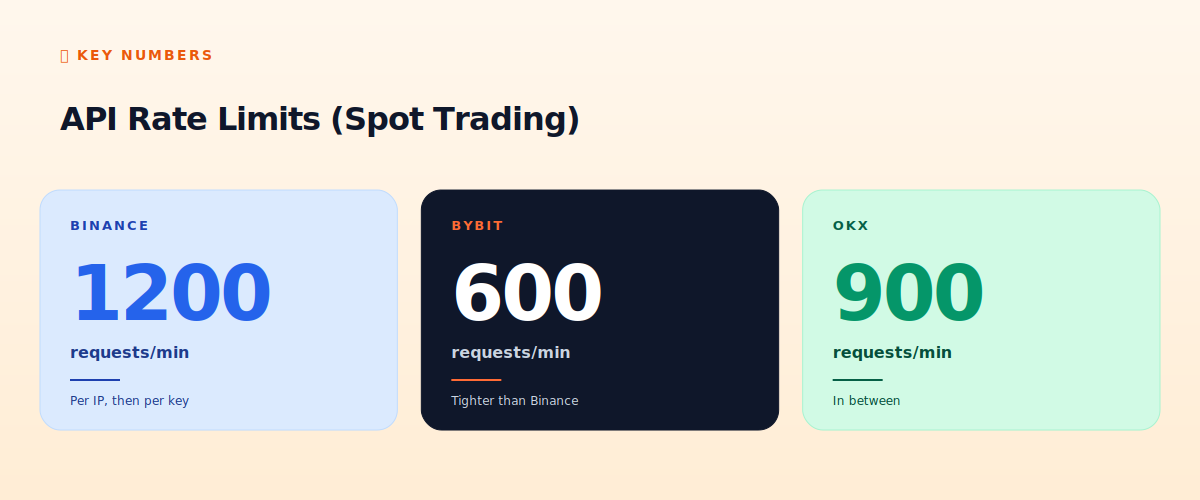
Rate limits matter for high-frequency strategies. For most OpenClaw bots, none of these limits are the bottleneck — LLM inference takes 1.5-3 seconds, so you naturally place far fewer than 600 orders/minute. But if you're running multiple strategies on one key, watch the limits.
Binance: 1200 req/min per IP, then separately tracked per API key. Order placement is rate-limited separately at 100 orders/10sec. Generous for most use cases.
Bybit: 600 req/min, more conservative. Order rate is 50 orders/sec. Sufficient for most strategies but tight if you're running multiple bots on one key.
OKX: 900 req/min on most endpoints. Order placement allows 60 orders/sec. Middle ground.
The trading fees
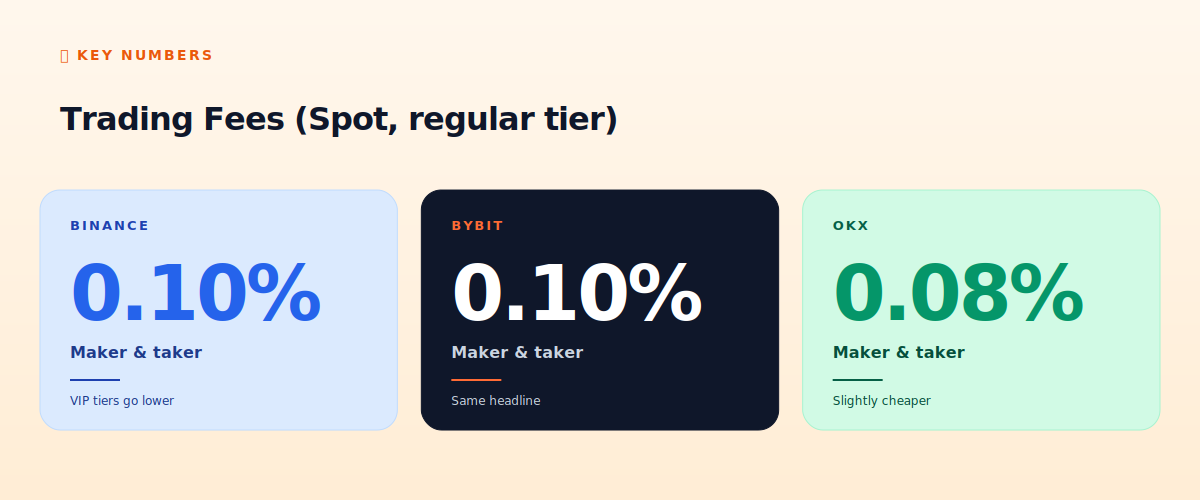
At the basic tier (no VIP status), spot fees are similar:
- Binance: 0.10% maker, 0.10% taker. With BNB hold: 0.075%. Highest volume tier (VIP 9): 0.012%.
- Bybit: 0.10% maker, 0.10% taker. Similar discounts available with BIT token.
- OKX: 0.08% maker, 0.10% taker. Slightly cheaper at the bottom tier. OKB token holders get further discount.
For a $1M monthly volume bot: Binance regular = $1000/month. OKX regular = $800-1000/month. The difference matters at scale; at $100K/month volume it's $20/month difference, which is negligible.
Futures fees are different. Binance perpetuals: 0.02% maker, 0.04% taker. Bybit: 0.01% maker, 0.06% taker (better for makers, worse for takers). OKX: 0.02% maker, 0.05% taker. Strategy-dependent which wins.
Latency to the API
Tested from 3 VPS locations to each exchange's API. Median latency over 24-hour period:
- From DigitalOcean Singapore to Binance Singapore: 4-8ms. To Bybit: 8-12ms. To OKX: 6-10ms.
- From Hetzner Falkenstein to Binance (closest US East): 110-130ms. To Bybit: 120-140ms. To OKX: 130-150ms.
- From Vultr São Paulo to Binance Singapore: 320-350ms (across globe). To Bybit: 310-340ms.
For latency-sensitive strategies (arbitrage, scalping), get your VPS within 50ms of the exchange. For OpenClaw bots running on LLM time (1500-3000ms), latency to exchange is rounding error.
Supported regions
Binance: Available in most countries globally. Restricted in US (Binance.US is separate, smaller), Canada (since 2023), UK (limited), Singapore (limited). Major SEA, Africa, LATAM all supported.
Bybit: Similar global coverage. Restricted in US, UK (since 2024). Strong in SEA, Asia, Middle East.
OKX: Most permissive of the three for fiat on-ramps in SEA and Africa. P2P market is excellent for Nigeria, Vietnam, Indonesia, Philippines. Restricted in US.
For our audience (SEA + Africa + LATAM), all three are accessible. OKX often has the cleanest fiat on-ramp via P2P; Binance has the deepest liquidity once you're funded.
Customer support
Real-world experience over 30 days:
- Binance: Average response time 8-24 hours via chat. Quality varies by region. English support better than local language support in most cases.
- Bybit: 2-6 hours response via chat. Higher quality on average. Smaller user base = less overworked support.
- OKX: 4-12 hours. Strong in SEA languages (Vietnamese, Indonesian, Thai). Weak in Spanish/Portuguese.
None will help you with API integration questions ("my bot is failing"). All three handle account issues, deposit/withdrawal issues, and KYC questions adequately.
For OpenClaw bots specifically
OpenClaw + CCXT works identically across all three. The differences in your code are minimal:
ccxt.binance.create_order(...)
ccxt.bybit.create_order(...)
ccxt.okx.create_order(...)
All three support spot, margin (where available), perpetuals, and most exotic order types. CCXT abstracts the differences. The main reason to choose one over another for OpenClaw is regional fit and your existing accounts.
Our recommendation
- Beginner with no exchange account: Binance. Most resources, deepest liquidity, easiest to find help.
- You're in SEA or Africa with cash: OKX P2P for on-ramp, then either trade there or move USDT to Binance.
- You want to focus on futures: Bybit. Cleaner futures UI, slightly better maker fees.
- You want multiple exchanges for arbitrage: Run Binance + Bybit + OKX all simultaneously via separate CCXT configs.
- Latency-critical (sub-100ms): Binance has the most diverse global infrastructure. Singapore-based bots get the best deals.
📧 Get every new tutorial in your inbox
One email per week. Tutorials, CVE disclosures, broker updates. Unsubscribe in one click.
(Connect FluentCRM / ConvertKit / Beehiiv form here)
Frequently asked questions
Can I use Coinbase or Kraken instead?
Yes — CCXT supports both. Coinbase is best for US-legal trading. Kraken is good but smaller futures market. For SEA/Africa/LATAM audience, Binance/Bybit/OKX dominate.
What about decentralized exchanges?
GMX, Hyperliquid, dYdX all work for futures but with worse liquidity and different mechanics. For OpenClaw bots, CEX (Binance/Bybit/OKX) is the practical choice.
Can I trade the same strategy on multiple exchanges?
Yes. Many bots arbitrage between exchanges. Multi-exchange operation requires separate API keys and careful account management.
Which has the lowest withdrawal fees?
Depends on the coin. For USDT: Bybit usually has lowest. For BTC: Binance. Check each exchange's withdrawal fee schedule.
Are any of these about to be banned in my region?
Regulatory landscape shifts constantly. Subscribe to each exchange's announcements. As of May 2026, no major bans pending in our audience regions.
What to read next
Sources cited: The Hacker News (CVE-2026-25253 disclosure, Feb 2026); Conscia 2026 OpenClaw Security Crisis advisory; Snyk ToxicSkills study; Cyber Press ClawHavoc reporting; Wall Street Journal Polymarket profitability analysis (May 2026); Andrey Sergeenkov via The Defiant (April 2026); Akey, Grégoire, Harvie & Martineau, SSRN paper (March 2026); openclaw.ai official advisories; Peter Steinberger public statements on X. Binance, Bybit, OKX official API documentation and fee schedules; 30-day latency benchmarks from our test VPSs.