Security context: Three critical CVEs disclosed in OpenClaw in Q1 2026 (CVE-2026-25253, CVE-2026-32922) plus the ClawHavoc supply-chain attack (1,184 malicious skills). Always run v2026.4.12 or later. Full security assessment.
A trading bot's wallet is the most exposed surface in your entire crypto operation. It connects to the internet 24/7, runs alongside potentially-untrusted skills, holds the private key on a VPS that might be compromised, and gets used dozens or hundreds of times daily. The mathematics of risk: if there's any chance of exploit, it will eventually happen.
This guide lays out the eight rules every serious operator follows for hot wallet management. The single biggest determinant of long-term survival in crypto bot trading is not how good your strategy is — it's how well you isolate your hot wallet from your main holdings.
TL;DR — The 30-second answer
- Rule 1: Hot wallet capped at <=2% of total crypto holdings.
- Rule 2: Hardware wallet for cold storage, never on a connected device.
- Rule 3: Separate seed phrase for the hot wallet. Generate fresh, store offline.
- Rule 4: No withdrawal permissions on bot API keys.
- Rule 5: Different VPS user for each wallet/strategy.
- Rule 6: Daily refund discipline: never let bot hold more than 1 day of trades.
- Rule 7: Multi-signature for warm wallet (2-of-3 minimum).
- Rule 8: Rotate the hot wallet quarterly. Move funds to fresh address.
The three-tier wallet architecture
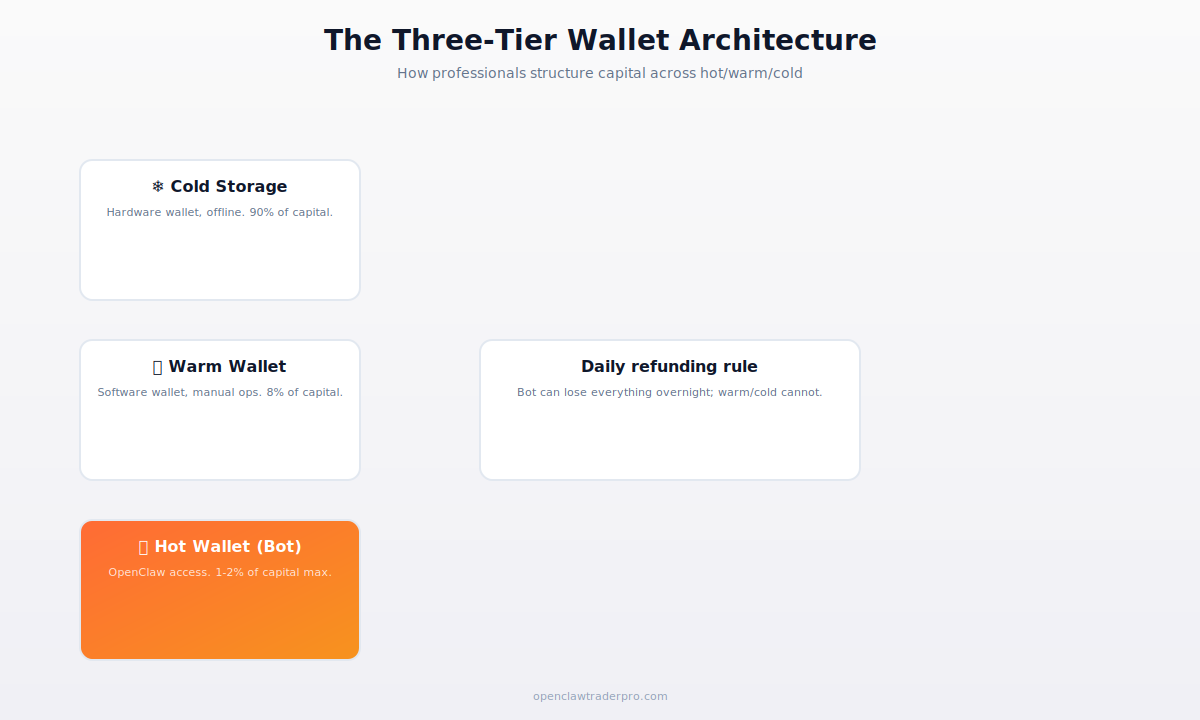
Cold storage (~90% of capital): hardware wallet (Ledger, Trezor, GridPlus). Never connected to a network during transactions. Hidden physical location. Separate seed phrase backed up on metal in fireproof location. Recovery test performed annually.
Warm wallet (~8% of capital): software wallet (MetaMask, Rabby) on a dedicated device that's not your daily computer. Used for manual operations: occasional rebalancing, manual market entries when bots aren't appropriate. Connected to the internet but not to your bot.
Hot wallet (max 2% of capital): on the VPS running OpenClaw. Holds only what the bot needs for that day's trading. Private key accessible to the bot for signing. If this wallet is drained, you accept it — 2% loss is annoying but not catastrophic.
Rule 1 — Cap the hot wallet
If your total crypto holdings are $50K, your hot wallet has no more than $1,000. If they're $500K, your hot wallet is $10K. The hot wallet is sacrificial. Any other configuration is roleplay at being a serious operator.
Justification: ClawHavoc demonstrated that 1,184 malicious skills can ship to ClawHub before being caught. Future incidents will happen. The CVE rate suggests OpenClaw will continue to have monthly critical issues. Operating as if your hot wallet is at acceptable risk means accepting that you could lose its contents this week.
Rule 2 — Hardware wallet for cold
Software wallets (MetaMask, Phantom, Solflare) store your private key in an encrypted file on a device that connects to the internet. If that device is compromised — through any attack vector — the wallet is drained.
Hardware wallets (Ledger Nano X, Trezor Model T, GridPlus Lattice1) store the private key on a secure element chip that never exposes it to the connected device. Transactions are signed on the device and the signature is sent out — the private key never leaves the hardware. Even a fully compromised computer can't drain a hardware wallet without physical access plus PIN.
Caveat about Ledger: the company suffered a customer database leak in 2020 with phishing campaigns continuing through 2026. Any email claiming to be from Ledger about updates, recoveries, or seed verification is a scam. Ledger never asks for your seed.
Rule 3 — Fresh seed for hot wallet
Never use your main seed phrase for hot wallet derivation. Generate a brand-new seed phrase specifically for the hot wallet. Store the seed phrase on paper, hidden in a different location than your main seed.
Why this matters: if your main seed is exposed (via any of: backup leak, phishing, social engineering, malware), your hot wallet derived from that seed is also exposed even if it lives on a separate device. Fresh seed = isolated risk.
Rule 4 — No withdrawal API permissions
On Binance, Bybit, OKX, and any other exchange: the API keys your bot uses must never have withdrawal permission enabled. We covered this in the Binance setup guide but it's worth repeating.
If your bot's API key is exfiltrated and withdrawals are disabled, an attacker can place trades but not move funds off the exchange. You'll see weird trades and can detect/respond. If withdrawals are enabled, an attacker can move all your funds in 30 seconds and they're gone forever.
Rule 5 — Separate VPS users per strategy
On your VPS, create separate Linux users for each strategy/wallet:
sudo useradd -m -s /bin/bash polymarket-bot
sudo useradd -m -s /bin/bash binance-bot
sudo useradd -m -s /bin/bash bybit-futures-bot
Install OpenClaw under each user, each with its own ~/.openclaw/ directory, its own wallet, its own API keys. If one user's environment is compromised, the others are isolated by Linux's permission system.
Rule 6 — Daily refund discipline
At the end of each day, the bot's wallet should hold no more than what's needed for the next day's trades. Excess proceeds get moved to the warm wallet manually. This is your operational discipline.
For Polymarket bots: at the end of each day, withdraw any USDC beyond your operational threshold. The Polymarket UI makes this easy — takes 30 seconds. For crypto bots: the exchange holds your trading capital (since API key can't withdraw); transfer profits to warm wallet manually weekly.
The discipline matters more than the exact threshold. Most bot operators don't do this and slowly accumulate larger hot wallet balances until the eventual compromise loses everything.
Rule 7 — Multi-signature for warm
For your warm wallet (the 8% tier), use multi-signature: 2-of-3 minimum. Three keys held in different locations; any two can authorize a transaction. Configurations:
- Gnosis Safe (Ethereum/Polygon): the gold standard. Web UI, well-audited, widely used.
- Casa (Bitcoin): consumer-friendly multi-sig with optional collaborative custody.
- Squads (Solana): the Solana equivalent of Gnosis Safe.
For the keys themselves: one on hardware wallet at home, one on a hardware wallet at a different location (safety deposit box, parent's house), one on a software wallet on a dedicated machine. Compromising any single key doesn't compromise the warm wallet.
Rule 8 — Rotate quarterly
Every 90 days: generate a fresh seed phrase for the hot wallet. Move all funds from old hot wallet to the new one. Update OpenClaw config. Burn the old wallet (don't reuse the address, don't keep the seed).
Why: any compromise that's gone undetected for 90 days is reset. Any leaked credentials become useless. The cost is minor (one transfer per quarter) and the protection is substantial.
What to do if your hot wallet IS drained
- Confirm it's actually drained — check Polygonscan/Etherscan to verify the transfer happened.
- Don't panic. Hot wallet drains are part of the operational risk model. You sized it specifically for this.
- Investigate the cause. Was it: malicious skill? Stolen API key? VPS compromise? Phishing of admin?
- Rotate everything. New seed, new API keys, new VPS. Don't reuse anything from the compromised system.
- Refund the new hot wallet with operational capital. Continue trading after the fix.
- Document the incident. What was lost, root cause, mitigations applied. Future-you will reference this.
📧 Get every new tutorial in your inbox
One email per week. Tutorials, CVE disclosures, broker updates. Unsubscribe in one click.
(Connect FluentCRM / ConvertKit / Beehiiv form here)
Frequently asked questions
How much should I keep in the hot wallet?
Position size of largest trade x ~5-10. If your max trade is $500, hot wallet should hold $2,500-5,000 max. Refund daily.
Can I use a single seed for hot and warm with different derivation paths?
Technically yes (HD wallets support this). Practically: don't. Fresh seed for hot wallet is cleaner separation.
Is Ledger Nano S sufficient?
Yes for low capital. Above $10K cold storage, upgrade to Nano X or Stax for better UX and longer-term reliability.
What about mobile wallets like Trust Wallet?
Acceptable for warm wallet use but inferior to hardware wallets for cold. Don't use for cold storage above $5K.
How do I move profits without exposing seed?
Use the exchange's UI to withdraw to warm wallet (assuming you have warm wallet address whitelisted). Or use the bot's wallet to send to warm wallet (one-way transaction, no seed exposure).
What to read next
- OpenClaw + Binance Setup
- ClawHavoc: 1,184 Malicious Skills
- The 12-Point OpenClaw Hardening Checklist
- CCXT Skill Deep Dive
Sources cited: The Hacker News (CVE-2026-25253 disclosure, Feb 2026); Conscia 2026 OpenClaw Security Crisis advisory; Snyk ToxicSkills study; Cyber Press ClawHavoc reporting; Wall Street Journal Polymarket profitability analysis (May 2026); Andrey Sergeenkov via The Defiant (April 2026); Akey, Grégoire, Harvie & Martineau, SSRN paper (March 2026); openclaw.ai official advisories; Peter Steinberger public statements on X. Ledger security advisories; Gnosis Safe documentation; on-chain analysis of bot wallet incidents 2024-2026.