Security context: Three critical CVEs disclosed in OpenClaw in Q1 2026 (CVE-2026-25253, CVE-2026-32922) plus the ClawHavoc supply-chain attack (1,184 malicious skills). Always run v2026.4.12 or later. Full security assessment.
CCXT is the most-installed OpenClaw skill for trading. As of May 2026, it's installed in approximately 89% of OpenClaw bots that trade crypto. It supports 120+ exchanges with a single unified API, abstracts away the differences between Binance's REST format and OKX's REST format, and lets you swap exchanges in your strategy by changing one line.
This deep dive covers what CCXT actually does, how it's used inside OpenClaw, where it shines and where it falls short. We assume you've installed and configured at least one exchange via CCXT (see our Binance setup guide).
TL;DR — The 30-second answer
- CCXT (CryptoCurrency eXchange Trading library) supports 120+ exchanges with one API.
- Open-source Node.js + Python library, MIT licensed.
- Used by 89% of OpenClaw crypto bots as of May 2026.
- Strengths: uniform interface, well-maintained, broad coverage.
- Weaknesses: per-exchange quirks still leak through, latency overhead 50-150ms.
- For LLM-speed bots: CCXT is the right choice. For sub-100ms HFT: use native exchange SDKs.
What CCXT actually does
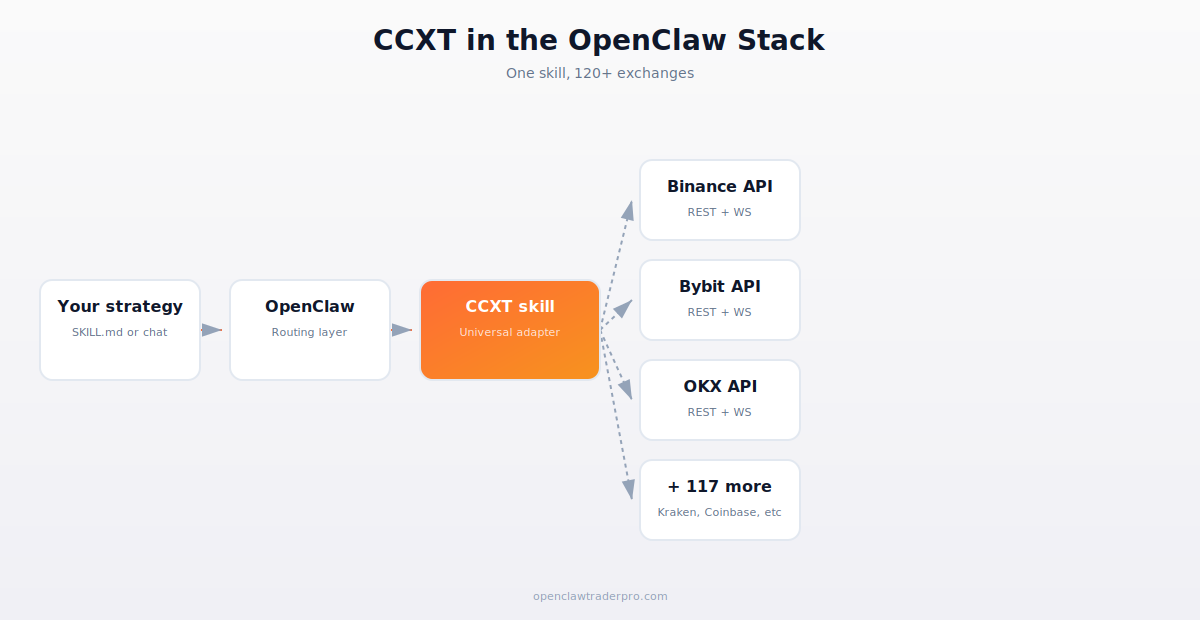
Without CCXT, integrating with Binance, Bybit, and OKX means three different REST API formats, three authentication schemes, three sets of error codes. Adding a fourth exchange means more code. CCXT provides a unified abstraction layer: exchange.create_order(symbol, type, side, amount, price) works identically across all supported exchanges.
Under the hood, CCXT translates the unified call into the exchange-specific format, handles authentication signing (HMAC, RSA, or whatever the exchange requires), parses the response back into a unified format, and returns it to you. The cost of this abstraction is 50-150ms additional latency vs hitting the exchange API directly.
What CCXT covers
Exchanges (120+ as of May 2026): all the big CEXes (Binance, Bybit, OKX, Coinbase, Kraken, Bitstamp, Bitfinex, Kucoin, Huobi), most regional exchanges (Indodax for Indonesia, Bitkub for Thailand, Mercado Bitcoin for Brazil), DEXes (Hyperliquid, Hyperliquid Perps, GMX, dYdX), and prediction markets that fit the model (Polymarket via plugin).
Functionality covered:
- Market data: tickers, order books, trade history, OHLCV candles, funding rates
- Account data: balances, positions, deposit addresses, transaction history
- Orders: market, limit, stop-loss, take-profit, trailing stops, conditional orders
- WebSocket streams (in CCXT Pro, the paid extension): real-time order book updates, trades, balance changes
- Margin and futures: position management, leverage setting, liquidation queries
What CCXT doesn't cover
Exchange-specific features often require dropping to the raw API:
- Binance's Convert feature (instant conversion without orderbook)
- Bybit's Copy Trading or Earn products
- OKX's structured products and yield farming
- Spot grid bots provided by exchanges natively
- VIP-level fee structures and rebate negotiations
If your strategy needs any of the above, you'll need exchange-specific code in addition to CCXT. The OpenClaw community has built skills for several common exchange-specific features — check ClawHub for binance-convert, bybit-earn, etc.
Configuring CCXT for OpenClaw
After clawhub install ccxt, configure each exchange:
openclaw config set ccxt.binance.api_key YOUR_KEY
openclaw config set ccxt.binance.api_secret YOUR_SECRET
openclaw config set ccxt.binance.defaultType spot  # or 'swap' for futures

openclaw config set ccxt.bybit.api_key YOUR_KEY
openclaw config set ccxt.bybit.api_secret YOUR_SECRET
openclaw config set ccxt.bybit.defaultType swap
Then in your trading skill, you can use both:
# Get ticker from both, place order on whichever is cheaper
btc_binance = ccxt.binance.fetch_ticker('BTC/USDT')
btc_bybit = ccxt.bybit.fetch_ticker('BTC/USDT')
if btc_binance.ask < btc_bybit.ask:
  ccxt.binance.create_market_buy_order(...)
else:
  ccxt.bybit.create_market_buy_order(...)
Common gotchas
- Symbol format varies. CCXT uses 'BTC/USDT' but some exchanges use 'BTCUSDT' or 'BTC-USDT'. CCXT translates, but custom strings break it.
- Quantity vs notional. Some exchanges want order size in base currency (0.001 BTC), some in quote (50 USDT). CCXT handles via the
amountparameter, but watch the fill response. - Decimal precision. Each exchange has different minimum tick sizes. CCXT exposes them via
exchange.markets[symbol]['precision']. - Rate limiting. CCXT throttles by default to stay under limits. You can disable with
exchange.rateLimit = falsebut you risk exchange bans. - Mode (spot/swap/margin) confusion. Setting
defaultType='swap'globally then trying to use spot endpoints will fail. Be explicit.
CCXT vs raw exchange SDKs
Use CCXT when:
- Trading multiple exchanges
- Strategy is in OpenClaw with LLM in the loop (latency already ~1500ms)
- Switching exchanges is a possibility
- You value developer time more than 50-150ms latency
Use raw exchange SDK when:
- Single exchange, single venue
- Sub-100ms latency is critical (HFT, MM bots)
- Need exchange-specific features CCXT doesn't expose
- Optimizing for lowest possible request count
CCXT Pro — the paid extension
CCXT Pro adds WebSocket support to CCXT. It's a paid product (~$300/month enterprise, $99/month individual) maintained by the same team. For OpenClaw bots that need real-time data (price ticks, balance changes), CCXT Pro provides one-line subscriptions instead of polling REST endpoints.
Is it worth it? For bots making decisions on minute-level data: no, REST polling is fine. For bots that need sub-second reaction to price moves: yes, the latency savings and reduced API call count are worth the subscription. Most OpenClaw bots can run profitably on REST polling.
Maintenance and updates
CCXT updates 2-4 times per week with new exchange listings, bug fixes, and API changes. The OpenClaw ccxt skill pins to a specific CCXT version that's tested with the OpenClaw release. To update:
clawhub update ccxt
Read the release notes before upgrading. Major version changes (e.g., 4.x → 5.x) occasionally break custom integrations.
📧 Get every new tutorial in your inbox
One email per week. Tutorials, CVE disclosures, broker updates. Unsubscribe in one click.
(Connect FluentCRM / ConvertKit / Beehiiv form here)
Frequently asked questions
Is CCXT free?
Yes for the base library (MIT license). CCXT Pro (WebSocket support) is paid.
Can I trust CCXT not to have vulnerabilities?
CCXT is audited and widely used (millions of installs). But your API keys flow through it — treat it like any dependency, keep updated, monitor for security advisories.
How do I add a new exchange CCXT doesn't support?
CCXT accepts community contributions. Or write a custom integration as an OpenClaw skill that doesn't go through CCXT.
Why is my CCXT call slow?
Usually because CCXT is rate-limiting to stay under exchange limits. Or because the exchange API itself is slow. Profile with timing logs to identify which.
What about Solana/Sui/other non-EVM chains?
CCXT supports their CEXes (e.g., Binance for SOL trading). For on-chain DEX interactions, use chain-specific libraries (Anchor for Solana, Sui SDK).
What to read next
- OpenClaw + Binance Setup
- OpenClaw + Bybit Futures
- Binance vs Bybit vs OKX for Bots
- Crypto Arbitrage Realistic Expectations
Sources cited: The Hacker News (CVE-2026-25253 disclosure, Feb 2026); Conscia 2026 OpenClaw Security Crisis advisory; Snyk ToxicSkills study; Cyber Press ClawHavoc reporting; Wall Street Journal Polymarket profitability analysis (May 2026); Andrey Sergeenkov via The Defiant (April 2026); Akey, Grégoire, Harvie & Martineau, SSRN paper (March 2026); openclaw.ai official advisories; Peter Steinberger public statements on X. CCXT documentation; OpenClaw bundled skills documentation; CCXT Pro pricing page.