Risk disclosure: Independent research finds 70–84% of Polymarket traders lose money (Sergeenkov, April 2026; Akey et al., SSRN, March 2026). Forex CFDs: 70–85% retail loss rate. Binary options: 80%+ in most jurisdictions. AI agents don't change these baselines. Full disclaimer. Security context: Three critical CVEs disclosed in OpenClaw in Q1 2026 (CVE-2026-25253, CVE-2026-32922) plus the ClawHavoc supply-chain attack (1,184 malicious skills). Always run v2026.4.12 or later. Full security assessment.
Market making — providing liquidity by quoting both buy and sell prices and capturing the spread — is how a lot of professional trading firms make money. It's also one of the hardest strategies for retail to execute profitably, because you're competing against high-frequency firms with infrastructure you can't match. This guide gives an honest assessment: how market making works, why retail mostly can't compete, and the narrow conditions where it's viable.
Spoiler: this is not an OpenClaw strategy. Market making needs sub-100ms execution; OpenClaw's LLM is far too slow. But understanding it matters, and there's a right tool (Hummingbot) if you pursue it.
TL;DR — The 30-second answer
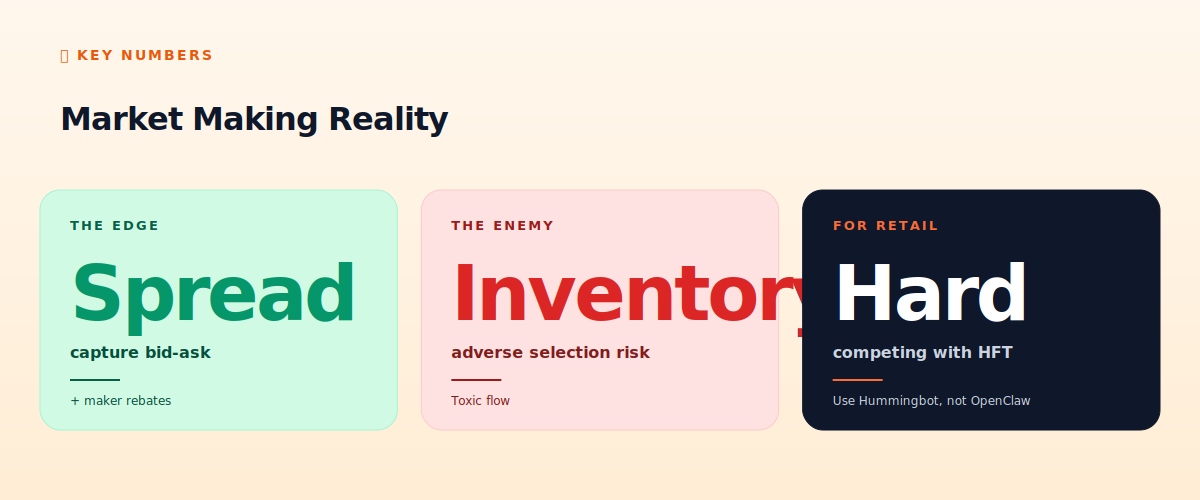
- The idea: quote both bid and ask, capture the spread, earn maker rebates.
- The enemy: adverse selection — informed traders pick you off (toxic flow).
- Why retail struggles: competing against HFT firms with co-located servers.
- OpenClaw can't do it: LLM latency (1.5-3s) vs the needed sub-100ms.
- Right tool: Hummingbot, not OpenClaw — if you pursue it at all.
- Honest verdict: an advanced, infrastructure-heavy game most retail should skip.
Market making reality
How market making works
A market maker continuously quotes both a buy price (bid) slightly below the market and a sell price (ask) slightly above. When a buyer takes your ask and a seller hits your bid, you've bought low and sold high, capturing the spread between them. Do this thousands of times across the day, and the small spreads add up. On many exchanges, makers also earn rebates — the exchange pays you for providing liquidity — adding to the profit. In theory, it's a steady, direction-neutral income from the bid-ask spread.
The enemy: adverse selection
Here's what kills naive market making: adverse selection, also called toxic flow. The problem is that the traders who hit your quotes aren't random — they're often better-informed than you. When someone aggressively buys from your ask, it's frequently because they know something (price is about to rise). You sold to them right before the move — you got 'picked off.' Your inventory now moves against you. The spread you captured is dwarfed by the loss on the position you're left holding.
Professional market makers manage this with sophisticated inventory models, fast quote adjustments, and informational edges. They widen spreads when toxic flow is likely, skew quotes based on inventory, and pull quotes microseconds before adverse moves. A naive market maker without these defenses gets adversely selected into losses — the informed traders systematically extract value.
Why retail mostly can't compete
Market making is dominated by HFT firms for structural reasons retail can't overcome:
- Latency. HFT firms co-locate servers in the exchange's data center, achieving microsecond reaction times. They update or pull quotes before you've even seen the market move. You're quoting stale prices they pick off.
- Infrastructure. Dedicated low-latency hardware, direct market data feeds, custom networking. The capital and expertise barrier is enormous.
- Inventory models. Sophisticated risk management that retail bots lack.
- Volume rebate tiers. The best maker rebates require volume retail can't match.
Competing against this with a retail setup is like racing a Formula 1 car with a bicycle. On major liquid pairs, the HFT firms own market making.
Why OpenClaw specifically can't do it
Even setting aside HFT competition, OpenClaw is structurally the wrong tool. Market making requires updating quotes in sub-100ms response to changing market conditions. OpenClaw's LLM adds 1.5-3 seconds per decision — you'd be quoting prices 30+ times too slow, getting picked off on every stale quote. This is the clearest example in our strategy series of OpenClaw being unsuitable. For market making, you need a purpose-built low-latency engine — Hummingbot is the standard (see our comparison). OpenClaw could oversee a Hummingbot market maker (adjusting parameters based on conditions) but cannot do the quoting itself.
The narrow viable cases
Market making isn't entirely closed to non-HFT players, but the viable niches are narrow: on smaller, less liquid pairs and smaller exchanges where HFT firms don't bother competing, wider spreads and less competition can make retail market making (via Hummingbot) marginally viable. Some operators make modest returns providing liquidity on long-tail pairs. But the returns are thin, the inventory risk is real, and it requires genuine expertise. It's a specialist niche, not a general retail strategy.
The honest verdict
Market making is a real, professional strategy that retail mostly shouldn't attempt on major pairs — you're outgunned by HFT infrastructure, and adverse selection punishes the naive. It is definitively not an OpenClaw strategy (latency makes it impossible). If you're genuinely drawn to it, the path is Hummingbot on smaller pairs, with realistic expectations of modest returns and real inventory risk, after developing real expertise. For most readers, the honest advice is to skip market making and focus on strategies that fit retail tools and timeframes — funding rate arbitrage, DCA, or regime-aware directional trading. Know what market making is; know that it's mostly not for you.
📧 Get every new tutorial in your inbox
One email per week. Tutorials, CVE disclosures, broker updates. Unsubscribe in one click.
(Connect FluentCRM / ConvertKit / Beehiiv form here)
Frequently asked questions
What is market making?
Quoting both a bid and an ask, capturing the spread when both fill, plus earning maker rebates. A direction-neutral strategy — in theory steady income from the bid-ask spread.
Why can't retail compete at market making?
HFT firms co-locate servers for microsecond reactions, have superior infrastructure and inventory models, and dominate the major pairs. Retail quotes stale prices that get picked off.
What is adverse selection?
Toxic flow — the traders hitting your quotes are often better-informed, picking you off right before adverse moves. The spread you capture is dwarfed by losses on the inventory you're left holding.
Can OpenClaw do market making?
No. It needs sub-100ms quote updates; OpenClaw's LLM adds 1.5-3s. It's 30x+ too slow. Use Hummingbot for market making, OpenClaw to oversee it at most.
Is market making ever viable for retail?
Marginally, on smaller/less-liquid pairs where HFT doesn't compete, via Hummingbot, with expertise and realistic expectations. A specialist niche, not a general retail strategy.
What to read next
- Hummingbot vs OpenClaw
- Scalping with Bots: Why LLM Latency Kills It
- Funding Rate Arbitrage
- Triangular Arbitrage: Why It's Hard
Sources cited: The Hacker News (CVE-2026-25253 disclosure, Feb 2026); Conscia 2026 OpenClaw Security Crisis advisory; Snyk ToxicSkills study; Cyber Press ClawHavoc reporting; Wall Street Journal Polymarket profitability analysis (May 2026); Andrey Sergeenkov via The Defiant (April 2026); Akey, Grégoire, Harvie & Martineau, SSRN paper (March 2026); openclaw.ai official advisories; Peter Steinberger public statements on X. market microstructure and market making literature; Hummingbot documentation.