Risk disclosure: Independent research finds 70–84% of Polymarket traders lose money (Sergeenkov, April 2026; Akey et al., SSRN, March 2026). Forex CFDs: 70–85% retail loss rate. Binary options: 80%+ in most jurisdictions. AI agents don't change these baselines. Full disclaimer. Security context: Three critical CVEs disclosed in OpenClaw in Q1 2026 (CVE-2026-25253, CVE-2026-32922) plus the ClawHavoc supply-chain attack (1,184 malicious skills). Always run v2026.4.12 or later. Full security assessment.
Scalping — making many tiny profits from small price moves, holding positions for seconds to minutes — is a popular trading style, and a tempting one to automate. But there's a hard structural reason OpenClaw can't scalp effectively: LLM latency. Every OpenClaw decision takes 1.5-3 seconds, and scalping needs sub-second timing. This guide gives the honest case for why you shouldn't try to scalp with an AI agent, and what to use if scalping genuinely appeals to you.
Like our market-making and triangular-arbitrage posts, this is partly about knowing the limits of your tools. Using OpenClaw to scalp is using the wrong tool for the job — and understanding why saves you from a frustrating, money-losing experiment.
TL;DR — The 30-second answer
- Scalping: many tiny profits from small moves, holding seconds to minutes.
- The requirement: sub-second execution — near-HFT timing.
- OpenClaw's latency: 1.5-3 seconds per decision — ~30x too slow.
- The result: by the time the LLM decides, the scalping opportunity is gone.
- Right tools: Hummingbot, coded bots, or manual scalping — not OpenClaw.
- Better fit for OpenClaw: slower strategies where judgment beats speed.
Why OpenClaw can't scalp
What scalping is
Scalping is a high-frequency-ish style: you aim to capture very small price moves — a few ticks, a fraction of a percent — many times throughout the session. Positions are held for seconds to a few minutes. A scalper might make dozens or hundreds of trades a day, each targeting a tiny profit, relying on volume of trades rather than size of any single move. Done well, the small edges accumulate; done poorly, fees and slippage eat everything.
Scalping demands speed. The opportunities are fleeting — a favorable price exists for a moment before the market moves. You need to spot the setup, decide, and execute almost instantly. Successful scalpers (human or bot) operate on reflexes and fast systems, reacting in milliseconds to seconds.
The latency problem
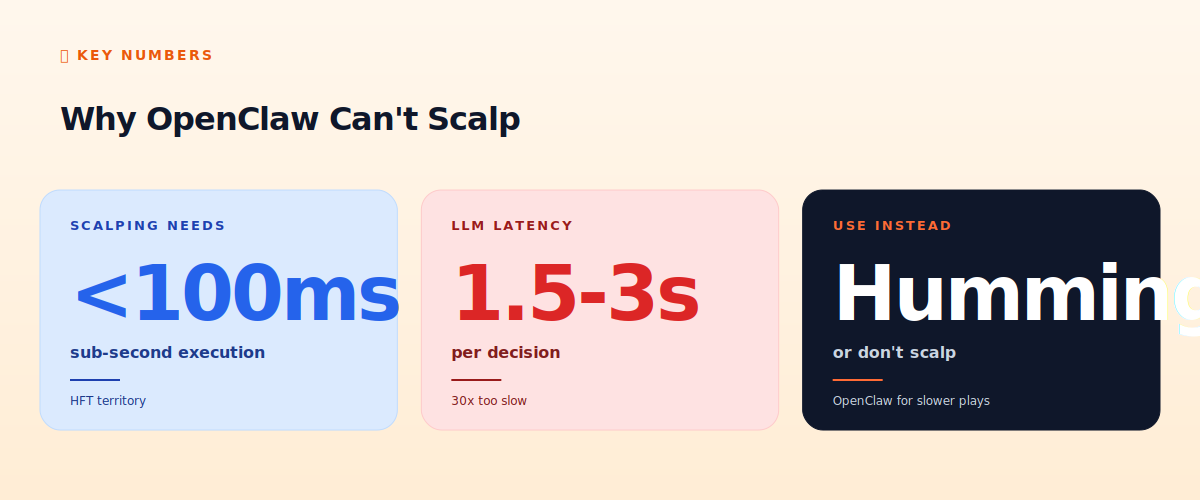
Here's the structural wall. Every decision OpenClaw makes goes through an LLM, which takes roughly 1.5 to 3 seconds to process and respond. For most OpenClaw strategies — monitoring, funding arbitrage, DCA, regime-aware directional trades — that latency is irrelevant; those strategies operate on minutes-to-hours timeframes. But scalping operates on a sub-second-to-seconds timeframe. By the time OpenClaw's LLM has 'looked' at the opportunity and decided to act, 1.5-3 seconds have passed — an eternity in scalping terms. The favorable price is long gone; you'd be executing on stale information, chasing moves that already happened.
It's roughly a 30x mismatch: scalping wants sub-100ms reactions, OpenClaw delivers multi-second ones. No amount of clever prompting fixes this — the latency is inherent to running an LLM in the decision loop. This is the same reason OpenClaw can't do triangular arbitrage or market making: all three need speed the LLM structurally can't provide.
What about cheaper/faster models?
A reasonable question: could a faster, cheaper LLM (or a local model) close the gap? Somewhat — faster models reduce latency — but not enough. Even the fastest LLM responses are hundreds of milliseconds to seconds, still far slower than scalping needs, and the network round-trips add more. You'd also sacrifice the reasoning quality that's OpenClaw's actual advantage. Trying to make OpenClaw fast enough to scalp means stripping away the very thing that makes it useful, and still falling short. It's the wrong tool no matter how you tune it.
What to use instead
If scalping genuinely appeals to you, the right tools exist — just not OpenClaw:
- Hummingbot or other coded, low-latency bots: deterministic strategies that execute in milliseconds without an LLM in the loop (see our comparison).
- Custom coded bots (Python with direct exchange WebSocket connections): if you can code, a tight execution loop reacts far faster than any LLM.
- Manual scalping: some traders scalp by hand with fast hotkeys — human reflexes, while slower than bots, at least apply judgment in real time.
And honestly: most retail scalping loses money even with the right tools, because fees and slippage on tiny moves are brutal, and you're competing with faster players. Scalping is one of the hardest styles to profit from. The fact that OpenClaw can't do it isn't much of a loss.
What OpenClaw is good for instead
OpenClaw's strength is the opposite of scalping: strategies where judgment matters more than speed. Funding rate arbitrage (8-hour cycles), DCA (scheduled), regime-aware directional trading (minutes-to-hours), monitoring and alerting, research and synthesis, multi-venue orchestration. In all of these, the LLM's 1.5-3 second latency is irrelevant, and its reasoning is a genuine asset. Play to that strength. Trying to scalp with OpenClaw is fighting the tool; using it for judgment-driven, slower strategies is using it as designed.
The honest verdict
OpenClaw cannot scalp effectively, and you shouldn't try — LLM latency (1.5-3s) is roughly 30x too slow for a style that needs sub-second timing. This isn't a flaw to work around; it's a fundamental property of putting an LLM in the decision loop. If scalping appeals to you, use a coded low-latency bot (Hummingbot or custom), with the sober awareness that retail scalping is hard to profit from regardless. And for OpenClaw, lean into what it does well: slower, judgment-driven strategies where reasoning beats reflexes. Knowing this boundary is part of using the tool wisely.
📧 Get every new tutorial in your inbox
One email per week. Tutorials, CVE disclosures, broker updates. Unsubscribe in one click.
(Connect FluentCRM / ConvertKit / Beehiiv form here)
Frequently asked questions
Can OpenClaw scalp?
No, not effectively. Scalping needs sub-second execution; OpenClaw's LLM adds 1.5-3 seconds per decision — roughly 30x too slow. By the time it decides, the opportunity is gone.
Why is OpenClaw too slow for scalping?
Every decision goes through an LLM, inherently taking 1.5-3 seconds. Scalping operates on sub-second timeframes. The latency mismatch is structural and can't be prompted away.
Would a faster LLM help?
Not enough. Even the fastest LLMs take hundreds of ms to seconds, still too slow, and you'd sacrifice the reasoning quality that's OpenClaw's actual advantage.
What should I use to scalp?
Coded low-latency bots like Hummingbot, custom Python bots with direct WebSocket connections, or manual scalping. Not an LLM-in-the-loop agent.
What is OpenClaw good for instead?
Judgment-driven, slower strategies: funding rate arbitrage, DCA, regime-aware directional trading, monitoring, research. Anywhere reasoning matters more than sub-second speed.
What to read next
- Hummingbot vs OpenClaw
- Market Making for Retail
- Triangular Arbitrage: Why It's Hard
- Funding Rate Arbitrage
Sources cited: The Hacker News (CVE-2026-25253 disclosure, Feb 2026); Conscia 2026 OpenClaw Security Crisis advisory; Snyk ToxicSkills study; Cyber Press ClawHavoc reporting; Wall Street Journal Polymarket profitability analysis (May 2026); Andrey Sergeenkov via The Defiant (April 2026); Akey, Grégoire, Harvie & Martineau, SSRN paper (March 2026); openclaw.ai official advisories; Peter Steinberger public statements on X. LLM latency characteristics; trading execution literature.