Risk disclosure: Independent research finds 70–84% of Polymarket traders lose money (Sergeenkov, April 2026; Akey et al., SSRN, March 2026). Forex CFDs: 70–85% retail loss rate. Binary options: 80%+ in most jurisdictions. AI agents don't change these baselines. Full disclaimer. Security context: Three critical CVEs disclosed in OpenClaw in Q1 2026 (CVE-2026-25253, CVE-2026-32922) plus the ClawHavoc supply-chain attack (1,184 malicious skills). Always run v2026.4.12 or later. Full security assessment. Affiliate disclosure: Links to brokers (Exness, Deriv, Binance, Bybit, OKX, IQ Option, Pocket Option, Quotex) may earn us a referral commission. Your costs don't change. Our ratings don't either.
You have a demanding job and limited time, but you want to put some capital to work with automated trading. OpenClaw can fit a busy life — if you set it up correctly for minimal hands-on time and maximum safety. This walkthrough is for the professional who can't watch charts all day and shouldn't try to. The approach: slow strategies, hard guardrails, and phone-based monitoring that takes about an hour a week.
The key insight for busy people: trying to actively day-trade around a full-time job is a recipe for stress and losses. The right fit is automation that runs safely while you work, with you supervising lightly — not chasing every market move.
TL;DR — The 30-second answer
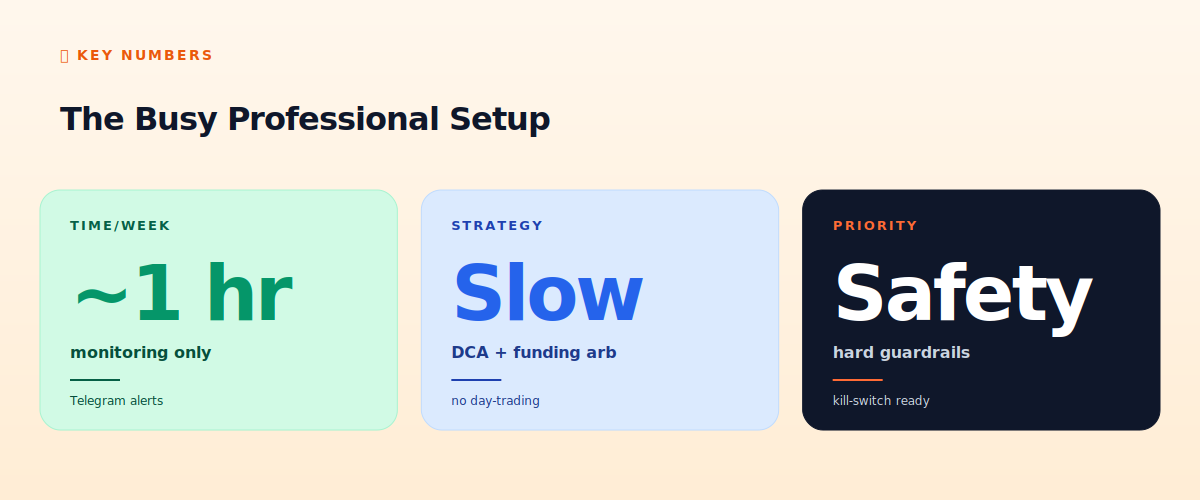
- The constraint: a demanding job, ~1 hour/week for trading. Plan around it.
- Wrong approach: trying to day-trade around your job. Stress + losses.
- Right approach: slow automated strategies + hard guardrails + phone monitoring.
- Best fit: DCA and funding rate arbitrage — minimal attention needed.
- Essential: Telegram alerts and a kill-switch you can hit from your phone.
- Mindset: supervise lightly; don't micromanage. Let the guardrails do the work.
The busy professional setup
The wrong approach (and why)
The trap many professionals fall into: trying to actively trade around their job — checking charts between meetings, placing trades on lunch breaks, glancing at prices during their commute. This fails for two reasons. First, it's stressful and distracting, hurting both your trading and your job. Second, fragmented attention is terrible for trading — you'll make impulsive decisions, miss exits, and react emotionally to the moves you happen to catch. Active trading demands sustained focus you don't have. Trying to force it around a busy life produces the worst of both worlds.
The right approach: automate and supervise
The fit for a busy professional is automation that runs without you, secured by guardrails so it can't hurt you much, and monitored lightly from your phone. You're not the trader making minute-by-minute decisions — the bot is, within strict limits you set, and you're the supervisor checking that everything's healthy. This is exactly what OpenClaw is good at: judgment-driven, slower strategies that don't need constant attention (unlike scalping, which it can't do anyway — see our scalping guide). Set it up well, and it works while you work.
The strategies that fit
Slow, low-attention strategies are the match:
- DCA (guide): the lowest-attention option. Scheduled buys accumulating a long-term position. Check it monthly.
- Funding rate arbitrage (guide): a market-neutral strategy on 8-hour cycles. Needs more monitoring than DCA (margin health) but far less than active trading. The bot manages it; you supervise.
- A conservative grid (guide) on a ranging pair, with OpenClaw's regime detection to pause it in trends. More involved, but still hands-off day-to-day.
All of these run on timeframes (hours to days) that don't require you to watch them. What they do require is good initial setup and reliable monitoring.
The non-negotiable safety setup
Because you're not watching closely, your guardrails must be excellent — they're doing the supervising you can't. Essentials:
- Hard guardrails from our hardening checklist: per-trade risk cap (1%), daily-loss kill-switch, position-size limits no signal can override.
- Telegram alerts (guide) for every trade, daily P&L, errors, and — critically — a heartbeat so you know the bot is alive.
- A phone kill-switch: a 'close all' command you can send from Telegram to flatten everything instantly if something feels wrong. Test it before you need it.
- Trade-only API keys (never withdrawal-enabled) so a compromise can't drain you.
- Conservative capital allocation: only deploy what you can afford to lose entirely, since you're not watching minute-by-minute.
The weekly routine
A realistic weekly rhythm for a busy professional: a few minutes daily glancing at Telegram alerts (is the heartbeat coming? any errors?), and about 30-60 minutes once a week reviewing performance, checking that strategies still suit current conditions, and confirming the guardrails are working. That's it. If you find yourself needing to monitor more than that, your setup is too active for your life — simplify it. The goal is a system robust enough that an hour a week of supervision is genuinely enough.
Honest expectations
A busy professional with a well-automated, conservative setup can realistically: deploy capital into slow strategies, earn modest returns in favorable conditions (or modest losses in unfavorable ones — remember the 70-84% reality), and do it without it consuming their life or threatening their finances. What they cannot do: generate large returns from minimal attention, or beat the market through automation (AI doesn't confer alpha — see state of AI agents). If your day job is your main income, treat trading as a small, automated experiment, not a second salary. The professionals who do this well keep it small, safe, and supervised — and never let it interfere with the career that actually pays them.
The honest verdict
For the busy professional, OpenClaw works as a set-and-monitor system, not an active-trading hobby you cram around meetings. Choose slow strategies (DCA, funding arbitrage), build excellent guardrails since they're doing the supervising, monitor lightly via Telegram with a phone kill-switch ready, and keep the capital small and safe. Spend an hour a week, not an hour a day. Done this way, automated trading can fit a demanding life without dominating it — but keep expectations modest, your day job primary, and your guardrails airtight.
📧 Get every new tutorial in your inbox
One email per week. Tutorials, CVE disclosures, broker updates. Unsubscribe in one click.
(Connect FluentCRM / ConvertKit / Beehiiv form here)
Frequently asked questions
Can I trade with a full-time job?
Yes, but not by day-trading around it — that's stressful and loss-prone. The fit is slow automated strategies with hard guardrails and light phone monitoring (~1 hour/week).
What strategies suit busy people?
DCA (lowest attention), funding rate arbitrage (8-hour cycles, more monitoring), or a conservative regime-aware grid. All run on timeframes that don't need watching.
What's the most important setup element?
Guardrails — they do the supervising you can't. Per-trade risk caps, a daily-loss kill-switch, Telegram alerts with a heartbeat, and a phone-based 'close all' command.
How much time does it really take?
A few minutes daily for alerts, plus ~30-60 minutes weekly for review. If you need more, your setup is too active for your life — simplify it.
Can this replace my salary?
No. AI doesn't confer alpha, and minimal attention can't generate large returns. Treat it as a small automated experiment, not a second income. Keep your day job primary.
What to read next
- Telegram Bot Integration
- Funding Rate Arbitrage
- The 12-Point Hardening Checklist
- DCA Bots: Automating Dollar-Cost Averaging
Sources cited: The Hacker News (CVE-2026-25253 disclosure, Feb 2026); Conscia 2026 OpenClaw Security Crisis advisory; Snyk ToxicSkills study; Cyber Press ClawHavoc reporting; Wall Street Journal Polymarket profitability analysis (May 2026); Andrey Sergeenkov via The Defiant (April 2026); Akey, Grégoire, Harvie & Martineau, SSRN paper (March 2026); openclaw.ai official advisories; Peter Steinberger public statements on X. OpenClaw automation patterns; retail loss-rate disclosures.