Risk disclosure: Independent research finds 70–84% of Polymarket traders lose money (Sergeenkov, April 2026; Akey et al., SSRN, March 2026). Forex CFDs: 70–85% retail loss rate. Binary options: 80%+ in most jurisdictions. AI agents don't change these baselines. Full disclaimer. Security context: Three critical CVEs disclosed in OpenClaw in Q1 2026 (CVE-2026-25253, CVE-2026-32922) plus the ClawHavoc supply-chain attack (1,184 malicious skills). Always run v2026.4.12 or later. Full security assessment.
DCA bots automate the simplest, most beginner-friendly strategy in trading: dollar-cost averaging. Buy a fixed amount at regular intervals, regardless of price. No prediction, no timing, no clever signals — just disciplined, automatic accumulation. It's boring, and that's exactly why it works for most people. This guide covers how to build a DCA bot in OpenClaw, when DCA makes sense, and the honest limits.
After the complex strategies in this series, DCA is a refreshing reminder: the best strategy for most people is often the simplest one they'll actually stick with.
TL;DR — The 30-second answer
- The idea: buy a fixed amount at regular intervals, regardless of price.
- Why it works: removes timing decisions and emotion; smooths entry price.
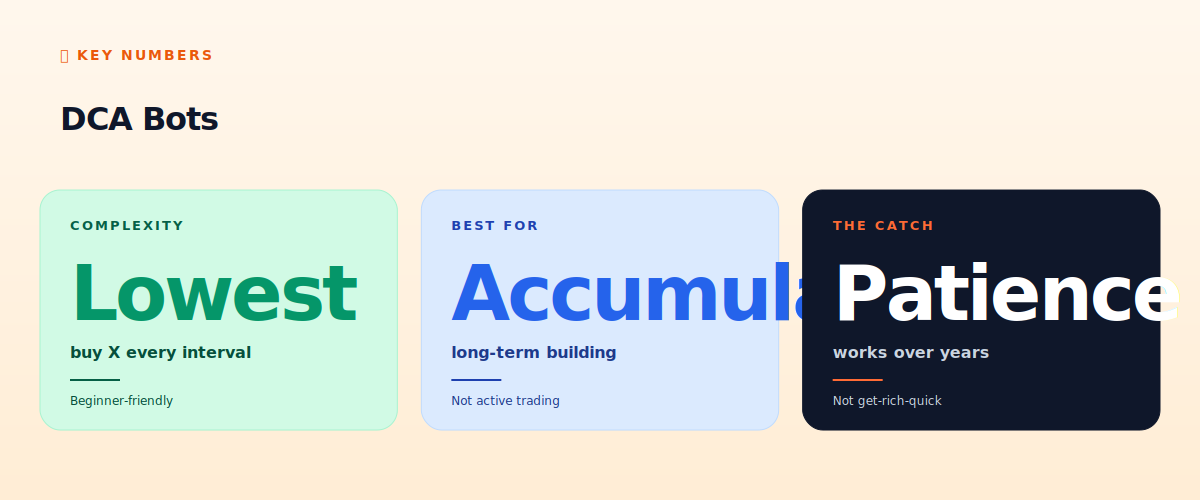
- Best for: long-term accumulation, not active trading.
- The advantage: simplest possible bot; nearly impossible to get catastrophically wrong.
- The catch: works over years, not weeks. Not get-rich-quick.
- OpenClaw fit: trivially easy — the simplest useful bot you can build.
DCA in one image
How DCA works
Dollar-cost averaging means investing a fixed dollar amount at regular intervals — say, $100 of BTC every week — regardless of the price. When BTC is expensive, your $100 buys less; when it's cheap, your $100 buys more. Over time, this averages out your entry price and removes the impossible task of timing the market. You never buy everything at the top, and you never need to predict the bottom. We covered the DCA-vs-lump-sum data in our comparison; here we focus on automating it.
Why a bot helps
DCA's whole value is discipline — buying consistently regardless of how you feel about the market. And discipline is exactly what humans are bad at. When BTC crashes 30%, the manual DCA-er often skips the buy out of fear ('I'll wait for it to stabilize') — missing the cheap purchase that's the entire point of DCA. When BTC pumps, they're tempted to buy extra (abandoning the fixed amount). A bot removes this: it buys $100 every week, mechanically, whether the market is euphoric or terrifying. The bot enforces the discipline the human lacks.
Building a DCA bot in OpenClaw
This is the simplest useful bot you can build. A conceptual OpenClaw DCA skill:
---
name: dca-bot
description: "Buy a fixed USD amount of an asset on a fixed schedule."
trigger: "dca buy|scheduled purchase"
---
On schedule (e.g. every Monday 9am via cron):
1. Check available USD balance.
2. If sufficient, place market buy for $100 of BTC.
3. Log the purchase (price, amount, timestamp).
4. Alert via Telegram with running average cost.
5. If balance insufficient, alert to top up.
That's essentially it. No regime detection, no signals, no complex logic. The cron schedule triggers the buy; the bot executes and logs. It's nearly impossible to get catastrophically wrong — the worst case is buying at a temporarily high price, which DCA's whole design absorbs. Compare this to a grid or momentum bot, where a misjudged regime can cause real damage. DCA's simplicity is its safety.
Variations
- Value-averaging: adjust the buy amount inversely to recent performance — buy more after dips, less after pumps. Slightly more sophisticated, captures more of the 'buy low' benefit.
- Dip-enhanced DCA: buy the regular amount on schedule, plus an extra buy if price drops more than X% from a recent high. Adds opportunistic accumulation.
- Multi-asset DCA: split the fixed amount across several assets (e.g. 60% BTC, 30% ETH, 10% others) for diversified accumulation.
OpenClaw can handle any of these — but resist the urge to over-engineer. Plain DCA's strength is its simplicity. Each 'enhancement' adds a decision that can be wrong. For most people, plain scheduled buying beats clever variations they'll second-guess.
The honest limits
DCA is not a trading strategy that generates alpha — it's an accumulation discipline. It works over years, not weeks. If you DCA into BTC for a month and it falls, DCA hasn't 'failed' — you've just started accumulating at lower prices, which is the point. DCA assumes the asset rises over your long horizon; if the asset goes to zero, DCA into it just means losing money steadily. So DCA suits assets you have long-term conviction in, not speculative tokens you're gambling on. And it's emphatically not get-rich-quick — it's get-rich-slowly-and-boringly, which is the only kind that reliably works for most people.
The honest verdict
DCA bots are the strategy we'd most readily recommend to a genuine beginner. They're simple, hard to break, emotionally sustainable, and grounded in solid evidence. They won't make you rich quickly — nothing reliably does — but they'll let you accumulate an asset you believe in without the timing stress and emotional mistakes that sink active traders. After all the complex strategies in this series, there's something honest about the simplest one being the best fit for most people. Build a DCA bot, automate the discipline, and let boring compound over years.
📧 Get every new tutorial in your inbox
One email per week. Tutorials, CVE disclosures, broker updates. Unsubscribe in one click.
(Connect FluentCRM / ConvertKit / Beehiiv form here)
Frequently asked questions
What is a DCA bot?
A bot that buys a fixed dollar amount of an asset at regular intervals regardless of price — automating dollar-cost averaging. The simplest useful trading bot.
Why use a bot instead of doing it manually?
Discipline. Humans skip buys when scared (crashes) or buy extra when greedy (pumps) — defeating DCA's purpose. A bot buys mechanically regardless of emotion.
Is DCA a good strategy?
For long-term accumulation of an asset you believe in, yes — simple, emotionally sustainable, evidence-backed. It's not active trading and won't generate alpha or quick riches.
How long does DCA take to work?
Years, not weeks. DCA assumes the asset rises over your long horizon. A month of falling prices isn't failure — it's accumulating cheaper.
Should I use enhanced DCA variations?
Usually not. Plain scheduled buying's strength is simplicity. Each 'enhancement' adds a decision that can be wrong. Resist over-engineering.
What to read next
- DCA vs Lump Sum: What the Data Says
- Grid Trading with OpenClaw
- Building a Multi-Strategy Portfolio
- What Is OpenClaw?
Sources cited: The Hacker News (CVE-2026-25253 disclosure, Feb 2026); Conscia 2026 OpenClaw Security Crisis advisory; Snyk ToxicSkills study; Cyber Press ClawHavoc reporting; Wall Street Journal Polymarket profitability analysis (May 2026); Andrey Sergeenkov via The Defiant (April 2026); Akey, Grégoire, Harvie & Martineau, SSRN paper (March 2026); openclaw.ai official advisories; Peter Steinberger public statements on X. dollar-cost averaging research; Vanguard DCA study.