Risk disclosure: Independent research finds 70–84% of Polymarket traders lose money (Sergeenkov, April 2026; Akey et al., SSRN, March 2026). Forex CFDs: 70–85% retail loss rate. Binary options: 80%+ in most jurisdictions. AI agents don't change these baselines. Full disclaimer. Security context: Three critical CVEs disclosed in OpenClaw in Q1 2026 (CVE-2026-25253, CVE-2026-32922) plus the ClawHavoc supply-chain attack (1,184 malicious skills). Always run v2026.4.12 or later. Full security assessment.
If you're a developer, OpenClaw is more than a tool to configure — it's a platform to build on. You can write custom skills, integrate any API, backtest your systematic logic, and create exactly the trading system you envision rather than settling for off-the-shelf bots. This walkthrough is for coders who want to build. It covers the developer's path: custom skills, the right tooling, backtesting the systematic core, and the security discipline that matters doubly when you're writing code that touches money.
Your coding ability is a genuine edge here — not in predicting markets (no one does that reliably), but in building robust, custom, well-tested systems that execute your strategy precisely and safely. Let's use it well.
TL;DR — The 30-second answer
- Your edge: building custom skills and systems, not market prediction.
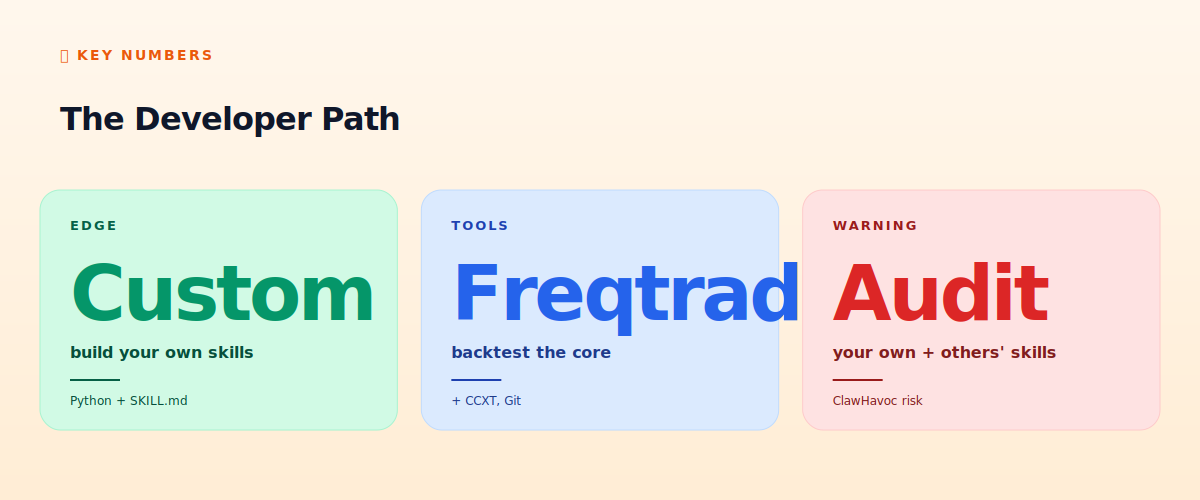
- Custom skills: SKILL.md + Python lets you implement any logic you can code.
- Backtest the systematic core in Freqtrade/Backtrader (the LLM layer can't be backtested cleanly).
- Tooling: CCXT, Git for version control, VS Code, a paper-trading harness.
- Security doubles in importance: audit others' skills AND review your own.
- The discipline: code can have bugs that lose money — test relentlessly.
The developer path
Where your coding ability actually helps
First, an honest framing: being a developer does not give you an edge in predicting markets. Code can't forecast prices any better than anything else — markets are adversarial and efficient enough that no amount of clever programming finds reliable alpha (see hype vs reality). Where your skills genuinely help is in execution and systems: building robust bots, implementing precise strategy logic, integrating data sources, automating monitoring, backtesting rigorously, and avoiding the bugs and operational failures that sink less careful traders. You build a better machine to execute whatever edge you have — the machine isn't the edge itself.
Building custom skills
OpenClaw's skill system is where developers shine. A skill is a SKILL.md file (defining the skill's purpose, triggers, and permissions) plus the logic to execute it. You can implement any strategy you can code: custom indicators, multi-exchange logic, bespoke risk rules, integrations with any API. Rather than using a community grid skill, you write your own grid skill exactly to your specifications — with your regime detection, your guardrails, your logging. This control is the developer's advantage: the bot does precisely what you designed, not what someone else's general-purpose skill assumes.
Start by studying the skill structure (our OpenClaw overview covers the basics), then build incrementally: a simple skill first (a DCA buy on schedule), test it thoroughly in paper mode, then add complexity. Treat skills like any production code — version controlled, tested, reviewed.
Backtesting the systematic core
Here's a key developer insight: OpenClaw's LLM-driven decisions can't be backtested cleanly (they're non-deterministic — see our backtesting guide), but the systematic parts of your strategy can and should be. Extract the deterministic logic — entry/exit rules, indicators, position sizing — and backtest it rigorously in Freqtrade or Backtrader. Use walk-forward analysis to avoid overfitting. Once you've validated the systematic core mathematically, layer the LLM judgment on top for the parts that need flexibility (regime assessment, news interpretation), and forward-test the complete system in paper mode. This hybrid approach plays to both the developer's rigor and OpenClaw's reasoning.
The developer's toolkit
- CCXT (deep dive): the standard library for exchange integration. Free, covers 120+ exchanges.
- Git: version control your skills and strategies. Essential — you'll want to track changes and roll back bad ones.
- Freqtrade / Backtrader: backtest the systematic core (guide).
- A paper-trading harness: run your bot against live data without real money. Your primary validation tool.
- Python data stack (pandas, numpy, ta-lib): for analysis and indicator computation.
- Logging and monitoring: structured logs plus Telegram alerts (guide) so you can debug and supervise.
Security: doubly important for developers
As a developer, security cuts two ways, and both matter:
- Auditing others' skills. The ClawHavoc incident (1,184 malicious skills — see our audit guide) means any community skill you install could be malicious. As a developer you can actually read the code — use that ability. Audit before installing.
- Reviewing your own code. Your bugs can lose money just as surely as malice. A logic error in position sizing, a mishandled API response, an off-by-one in a loop — any can cause real losses. Test relentlessly, especially the risk-management code. A bug in your stop-loss logic is catastrophic.
Follow the full hardening checklist, use trade-only API keys, isolate the bot, and treat money-touching code with the seriousness it deserves. Developers sometimes over-trust their own code — resist that. Your code is exactly as fallible as any other, and the cost of bugs here is direct financial loss.
The honest verdict
For developers, OpenClaw is a powerful platform to build exactly the trading system you want — custom skills, precise logic, rigorous backtesting of the systematic core, and full control. Your coding ability is a real advantage in building robust, well-tested, safe systems. But hold the honest line: that ability helps you execute a strategy better, not predict markets (which no code can do reliably). Build incrementally, backtest the deterministic parts, paper-test the whole, audit others' skills and review your own ruthlessly, and respect that money-touching code demands production-grade discipline. The developer who builds carefully has a genuine operational edge; the one who over-trusts hasty code has a fast way to lose money with elegant bugs.
📧 Get every new tutorial in your inbox
One email per week. Tutorials, CVE disclosures, broker updates. Unsubscribe in one click.
(Connect FluentCRM / ConvertKit / Beehiiv form here)
Frequently asked questions
Does being a developer give me a trading edge?
Not in predicting markets — no code does that reliably. Your edge is building robust, precise, well-tested execution systems and avoiding the bugs and failures that sink careless traders.
How do I build a custom OpenClaw skill?
A skill is a SKILL.md (purpose, triggers, permissions) plus logic. Start simple (a scheduled DCA buy), test in paper mode, then add complexity. Treat it like production code.
Can I backtest my OpenClaw strategy?
The LLM-driven parts can't be backtested cleanly (non-deterministic). Extract the systematic core and backtest it in Freqtrade/Backtrader with walk-forward analysis, then paper-test the full system.
What tools do I need?
CCXT (exchange integration), Git (version control), Freqtrade/Backtrader (backtesting), a paper-trading harness, the Python data stack, and structured logging plus Telegram alerts.
What security matters for developers?
Both auditing others' skills (ClawHavoc risk — read the code before installing) and reviewing your own (bugs in money-touching code lose money). Test risk-management logic relentlessly.
What to read next
- CCXT Skill Deep Dive
- Backtesting with OpenClaw: Tools & Limits
- Spot a Malicious Skill in 60 Seconds
- Freqtrade vs OpenClaw
Sources cited: The Hacker News (CVE-2026-25253 disclosure, Feb 2026); Conscia 2026 OpenClaw Security Crisis advisory; Snyk ToxicSkills study; Cyber Press ClawHavoc reporting; Wall Street Journal Polymarket profitability analysis (May 2026); Andrey Sergeenkov via The Defiant (April 2026); Akey, Grégoire, Harvie & Martineau, SSRN paper (March 2026); openclaw.ai official advisories; Peter Steinberger public statements on X. OpenClaw skill documentation; ClawHavoc disclosures; backtesting literature.