Risk disclosure: Independent research finds 70–84% of Polymarket traders lose money (Sergeenkov, April 2026; Akey et al., SSRN, March 2026). Forex CFDs: 70–85% retail loss rate. Binary options: 80%+ in most jurisdictions. AI agents don't change these baselines. Full disclaimer. Security context: Three critical CVEs disclosed in OpenClaw in Q1 2026 (CVE-2026-25253, CVE-2026-32922) plus the ClawHavoc supply-chain attack (1,184 malicious skills). Always run v2026.4.12 or later. Full security assessment. Affiliate disclosure: Links to brokers (Exness, Deriv, Binance, Bybit, OKX, IQ Option, Pocket Option, Quotex) may earn us a referral commission. Your costs don't change. Our ratings don't either.
If you already trade forex and want to automate a strategy through OpenClaw, this walkthrough is for you. Forex automation with OpenClaw works through the MT5 HTTP bridge — connecting your agent to a MetaTrader 5 account so it can execute trades. This guide covers the practical realities: setting up the bridge, lot sizing and risk, session timing, the cost of swaps, and the honest limits of automating forex with an LLM-driven agent.
We assume you understand forex basics (pips, lots, leverage) from our beginner series. This is about connecting that knowledge to automated execution through OpenClaw, with realistic expectations about what works.
TL;DR — The 30-second answer
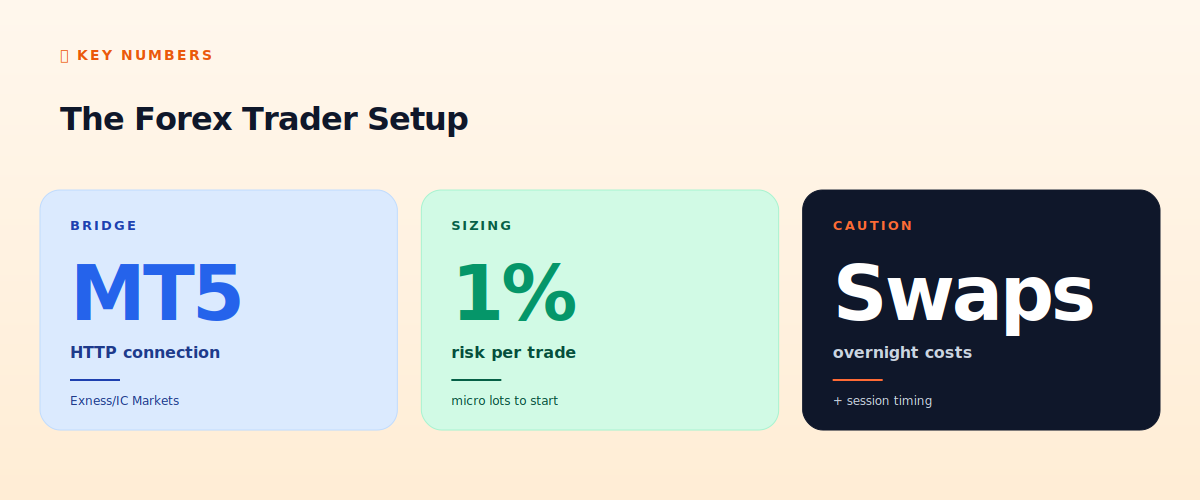
- The connection: OpenClaw to MT5 via the HTTP bridge (Exness, IC Markets, etc.).
- Sizing: the 1% rule, micro lots to start (see pips and risk-of-ruin guides).
- Session timing matters: liquidity and volatility vary by trading session.
- Watch swaps: overnight holding costs can erode a strategy held for days.
- OpenClaw fit: good for slower forex strategies; not for scalping (latency).
- Honest limit: automation executes your edge; it doesn't create one.
The forex trader setup
How OpenClaw connects to forex
Forex trades through brokers using the MetaTrader platform, and OpenClaw connects via the MT5 HTTP bridge — a connection that lets your agent send orders to your MetaTrader 5 account programmatically. We cover the technical setup in detail in our MT5 bridge guide; the short version: you run a bridge that exposes your MT5 account to OpenClaw over HTTP, with appropriate security, so the agent can read prices and place/manage orders. Your broker (Exness, IC Markets, Pepperstone — see our reviews) needs to support MT5, which most major forex brokers do.
Lot sizing and risk — the foundation
Before automating anything, get sizing right — it matters more than your strategy (see risk of ruin). For automated forex:
- Apply the 1% rule: risk no more than 1% of your account per trade. Your bot computes position size so that the distance to your stop-loss equals 1% of the account (using pip value — see our pip guide).
- Start with micro lots (~$0.10/pip). Even while you validate the automated strategy, micro lots keep mistakes survivable.
- Hard-code the sizing logic so no signal can produce an oversized position. The bot calculates lots from account size, stop distance, and the 1% rule — never a fixed large lot.
This connects directly to our lot sizing guide, which works through the calculations. Automated forex without disciplined sizing is automated ruin.
Session timing
Forex trades 24/5 across global sessions (Sydney, Tokyo, London, New York), and conditions vary significantly by session. The London and New York sessions (and especially their overlap) have the highest liquidity and volatility; the Asian session is quieter for major pairs. This matters for automation: a strategy that works in liquid London hours may perform poorly in thin Asian hours (wider spreads, more slippage). Your OpenClaw bot can be session-aware — trading only during favorable sessions for your strategy, or adjusting behavior by session. The LLM can reason about session context, which a simple mechanical bot handles poorly. Build session awareness into your forex automation.
The swap cost trap
A forex-specific cost that catches automated traders: swaps (overnight rollover fees). Holding a leveraged forex position overnight incurs a swap charge based on the interest-rate differential between the two currencies (see our fees guide). For a strategy that holds positions for days or weeks, swaps accumulate and can quietly erode or eliminate your edge. A strategy that looks profitable on price moves alone can be unprofitable once swaps are counted. Your bot must account for swap costs in evaluating whether a multi-day position is worth holding — ignoring them is a common automated-forex mistake.
Where OpenClaw fits in forex
OpenClaw suits slower forex strategies — swing trades held hours to days, trend-following, session-based approaches — where its 1.5-3 second decision latency is irrelevant. It does not suit scalping (see our scalping guide) — the latency makes sub-second forex scalping impossible. So match your automated forex strategy to OpenClaw's pace: it can manage a momentum or swing strategy with good judgment (regime awareness, news avoidance via economic calendar checks), but it can't fire off rapid scalps. Play to the strength: judgment-driven, slower forex trading.
The honest limits
The same honest truth applies as everywhere: automating your forex strategy doesn't create an edge — it executes whatever edge (or lack of one) you bring. If your manual forex trading loses money, automating it loses money faster and more consistently. Automation's benefits are real but specific: consistent execution without emotional deviation, the ability to monitor and act across sessions you can't watch, disciplined sizing and stops, and freedom from screen-watching. But forex retail loss rates (70-85% — see broker disclosures in our reviews) don't improve through automation. Automate a strategy you've validated, not a hope.
The honest verdict
For the forex trader, OpenClaw automates execution through the MT5 HTTP bridge — suitable for slower, judgment-driven strategies (swing, trend, session-based), not scalping. Get lot sizing right first (1% rule, micro lots, hard-coded), build session awareness, account for swap costs, and use the LLM's judgment for regime and news. But hold the line: automation executes your edge, it doesn't manufacture one. If you have a validated forex strategy, OpenClaw can run it more consistently than you would manually; if you don't, no bridge or bot changes the 70-85% loss reality. Automate validated edges, size with discipline, and respect the costs.
📧 Get every new tutorial in your inbox
One email per week. Tutorials, CVE disclosures, broker updates. Unsubscribe in one click.
(Connect FluentCRM / ConvertKit / Beehiiv form here)
Frequently asked questions
How does OpenClaw trade forex?
Through the MT5 HTTP bridge — a connection letting the agent send orders to your MetaTrader 5 account. Your broker (Exness, IC Markets, etc.) needs MT5 support, which most major forex brokers have.
What's the most important thing in automated forex?
Lot sizing. Apply the 1% rule (risk 1% per trade), start with micro lots, and hard-code the sizing so no signal produces an oversized position. Sizing matters more than strategy.
Why does session timing matter?
Forex conditions vary by session — London/New York have high liquidity, the Asian session is thinner for majors. A strategy can perform differently by session; build session awareness into the bot.
What are swap costs?
Overnight rollover fees on leveraged forex positions, based on interest-rate differentials. They accumulate over days/weeks and can erode an edge. The bot must account for them on multi-day positions.
Can OpenClaw scalp forex?
No — LLM latency (1.5-3s) makes sub-second forex scalping impossible. OpenClaw suits slower strategies (swing, trend, session-based) where judgment matters more than speed.
What to read next
- OpenClaw MT5 HTTP Bridge Setup
- Forex Lot Sizing & Risk Management
- Forex Strategies That Actually Work
- Reading an Economic Calendar
Sources cited: The Hacker News (CVE-2026-25253 disclosure, Feb 2026); Conscia 2026 OpenClaw Security Crisis advisory; Snyk ToxicSkills study; Cyber Press ClawHavoc reporting; Wall Street Journal Polymarket profitability analysis (May 2026); Andrey Sergeenkov via The Defiant (April 2026); Akey, Grégoire, Harvie & Martineau, SSRN paper (March 2026); openclaw.ai official advisories; Peter Steinberger public statements on X. MT5 bridge documentation; forex broker disclosures; forex session and swap mechanics.