Risk disclosure: Independent research finds 70–84% of Polymarket traders lose money (Sergeenkov, April 2026; Akey et al., SSRN, March 2026). Forex CFDs: 70–85% retail loss rate. Binary options: 80%+ in most jurisdictions. AI agents don't change these baselines. Full disclaimer.
Markets move on information, and the most predictable bursts of volatility come from scheduled economic data releases. An economic calendar lists when these market-moving events happen — jobs reports, inflation data, central bank decisions — so you're never blindsided. This guide explains the key high-impact events (NFP, CPI, FOMC), how to read an economic calendar, and the honest truth about trading around news (mostly: don't, as a beginner).
Even if you never trade the news directly, knowing when these events hit lets you avoid getting caught in violent moves — which is reason enough to keep a calendar open.
TL;DR — The 30-second answer
- An economic calendar lists scheduled data releases that move markets.
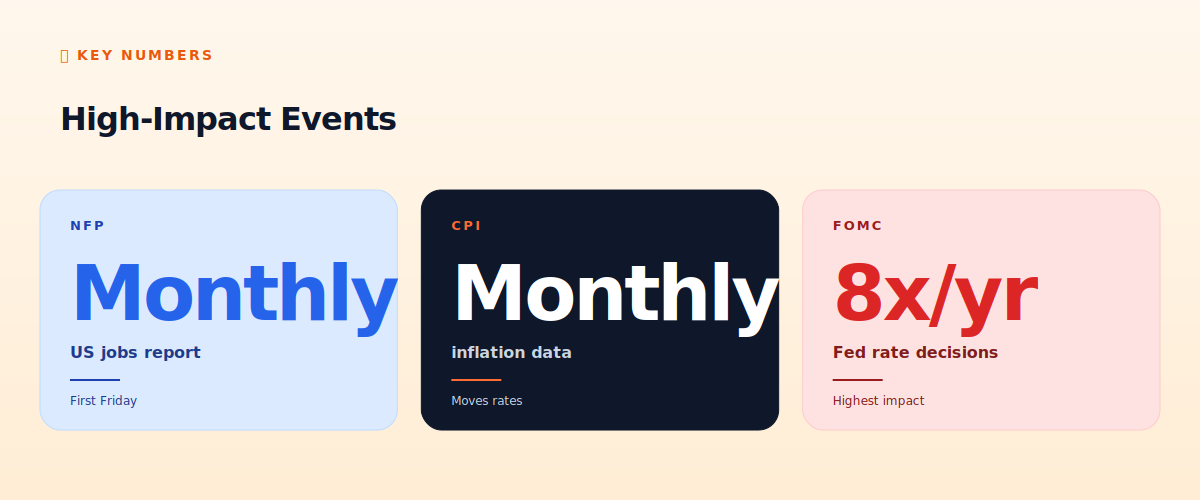
- NFP: US Non-Farm Payrolls (monthly jobs report). High forex/index impact.
- CPI: inflation data. Moves interest-rate expectations and everything tied to them.
- FOMC: US Federal Reserve rate decisions. The highest-impact event.
- Volatility spikes around these releases — spreads widen, slippage jumps.
- Beginner advice: usually step aside around major news rather than trade it.
The high-impact events
What an economic calendar is
An economic calendar is a schedule of upcoming economic data releases and events, with their expected market impact. Free versions are available on most financial sites (Forex Factory, Investing.com, and others). Each entry typically shows: the event name, the date and time, the affected currency/market, the impact level (often color-coded low/medium/high), the previous value, the forecast (what analysts expect), and after release, the actual value. The gap between forecast and actual is usually what moves markets — a surprise, not the number itself.
NFP — Non-Farm Payrolls
The US Non-Farm Payrolls report, released on the first Friday of each month, measures how many jobs the US economy added (excluding farm work). It's one of the most-watched indicators because employment signals economic health and influences Federal Reserve policy. NFP releases routinely cause sharp, fast moves in forex (especially USD pairs), gold, and stock indices. The volatility in the minutes around NFP is intense — spreads widen, prices whipsaw, and slippage spikes. It's a classic 'high impact' calendar event.
CPI — Consumer Price Index
CPI measures inflation — how much consumer prices have risen. It's become especially market-moving in the current era because inflation drives central bank interest-rate decisions, and rates drive virtually everything (currencies, bonds, stocks, crypto). A hotter-than-expected CPI suggests rates may stay high or rise (often bad for risk assets); a cooler reading suggests rates may fall (often good for risk assets). CPI releases move markets sharply, and the reaction ripples across asset classes because of the rate-expectation channel.
FOMC — Federal Reserve decisions
The FOMC (Federal Open Market Committee) sets US interest rates, meeting eight times a year. These are arguably the highest-impact scheduled events in global markets. The rate decision itself, plus the accompanying statement and the Fed Chair's press conference, can move every asset class violently. Because US rates anchor global finance, FOMC decisions ripple worldwide — affecting forex, crypto, stocks, and commodities everywhere, including the markets our audience trades. The press conference often moves markets as much as the decision, as traders parse every word for future-rate hints.
Other central banks (ECB, Bank of England, etc.) have equivalent high-impact decisions for their currencies, but the Fed's reach is global.
Why volatility spikes around news
Before a major release, the market is uncertain — traders hold off, liquidity thins. At the release, the actual number hits, and if it differs from the forecast, everyone reacts at once: a flood of orders, rapid repricing, and a violent move. In these moments, spreads widen dramatically (the order book thins and re-forms), slippage spikes, and stop-losses can be triggered at much worse prices than set (or 'gapped' past entirely). It's the most treacherous time to have an unmanaged position.
Should you trade the news?
Honest beginner advice: usually not. Trading news releases is tempting — big moves look like big opportunities — but it's one of the hardest things in trading:
- The move is unpredictable. Even if you correctly guess the data, the market reaction can be counterintuitive (markets often 'price in' expectations and move opposite to the obvious read).
- Slippage and spreads are brutal. You may get filled far from your intended price; stops may not protect you as expected.
- Speed matters. The big move happens in seconds — you're competing with algorithms reacting in milliseconds.
For most beginners and most bots, the sound approach is to step aside around major news: avoid opening new positions just before high-impact releases, and consider reducing exposure or widening stops on existing positions. Many OpenClaw traders build news-awareness into their bots — checking the economic calendar and pausing trading around high-impact events to avoid the slippage and whipsaw. That's using the calendar defensively, which is the wise use for most.
Using the calendar with OpenClaw
A practical OpenClaw use: a skill that checks an economic calendar and pauses or de-risks trading around high-impact events. Before the bot opens a position, it can verify no major release is imminent; if NFP or FOMC is minutes away, it holds off. This avoids the worst slippage and whipsaw. It's a good example of OpenClaw's strength — the LLM can read a calendar, assess event impact, and reason about whether to trade, which a simple mechanical bot can't easily do. We touch on integrating data sources in our free tools guide.
The honest verdict
An economic calendar is essential awareness even if you never trade the news. The big three — NFP, CPI, FOMC — cause predictable volatility spikes that can blindside the unprepared, triggering stops at terrible prices and whipsawing positions. For beginners, the calendar's main value is defensive: know when the storms are coming, and step aside or de-risk rather than trying to trade them. Leave news trading to the experienced and the fast. Keep a calendar open, respect the high-impact events, and let the volatility pass before resuming. That discipline alone saves more money than most 'news trading strategies' ever make.
📧 Get every new tutorial in your inbox
One email per week. Tutorials, CVE disclosures, broker updates. Unsubscribe in one click.
(Connect FluentCRM / ConvertKit / Beehiiv form here)
Frequently asked questions
What is an economic calendar?
A schedule of upcoming market-moving data releases — jobs reports, inflation, central bank decisions — showing date, time, expected impact, forecast, and actual values. Free versions are widely available.
What are NFP, CPI, and FOMC?
NFP is the US monthly jobs report (first Friday). CPI is inflation data (drives rate expectations). FOMC is the US Fed's rate decisions (8x/year, highest impact). All cause sharp volatility.
Why does volatility spike around news?
Before release, liquidity thins as traders wait. At release, if the actual differs from forecast, everyone reacts at once — rapid repricing, widened spreads, and spiking slippage.
Should beginners trade the news?
Usually not. Reactions are unpredictable, slippage and spreads are brutal, and you compete with millisecond algorithms. The wise use is defensive — step aside around major releases.
How can OpenClaw use an economic calendar?
A skill can check the calendar and pause or de-risk trading around high-impact events, avoiding the worst slippage and whipsaw. The LLM can read and assess event impact a mechanical bot can't.
What to read next
- What Is Slippage?
- Understanding the Order Book & Market Depth
- Best Free Trading Tools
- Forex Strategies That Actually Work
Sources cited: The Hacker News (CVE-2026-25253 disclosure, Feb 2026); Conscia 2026 OpenClaw Security Crisis advisory; Snyk ToxicSkills study; Cyber Press ClawHavoc reporting; Wall Street Journal Polymarket profitability analysis (May 2026); Andrey Sergeenkov via The Defiant (April 2026); Akey, Grégoire, Harvie & Martineau, SSRN paper (March 2026); openclaw.ai official advisories; Peter Steinberger public statements on X. economic indicator definitions; central bank publications.