Risk disclosure: Independent research finds 70–84% of Polymarket traders lose money (Sergeenkov, April 2026; Akey et al., SSRN, March 2026). Forex CFDs: 70–85% retail loss rate. Binary options: 80%+ in most jurisdictions. AI agents don't change these baselines. Full disclaimer. Security context: Three critical CVEs disclosed in OpenClaw in Q1 2026 (CVE-2026-25253, CVE-2026-32922) plus the ClawHavoc supply-chain attack (1,184 malicious skills). Always run v2026.4.12 or later. Full security assessment. Affiliate disclosure: Links to brokers (Exness, Deriv, Binance, Bybit, OKX, IQ Option, Pocket Option, Quotex) may earn us a referral commission. Your costs don't change. Our ratings don't either.
You have $100 and you're curious about OpenClaw. What can you realistically do? This walkthrough is for the genuine beginner starting with a small amount — and it's going to be honest in a way most 'turn $100 into $10,000' content isn't. With $100, your goal is not to get rich. Your goal is to learn the craft while losing as little as possible, treating that $100 as tuition. Here's a grounded starter plan that does exactly that.
We'll cover what $100 actually buys you, the realistic setup, the strategies that fit, and the expectations to hold. If you came looking for how to flip $100 into a fortune, this isn't that — because that doesn't exist. This is how to start sensibly.
TL;DR — The 30-second answer
- The honest goal with $100: learn, don't get rich. Treat it as tuition.
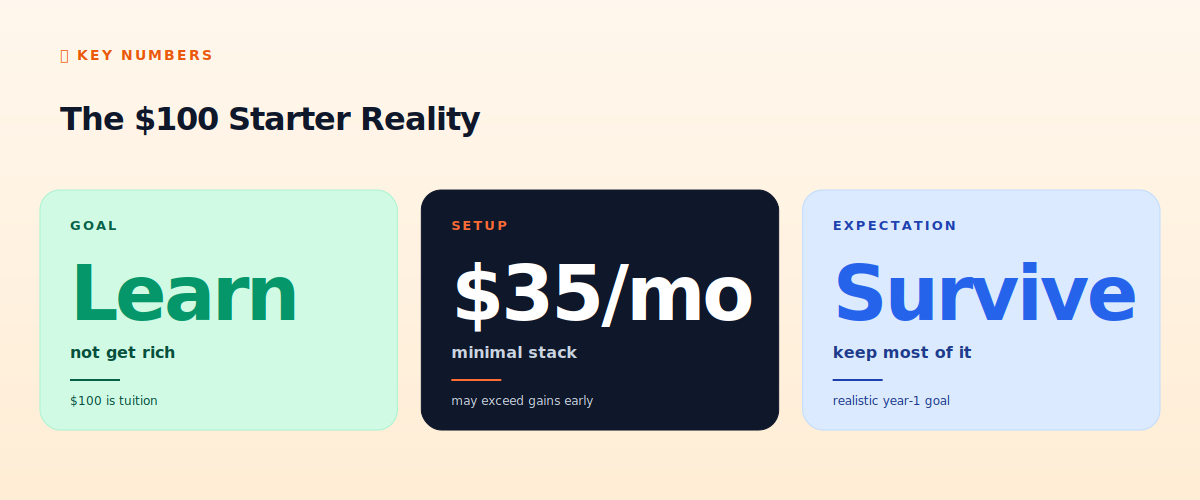
- The cost problem: a $35/mo OpenClaw setup may exceed your gains early on.
- Realistic year-1 target: survive, keep most of the $100, learn a lot.
- Best fit: paper trade first, then tiny spot positions or DCA.
- Avoid: leverage, 'recovery' systems, anything promising to multiply $100 fast.
- The real return on $100 is education, not profit — and that's fine.
The $100 reality
What $100 actually buys you
Let's be direct about the math. $100 is enough to learn, experiment, and make real (small) trades — but it is not enough to generate meaningful income, and the running costs of a serious OpenClaw setup will likely exceed any early gains. A minimal setup (Hetzner VPS + DeepSeek API + free tools) runs around $35/month (see our cost calculator). If you're trading $100 and paying $35/month in infrastructure, you'd need to earn 35% monthly just to cover costs — which is fantasy-land territory. So the first honest realization: at $100, the economics don't work for profit. That's okay, because profit isn't the point yet.
Reframe: $100 is tuition
The productive mindset: your $100 (and any modest setup cost) is the price of a hands-on education in automated trading. Compare it to a course — people pay hundreds for trading courses that teach less than you'll learn by actually running a small bot, watching it work, making mistakes, and understanding why 70-84% of retail loses (see hype vs reality). If you finish your first year having learned the craft and kept most of your $100, you've done better than the vast majority of beginners, who lose it all chasing the dream. Survival and learning are the win condition.
The realistic starter plan
- Phase 1 — Paper trade (weeks 1-4, $0 risked). Before risking a cent, run OpenClaw in paper mode. Learn the install (guide), build a simple bot, watch it trade fake money. This is free education — don't skip it.
- Phase 2 — Tiny real trades (months 2-3, $20-30 of the $100). Move a small slice to real trading. Spot only, no leverage. The point is experiencing real execution, fees, and slippage — not profit.
- Phase 3 — Reassess. After a few months, honestly evaluate: are you learning? Are you disciplined? Did you survive? If yes, you've built a foundation. If you blew up the $20-30, you learned a cheap lesson about your risk management before it cost real money.
Strategies that fit $100
With $100, keep it simple: spot trading (no leverage, no liquidation risk) and DCA (see our DCA guide) are the sensible fits. A DCA bot accumulating a small position teaches you automation with minimal risk. Avoid anything requiring more capital to make sense — grid trading needs room to work, funding arbitrage needs enough capital to clear fees, and leverage is how beginners turn $100 into $0. Match the strategy to the tiny capital: simple, spot, low-stakes.
What to absolutely avoid
- Leverage. At $100, leverage is a fast track to liquidation. A 10x position liquidates on a 10% move (see leverage guide). Don't.
- 'Turn $100 into $10K' content. It's selling courses or affiliate signups, not a real path. The math doesn't exist.
- Martingale or 'recovery' systems. These promise to recover losses by doubling down — and guarantee ruin (see martingale trap). Especially deadly on small accounts.
- Binary options. The asymmetric payouts and 80%+ loss rates make them the worst place to start (see why 80% lose).
- Money you can't lose. If $100 is rent or food money, don't trade it. Trade only genuinely disposable funds.
The honest expectations
Here's what a realistic, successful first year with $100 looks like: you learned to install and run OpenClaw, built a simple bot, understood fees and slippage firsthand, experienced small wins and losses, internalized risk management, and ended the year with most of your $100 intact and a real understanding of how trading works. That's success. What it does not look like: turning $100 into thousands. Anyone who tells you otherwise is selling something. The traders who eventually do well almost all started by surviving the beginner phase with realistic expectations — not by getting rich on their first $100.
The honest verdict
With $100, OpenClaw is a learning tool, not an income source — the running costs alone make profit impractical at that scale. Embrace that: treat the $100 as tuition, paper trade first, make tiny real trades to feel the mechanics, avoid leverage and 'recovery' schemes entirely, and measure success by what you learned and how much you kept rather than how much you made. Build the skills now while the stakes are tiny, and add capital later only once you've proven discipline. The beginner who survives year one with $100 and real knowledge is far ahead of the one who lost it chasing a fantasy.
📧 Get every new tutorial in your inbox
One email per week. Tutorials, CVE disclosures, broker updates. Unsubscribe in one click.
(Connect FluentCRM / ConvertKit / Beehiiv form here)
Frequently asked questions
Can I make money with OpenClaw and $100?
Realistically, no — the running costs (~$35/mo) likely exceed gains at that scale. With $100, the goal is learning, not income. Treat it as tuition.
What should I do with $100 then?
Paper trade first (free), then make tiny spot trades ($20-30) to learn execution, fees, and slippage. Success is surviving and learning, not getting rich.
What strategies fit $100?
Simple spot trading (no leverage) and DCA. Avoid grid (needs room), funding arb (needs capital to clear fees), and anything leveraged.
What should I avoid with a small account?
Leverage, 'turn $100 into $10K' content, martingale/recovery systems, binary options, and any money you can't afford to lose.
What does a successful first year look like?
Learning to run OpenClaw, understanding fees and risk firsthand, and ending with most of your $100 intact. That beats the majority who lose it all chasing the dream.
What to read next
- OpenClaw Cost Calculator
- DCA Bots: Automating Dollar-Cost Averaging
- Risk of Ruin: The Math Every Trader Must Know
- OpenClaw for the Student
Sources cited: The Hacker News (CVE-2026-25253 disclosure, Feb 2026); Conscia 2026 OpenClaw Security Crisis advisory; Snyk ToxicSkills study; Cyber Press ClawHavoc reporting; Wall Street Journal Polymarket profitability analysis (May 2026); Andrey Sergeenkov via The Defiant (April 2026); Akey, Grégoire, Harvie & Martineau, SSRN paper (March 2026); openclaw.ai official advisories; Peter Steinberger public statements on X. OpenClaw cost data; retail loss-rate disclosures.