Risk disclosure: Independent research finds 70–84% of Polymarket traders lose money (Sergeenkov, April 2026; Akey et al., SSRN, March 2026). Forex CFDs: 70–85% retail loss rate. Binary options: 80%+ in most jurisdictions. AI agents don't change these baselines. Full disclaimer. Security context: Three critical CVEs disclosed in OpenClaw in Q1 2026 (CVE-2026-25253, CVE-2026-32922) plus the ClawHavoc supply-chain attack (1,184 malicious skills). Always run v2026.4.12 or later. Full security assessment.
Open YouTube, search 'AI trading bot,' and you'll find an endless stream of promises: 95% win rates, passive income while you sleep, AI that beats the market. Open a regulator's quarterly disclosure, and you'll find a different story: 70-84% of retail traders lose money, with or without AI. This piece puts the hype and the reality side by side, honestly, so you can recognize the difference before it costs you.
This is the reality-check post we'd want every reader to see before believing any AI trading marketing — including, to be clear, before over-believing what an OpenClaw bot can do for them.
TL;DR — The 30-second answer
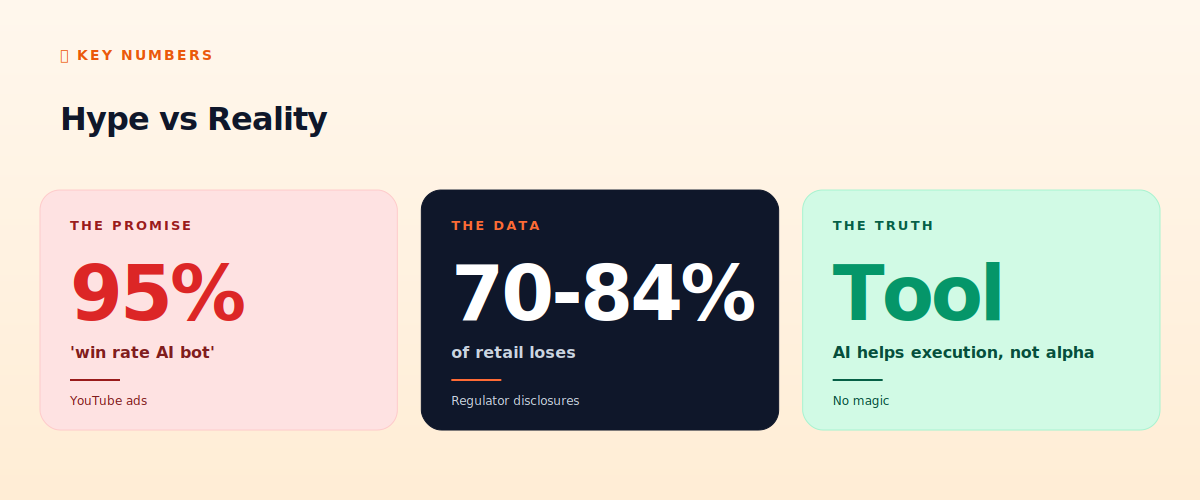
- The promise: '95% win rate AI bots,' 'passive income,' 'beat the market.'
- The data: 70-84% of retail loses (regulator disclosures). AI hasn't changed this.
- The truth: AI helps execution and monitoring; it doesn't generate alpha.
- Red flags: guaranteed returns, hidden track records, bots sold as products.
- The selling-shovels economy: most 'AI bot' money is made selling bots, not trading.
- Honest use: AI is a tool that amplifies your edge — if you have one.
Hype vs reality
The promise
The marketing for AI trading is remarkably consistent across platforms:
- '95% win rate AI bot' — an accuracy that would make you richer than any hedge fund in history if true.
- 'Passive income while you sleep' — the dream of money without effort or risk.
- 'Our proprietary AI beats the market' — a claim that, if real, the seller would never share for $499.
- 'Used by professional traders' — vague authority with no verifiable basis.
- 'Limited spots available' — artificial scarcity to pressure a quick decision.
These promises share a structure: a specific, impressive-sounding number; the removal of effort and risk; and an urgency to buy. They're engineered to bypass skepticism. And they describe a capability that, per all available evidence, does not exist.
The reality
The regulatory data is unambiguous and publicly available:
- Forex CFDs: 70-85% of retail accounts lose money (ESMA, ASIC, FCA broker disclosures).
- Binary options: 80%+ lose (CySEC disclosures; IQ Option's own data shows 83%).
- Crypto derivatives: similar loss rates; most leveraged retail traders are liquidated.
- Prediction markets: 84.1% of Polymarket wallets are in the red (Sergeenkov, April 2026).
Crucially, these numbers haven't improved with the arrival of AI trading tools. If AI bots delivered anything close to the advertised win rates, the aggregate loss statistics would have fallen. They haven't. The most parsimonious explanation: the AI bots don't deliver the advertised edge. The reality is the data, not the testimonials.
Why the gap exists: the selling-shovels economy
Here's the uncomfortable structural truth. In a gold rush, the reliable money isn't in mining gold — it's in selling shovels to miners. The AI trading economy works the same way: most of the money is made selling 'AI trading' products, not trading with them.
- Course sellers earn more from courses than from trading.
- Bot sellers earn more from bot sales than from running the bots.
- Signal sellers earn from subscriptions, not from the signals.
- Affiliate marketers earn commission on your deposits and losses (see our Pocket Option warning).
This creates a massive incentive to overstate what AI trading can do. The people loudest about AI trading profits usually profit from convincing you, not from trading. Ask the simple question: if this bot reliably won 95% of trades, why would anyone sell it for $499 instead of quietly using it to become a billionaire? The answer is that it doesn't, so selling it is the actual business model.
The red flags
Recognize AI trading hype by these signs:
- Guaranteed or fixed returns. Real trading has variance. Guaranteed returns mean a Ponzi or a lie.
- Specific high win rates with no verified record. '95% win rate' with screenshot 'proof' is survival bias or fabrication. Demand broker-verified statements.
- Bots sold as products. A genuinely profitable bot isn't sold for a flat fee — its owner uses it.
- Urgency and scarcity. 'Limited spots' is a sales tactic, not a feature of profitable trading.
- Emphasis on ease over edge. 'Anyone can do it, no skill needed' contradicts how markets actually work.
- Affiliate links everywhere. If the reviewer earns from your signup, their review isn't objective.
The honest version of AI trading
None of this means AI trading tools are worthless — they're not. It means the honest version is far less exciting than the marketing:
- AI can execute your strategy consistently, without emotion. It can't create a winning strategy you don't have.
- AI can monitor markets and alert you 24/7. It can't predict which way they'll move.
- AI can save you time and reduce errors. It can't change the 70-84% loss rate for traders without an edge.
- AI is a powerful tool that amplifies your skill and discipline. It isn't a substitute for them.
We say this about our own subject matter: an OpenClaw bot is genuinely useful, but it won't make you money if you don't have a real strategy. We'd rather you use it with accurate expectations than believe the hype and join the loss statistics. The honest framing — useful tool, not magic edge — is the one that protects your capital.
The bottom line
When you see an AI trading promise, hold it against the data: 70-84% of retail loses, and AI hasn't changed that. If a claim implies AI beats those odds for you effortlessly, it's hype — and usually someone selling shovels. Use AI for what it genuinely does (execution, monitoring, research), bring your own edge and discipline, and treat every '95% win rate' ad as a warning sign, not an opportunity. The traders who survive are the ones who never believed the magic in the first place.
📧 Get every new tutorial in your inbox
One email per week. Tutorials, CVE disclosures, broker updates. Unsubscribe in one click.
(Connect FluentCRM / ConvertKit / Beehiiv form here)
Frequently asked questions
Are AI trading bots a scam?
The tools themselves aren't inherently scams — AI genuinely helps with execution and monitoring. But the marketing (95% win rates, guaranteed income) describes capabilities that don't exist, and many sellers profit from the hype, not from trading.
Why hasn't AI improved retail loss rates?
Because AI doesn't generate alpha. The 70-84% loss rates persist because AI can't predict markets — it can only execute strategies, and most retail strategies lack edge.
If a bot wins 95%, why sell it?
Exactly the question to ask. A genuinely 95%-winning bot would make its owner a billionaire; selling it for $499 means it doesn't work. Selling is the real business model.
What's the 'selling shovels' economy?
In a gold rush, shovel-sellers profit reliably while miners mostly don't. Most AI-trading money is made selling courses, bots, and signals — not from trading with them.
So is OpenClaw worth using?
Yes, with accurate expectations. It's a genuinely useful tool for execution and monitoring. It won't create an edge you don't have — we'd rather you know that than join the loss statistics.
What to read next
- The State of AI Trading Agents in 2026
- Binary Options Scams: Recognition Guide
- Why 80% of Binary Options Traders Lose
- What Is OpenClaw?
Sources cited: The Hacker News (CVE-2026-25253 disclosure, Feb 2026); Conscia 2026 OpenClaw Security Crisis advisory; Snyk ToxicSkills study; Cyber Press ClawHavoc reporting; Wall Street Journal Polymarket profitability analysis (May 2026); Andrey Sergeenkov via The Defiant (April 2026); Akey, Grégoire, Harvie & Martineau, SSRN paper (March 2026); openclaw.ai official advisories; Peter Steinberger public statements on X. ESMA/ASIC/FCA/CySEC retail loss disclosures; Sergeenkov/The Defiant (April 2026); Akey et al. (SSRN, March 2026); WSJ (May 2026).