Risk disclosure: Independent research finds 70–84% of Polymarket traders lose money (Sergeenkov, April 2026; Akey et al., SSRN, March 2026). Forex CFDs: 70–85% retail loss rate. Binary options: 80%+ in most jurisdictions. AI agents don't change these baselines. Full disclaimer. Security context: Three critical CVEs disclosed in OpenClaw in Q1 2026 (CVE-2026-25253, CVE-2026-32922) plus the ClawHavoc supply-chain attack (1,184 malicious skills). Always run v2026.4.12 or later. Full security assessment.
AI trading agents are the most hyped category in retail trading right now, and the gap between the marketing and the reality is enormous. This is an honest mid-2026 survey of where the technology actually stands: what AI agents genuinely do well, what they can't do (no matter what the ads claim), and where the field is heading. No hype, no doom — just an accurate landscape.
If you're considering an OpenClaw bot or any AI trading tool, this is the context you need to set realistic expectations.
TL;DR — The 30-second answer
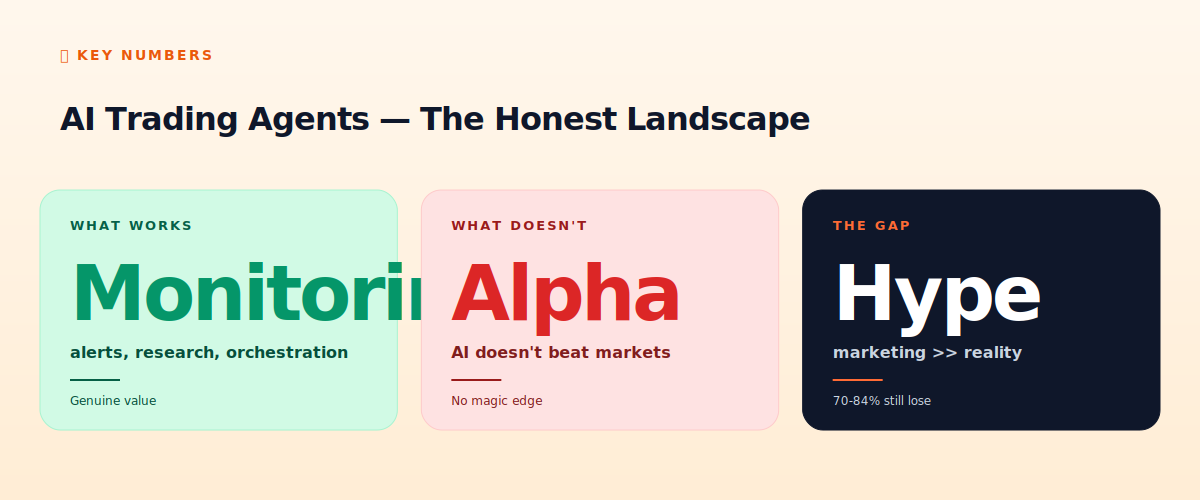
- What AI agents do well: monitoring, research, orchestration, disciplined execution.
- What they don't do: generate alpha. AI doesn't beat markets by magic.
- The hype gap: marketing promises '95% win rates'; reality is 70-84% still lose.
- Genuine progress: tool use, reasoning, and multi-step orchestration have improved a lot.
- The honest framing: AI is a powerful tool, not an edge in itself.
- Where it's heading: better orchestration and safety, not magical profitability.
The honest landscape
What AI trading agents genuinely do well
Setting hype aside, AI agents like OpenClaw deliver real value in specific areas:
- Monitoring at scale. An agent watches dozens of markets 24/7, applies your criteria, and alerts you — something no human can sustain. This is genuinely valuable and uncontroversial.
- Research and synthesis. Reading news, summarizing developments, cross-referencing data sources. AI is good at digesting information volume.
- Disciplined execution. An agent executes your strategy without the emotional deviations that sink manual traders — no panic-selling, no revenge trading.
- Multi-step orchestration. Chaining tasks across data sources, exchanges, and tools. Modern agents handle complex workflows well.
- Natural-language strategy. Describing what you want in plain language rather than coding it — lowering the barrier to automation.
These are real capabilities that have improved substantially. The tool use, reasoning quality, and orchestration of 2026's models are markedly better than a year ago. This progress is genuine.
What AI trading agents cannot do
Here's the part the marketing omits: AI does not generate alpha. It doesn't have a magic ability to predict markets that humans lack. The reasons are fundamental:
- Markets are adversarial. Every edge gets competed away. If an AI could reliably predict prices, the prediction would move the price and erase the edge.
- LLMs aren't trained for price prediction. They're trained on text. They reason well about information, but they have no special market-forecasting ability.
- Public information is already priced in. An AI reading the same news you read has no informational advantage — the market has already reacted.
- Hallucination is real. AI agents make confident mistakes. An agent that's wrong with conviction can lose money faster than a cautious human.
The regulatory data confirms it: retail loss rates (70-84% across forex, crypto, binaries) haven't improved with the arrival of AI tools. If AI conferred a market edge, we'd see it in the numbers. We don't.
The hype gap
The marketing for AI trading tools — '95% win rate AI bot,' 'let AI make you passive income,' 'our proprietary algorithm beats the market' — describes a capability that doesn't exist. We dissect this in detail in AI Trading Hype vs Reality. The gap between what's promised and what's real is the single biggest source of retail losses in this category: people buy 'AI bots' expecting alpha, get the same ~50% win rate as anyone, and lose to fees and the asymmetry of leveraged products.
Where AI genuinely helps your trading
The productive framing: AI is a powerful tool that amplifies whatever strategy and discipline you bring. It won't create an edge, but it will:
- Execute a sound strategy more consistently than you would manually.
- Monitor more markets than you could watch yourself.
- Remove emotional decision-making from execution.
- Free your time by automating routine monitoring and alerts.
- Help you research and stay informed faster.
If you have a genuine edge (a real strategy with positive expectancy), AI helps you execute it better. If you don't have an edge, AI helps you lose money more efficiently. The AI is a multiplier, not a source — this is the core truth the hype obscures.
Where the field is heading
The realistic trajectory for 2026 and beyond: better orchestration (agents coordinating more tools and venues), improved safety (skill sandboxing, better guardrails, reduced hallucination), and lower costs (cheaper models, local inference). What's NOT coming: magical profitability. The improvements will make AI agents better tools, not better fortune-tellers. Anyone promising the latter is selling the hype, not the reality.
The bottom line
AI trading agents in 2026 are genuinely useful tools for monitoring, research, orchestration, and disciplined execution — real capabilities that have meaningfully improved. They are not, and will not become, a source of market-beating alpha. Use them for what they're good at, bring your own edge and discipline, and ignore anyone claiming AI will beat the market for you. The honest middle ground — useful tool, not magic — is where the value actually is.
📧 Get every new tutorial in your inbox
One email per week. Tutorials, CVE disclosures, broker updates. Unsubscribe in one click.
(Connect FluentCRM / ConvertKit / Beehiiv form here)
Frequently asked questions
Can AI trading agents beat the market?
No. AI doesn't generate alpha. It has no special price-prediction ability — LLMs are trained on text, not market forecasting. Retail loss rates haven't improved with AI.
So why use an AI trading agent at all?
For monitoring at scale, research, disciplined execution, and orchestration — real capabilities. AI amplifies a strategy you already have; it doesn't create an edge.
Are the '95% win rate AI bot' ads real?
No. They describe a capability that doesn't exist. The regulatory data (70-84% of retail loses) is the reality. See our hype vs reality piece.
Has AI trading technology actually improved?
Yes — tool use, reasoning, and orchestration are markedly better than a year ago. The progress is real; the alpha-generation claims are not.
Will AI agents eventually beat markets?
No. Better orchestration and safety are coming; magical profitability isn't. Markets are adversarial — any real edge gets competed away.
What to read next
Sources cited: The Hacker News (CVE-2026-25253 disclosure, Feb 2026); Conscia 2026 OpenClaw Security Crisis advisory; Snyk ToxicSkills study; Cyber Press ClawHavoc reporting; Wall Street Journal Polymarket profitability analysis (May 2026); Andrey Sergeenkov via The Defiant (April 2026); Akey, Grégoire, Harvie & Martineau, SSRN paper (March 2026); openclaw.ai official advisories; Peter Steinberger public statements on X. regulatory loss-rate disclosures; Akey et al. (SSRN, March 2026); WSJ (May 2026); model capability research.