Risk disclosure: Independent research finds 70–84% of Polymarket traders lose money (Sergeenkov, April 2026; Akey et al., SSRN, March 2026). Forex CFDs: 70–85% retail loss rate. Binary options: 80%+ in most jurisdictions. AI agents don't change these baselines. Full disclaimer. Security context: Three critical CVEs disclosed in OpenClaw in Q1 2026 (CVE-2026-25253, CVE-2026-32922) plus the ClawHavoc supply-chain attack (1,184 malicious skills). Always run v2026.4.12 or later. Full security assessment.
OpenClaw went from a personal prototype to the most-starred repository on GitHub in roughly six months. Along the way: a rename forced by trademark issues, multiple serious security incidents, the creator departing for OpenAI, and a transfer to an independent foundation. This roundup consolidates the defining events of OpenClaw's first half of 2026 — the timeline every new user should understand.
We've covered these events individually across the site; this brings them together chronologically with the context that matters for traders deciding whether and how to use OpenClaw.
TL;DR — The 30-second answer
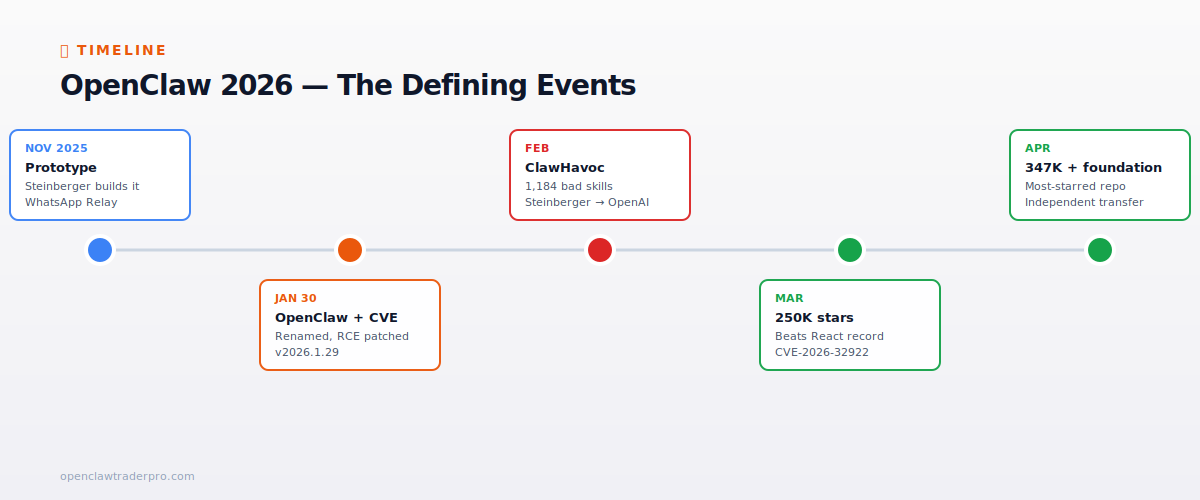
- Nov 2025: Peter Steinberger builds the prototype (originally 'Clawdbot').
- Jan 2026: renamed OpenClaw; first major CVE (RCE) patched.
- Feb 2026: ClawHavoc incident (1,184 malicious skills); Steinberger joins OpenAI.
- Mar 2026: hits 250K stars, beating React's record; another CVE.
- Apr 2026: 347K+ stars (most-starred repo); transferred to independent foundation.
- The lesson: explosive growth + real security incidents = audit everything.
The timeline
November 2025 — The prototype
Peter Steinberger (known previously for PSPDFKit) built the original prototype, initially called 'Clawdbot,' as a personal project — an AI agent that could control applications and automate tasks through natural language, starting with a WhatsApp relay. The concept resonated immediately: a general-purpose AI agent you could direct in plain language, extensible through community 'skills.'
January 2026 — Rename and first CVE
The project was renamed OpenClaw (trademark considerations around the original name) and released more broadly. With visibility came scrutiny: the first major security vulnerability, a remote code execution (RCE) flaw, was discovered and patched in version 2026.1.29. This set the pattern for the year — rapid growth shadowed by serious security issues, a consequence of a fast-moving project with a permissive skill-execution model.
February 2026 — ClawHavoc and the OpenAI move
February brought the most significant security event: ClawHavoc, in which researchers identified 1,184 malicious skills published to the community skill repository (ClawHub). These skills, if installed, could exfiltrate API keys, drain wallets, or execute arbitrary code — a direct threat to anyone running trading bots with live credentials. We cover the implications in our skill audit guide.
Also in February, creator Peter Steinberger announced he was joining OpenAI. This raised questions about the project's future governance — would it remain independent, or be absorbed? The answer came in April.
March 2026 — Record-breaking growth
OpenClaw crossed 250,000 GitHub stars in March, surpassing the record previously held by frameworks like React — an extraordinary pace for a project barely a few months old. The growth reflected genuine utility and viral enthusiasm. But March also brought another vulnerability (CVE-2026-32922), reinforcing that the security challenges weren't behind it.
April 2026 — Most-starred repo and foundation transfer
By April, OpenClaw reached 347,000+ stars, making it the most-starred repository on GitHub. Crucially, governance was transferred to an independent foundation — resolving the uncertainty from Steinberger's OpenAI move. The foundation structure aimed to ensure the project remained open, community-governed, and not controlled by any single company. For users, this was reassuring: OpenClaw would persist as genuinely open infrastructure.
What it means for traders
The story has two halves, and both matter:
- The bullish half: OpenClaw is real, widely adopted, actively developed, and now governed by an independent foundation. It's not a flash in the pan — it's established infrastructure with enormous community momentum.
- The cautionary half: the security incidents (RCE CVEs, ClawHavoc's 1,184 malicious skills) are not theoretical. For traders running bots with live API keys and wallet access, the attack surface is real. Every skill you install can execute code on your machine.
The practical takeaway: OpenClaw is worth using, but audit every skill before installing it, never grant withdrawal permissions to API keys, isolate trading bots from other systems, and follow the hardening checklist. The explosive growth brought both genuine capability and genuine risk; treat both seriously.
What's next
With foundation governance in place, the focus shifts to maturing the security model (better skill sandboxing, signed skills, audit tooling) and stabilizing the API. For traders, the trajectory is encouraging — a maturing project with institutional backing — but the core security discipline remains your responsibility regardless of how the framework evolves. We'll update this roundup as 2026 progresses.
📧 Get every new tutorial in your inbox
One email per week. Tutorials, CVE disclosures, broker updates. Unsubscribe in one click.
(Connect FluentCRM / ConvertKit / Beehiiv form here)
Frequently asked questions
Is OpenClaw safe to use for trading?
Yes, with discipline. The framework is established and foundation-governed, but security incidents (CVEs, malicious skills) are real. Audit every skill, never grant withdrawal permissions, follow the hardening checklist.
Who created OpenClaw?
Peter Steinberger, in late 2025 (originally as 'Clawdbot'). He joined OpenAI in February 2026; the project later transferred to an independent foundation.
What was ClawHavoc?
A February 2026 incident where 1,184 malicious skills were found in the community repository — capable of stealing keys or draining wallets. It underscores the need to audit skills.
Is OpenClaw really the most-starred GitHub repo?
As of April 2026, yes — 347K+ stars, surpassing the previous record holders. Extraordinary for a project under a year old.
Will OpenClaw stay independent?
The April 2026 transfer to an independent foundation was designed to ensure exactly that — community governance, not single-company control.
What to read next
- What Is OpenClaw?
- Spot a Malicious Skill in 60 Seconds
- The State of AI Trading Agents in 2026
- The 12-Point Hardening Checklist
Sources cited: The Hacker News (CVE-2026-25253 disclosure, Feb 2026); Conscia 2026 OpenClaw Security Crisis advisory; Snyk ToxicSkills study; Cyber Press ClawHavoc reporting; Wall Street Journal Polymarket profitability analysis (May 2026); Andrey Sergeenkov via The Defiant (April 2026); Akey, Grégoire, Harvie & Martineau, SSRN paper (March 2026); openclaw.ai official advisories; Peter Steinberger public statements on X. OpenClaw GitHub repository and release notes; CVE databases; ClawHavoc security disclosures; foundation announcements.