This is not legal or tax advice. Regulations change frequently and vary by jurisdiction. Consult a qualified local professional before making decisions based on regulatory status. Risk disclosure: Independent research finds 70–84% of Polymarket traders lose money (Sergeenkov, April 2026; Akey et al., SSRN, March 2026). Forex CFDs: 70–85% retail loss rate. Binary options: 80%+ in most jurisdictions. AI agents don't change these baselines. Full disclaimer.
Crypto regulation in 2026 is a patchwork that varies enormously across the regions our audience lives in — Southeast Asia, Africa, and Latin America. Some markets have built clear frameworks; others remain ambiguous; a few are restrictive. This guide gives a practical, region-by-region overview of where things stand, focused on what actually affects traders running OpenClaw bots.
Critical caveat: this is a landscape overview, not legal advice. Regulations shift, enforcement varies, and your specific situation needs a local professional. Use this to orient yourself, then verify locally.
TL;DR — The 30-second answer
- Crypto regulation is a patchwork — varies hugely by country, changes often.
- Most of our regions: crypto trading is legal but increasingly regulated and taxed.
- EU's MiCA sets a comprehensive framework that influences global standards.
- Tax is the universal theme: profits are increasingly taxable everywhere.
- Bot trading itself is rarely specifically regulated — the activity it does is what's regulated.
- Not legal advice — verify your specific situation with a local professional.
Regional snapshot
The global context: MiCA and its influence
The EU's Markets in Crypto-Assets (MiCA) regulation, now in force, is the most comprehensive crypto framework globally. While it directly governs only the EU, it influences standards worldwide — exchanges that want EU access comply with it, and other jurisdictions look to it as a model. The broad direction MiCA represents — licensing exchanges, requiring transparency, protecting consumers, clarifying tax — is the direction most of the world is heading, including our regions.
Southeast Asia
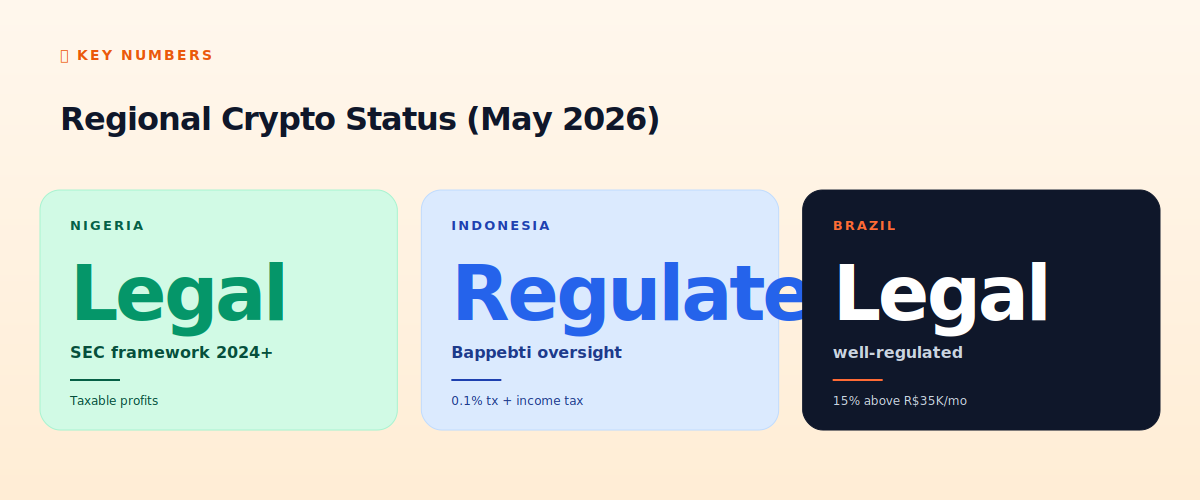
Indonesia: crypto is a regulated commodity under Bappebti (the commodity futures regulator). Trading is legal on licensed exchanges, subject to a small transaction tax (~0.1%) plus income tax on gains. The framework is relatively clear.
Philippines: the BSP (central bank) and SEC regulate crypto activities. Virtual asset service providers need registration. Trading is legal; tax treatment is evolving.
Vietnam: historically ambiguous — crypto wasn't recognized as legal tender or a regulated asset, creating uncertainty. The government has been developing a clearer framework; check current status, as this is one of the more fluid situations.
Thailand: the SEC regulates crypto with a relatively developed framework. Licensed exchanges, KYC requirements, and tax on gains. One of the clearer SEA environments.
Africa
Nigeria: after a period of restrictions, the SEC introduced a framework (from 2024 onward) recognizing and regulating digital assets. Trading is legal; profits are taxable. Nigeria has one of Africa's largest crypto-adopting populations, and the regulatory direction has been toward formalizing rather than banning.
South Africa: the FSCA regulates crypto as a financial product. Crypto asset service providers need licensing. Relatively developed framework; gains are taxable. One of Africa's clearer environments.
Kenya: developing framework, with tax authorities increasingly focused on crypto gains. The CMA has explored regulation. Check current status — it's evolving.
Latin America
Brazil: well-regulated, with a legal framework recognizing crypto and clear tax rules (gains above a monthly threshold — around R$35,000 — are taxable at 15%+). One of LATAM's most developed environments. Major exchanges operate legally.
Mexico: crypto is legal but not legal tender; the fintech law provides some framework. Tax applies to gains. Relatively permissive but with evolving specifics.
Argentina: crypto is widely used (partly as an inflation hedge) and legal, though the regulatory and tax framework has been in flux amid broader economic changes. High adoption, evolving rules.
What this means for bot traders
A few practical principles cut across all these jurisdictions:
- Bot trading itself is rarely specifically regulated. What's regulated is the underlying activity — trading crypto, the exchanges you use, the gains you make. Running an OpenClaw bot doesn't change your legal obligations versus trading manually.
- Tax is nearly universal. Almost everywhere, crypto profits are taxable. An active bot generates many taxable events — use tax software (see our comparison) and consult a local professional.
- Use licensed/compliant exchanges where your jurisdiction has them. This simplifies tax reporting and reduces legal risk versus offshore venues.
- Keep records. Regulators increasingly expect documentation. Your bot's logs plus tax software create the paper trail.
- Status changes — verify. The snapshots above are accurate as of mid-2026 but regulations shift. Always confirm current status locally.
The prediction-market wrinkle
Prediction markets (Polymarket, Kalshi) add complexity. Polymarket is US-blocked and operates offshore; its legal status in our regions varies and the classification of winnings (capital gains? gambling? income?) is jurisdiction-specific. Kalshi is US-only. We cover the jurisdiction details in our Polymarket tax and legal guide. This is an area where professional advice is especially worth it.
The honest bottom line
Across our core regions, the trend is consistent: crypto trading is increasingly legal but regulated and taxed. The 'wild west' era is ending; the 'formalized and taxable' era is here. For bot traders, this means: use compliant exchanges, track your transactions, pay your taxes, keep records, and consult a local professional for your specific situation. This guide orients you; it doesn't replace local legal advice — regulations change too fast and vary too much for any general guide to be authoritative for your case.
📧 Get every new tutorial in your inbox
One email per week. Tutorials, CVE disclosures, broker updates. Unsubscribe in one click.
(Connect FluentCRM / ConvertKit / Beehiiv form here)
Frequently asked questions
Is crypto trading legal in my country?
In most of SEA, Africa, and LATAM, yes — increasingly legal but regulated and taxed. Specifics vary by country and change often. Verify locally.
Is running a trading bot specifically regulated?
Rarely. What's regulated is the underlying activity (trading crypto, the exchanges, the gains). A bot doesn't change your legal obligations versus manual trading.
Do I owe taxes on bot trading profits?
Almost certainly — crypto gains are taxable in most jurisdictions. An active bot generates many taxable events. Use tax software and consult a local professional.
What's MiCA?
The EU's comprehensive crypto framework. It directly governs the EU but influences global standards — the direction most jurisdictions are heading.
Is this legal advice?
No. It's a landscape overview. Regulations change fast and vary by jurisdiction. Consult a qualified local professional for your situation.
What to read next
- Polymarket Tax & Legal Guide
- Crypto Tax Software Compared
- The State of AI Trading Agents in 2026
- Hot Wallet Hygiene for Bots
Sources cited: The Hacker News (CVE-2026-25253 disclosure, Feb 2026); Conscia 2026 OpenClaw Security Crisis advisory; Snyk ToxicSkills study; Cyber Press ClawHavoc reporting; Wall Street Journal Polymarket profitability analysis (May 2026); Andrey Sergeenkov via The Defiant (April 2026); Akey, Grégoire, Harvie & Martineau, SSRN paper (March 2026); openclaw.ai official advisories; Peter Steinberger public statements on X. EU MiCA regulation; regional regulator publications (Bappebti, FSCA, Brazilian and Nigerian SEC frameworks); not exhaustive or current legal authority.