Risk disclosure: Independent research finds 70–84% of Polymarket traders lose money (Sergeenkov, April 2026; Akey et al., SSRN, March 2026). Forex CFDs: 70–85% retail loss rate. Binary options: 80%+ in most jurisdictions. AI agents don't change these baselines. Full disclaimer. This is informational, not legal or tax advice. Consult a qualified attorney and accountant for your specific jurisdiction.
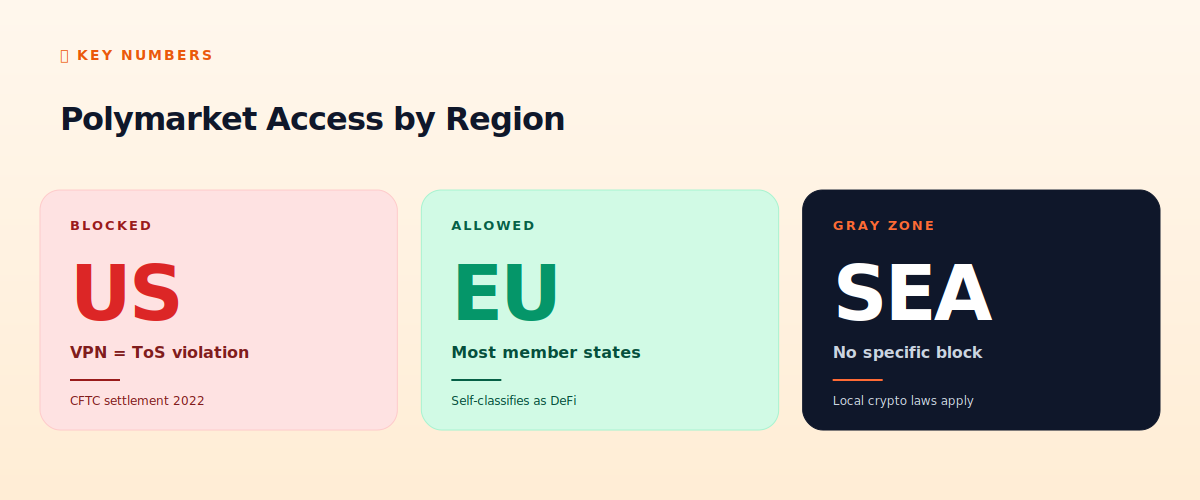
Polymarket exists in an awkward legal middle. It's a blockchain-based prediction market that the US CFTC classified as an unregistered swap exchange in 2022. It operates from offshore, restricts US residents, and self-identifies as DeFi. For traders in SEA, Africa, Europe, Latin America, the rules vary wildly.
This guide covers what we know about Polymarket access and tax treatment across major jurisdictions. We are not lawyers and this is not legal advice. We're summarizing public regulatory positions, common practices, and red flags. Always consult professionals for your specific situation.
TL;DR — The 30-second answer
- US residents: Polymarket is geo-blocked. VPN use violates Terms of Service and may expose you to CFTC enforcement. Use Kalshi instead.
- UK residents: FCA has issued warnings but no specific block. Treated like any unregistered investment platform.
- EU residents: Most member states have no specific Polymarket prohibition. MiCA-era considerations apply.
- SEA + Africa + LATAM: Typically accessible. Local crypto regulations determine legality.
- Tax: Every trade is typically taxable in most jurisdictions. Use crypto tax software (Koinly, CoinTracker).
- Reporting: Polymarket reports nothing. You're responsible for your own records.
Access by jurisdiction
United States
Status: Geo-blocked. After 2022 CFTC settlement, Polymarket implemented geo-fencing for US IP addresses. The platform's Terms of Service prohibit US residents.
VPN risk: Using a VPN to bypass the block is a ToS violation. More seriously, if the CFTC identifies a US person trading on Polymarket, enforcement action may follow — per their 2022 statement, they reserve this option. We do not recommend US residents use Polymarket via VPN.
Alternative: Kalshi is CFTC-regulated, US-legal, and has overlapping market coverage. For US-only traders, this is the correct choice.
United Kingdom
Status: Accessible. FCA has issued warnings about unregistered crypto platforms generally, including Polymarket. No specific block.
Tax treatment: Trading profits typically taxable as capital gains (or income for high-frequency traders). HMRC's crypto guidance applies. Each disposal is taxable; track your basis carefully.
FSCS protection: None. Funds on Polymarket are not protected by UK regulators.
European Union
Status: Mixed by member state. Most allow access; some (Belgium, certain regulators) have issued warnings.
MiCA implications: The Markets in Crypto-Assets regulation came into force in 2024. Polymarket would likely need to register as a crypto-asset service provider to operate in EU member states under MiCA. Currently they do not. Member state enforcement varies.
Tax treatment: Varies by country. Germany has favorable rules (12-month hold = tax-free). France treats trading as taxable income. Italy taxes at 26%.
Southeast Asia (Indonesia, Philippines, Vietnam, Thailand, Malaysia, Singapore)
Status: Accessible in all. Local crypto regulations apply.
Singapore: Polymarket falls under MAS's crypto framework. Trading is legal; tax-free if not your main income source.
Indonesia: Crypto trading is legal but heavily regulated. Polymarket isn't on the official list of approved exchanges, putting it in a gray zone. Tax: 0.1% per transaction + income tax on profits.
Philippines: Accessible. BSP (Bangko Sentral) treats crypto trading as taxable. No specific Polymarket ban.
Vietnam: Crypto holdings legal, trading exists in legal gray. No specific Polymarket prohibition. Income tax applies to any profits.
Thailand: Crypto trading legal but exchanges must be licensed by SEC. Polymarket isn't, but personal use isn't typically enforced against. Capital gains taxable.
Malaysia: Accessible. Securities Commission has issued general warnings about offshore crypto platforms but no Polymarket ban. Capital gains generally tax-free.
Africa (Nigeria, South Africa, Kenya, Ghana, Egypt)
Status: Accessible across the region.
Nigeria: Crypto trading legal after 2024 SEC clarification. Polymarket accessible; income tax applies to profits.
South Africa: SARB classifies crypto as taxable asset. Trading is legal. SARS expects declaration of profits.
Kenya: Crypto legal as of 2024. Profits taxable. Polymarket accessible.
Ghana: Crypto in gray zone. Polymarket accessible. Tax treatment unclear.
Latin America (Brazil, Mexico, Argentina, Colombia, Chile)
Brazil: Crypto trading legal and well-regulated. Polymarket accessible. Tax: 15% on profits above R$35K/month.
Mexico: Crypto operations legal under fintech law. Polymarket accessible. Tax via SAT.
Argentina: Crypto trading legal. Polymarket accessible. Tax compliance is required and increasingly enforced.
Tax: every trade is potentially taxable
In most jurisdictions, each Polymarket trade is a taxable event because you're disposing of USDC (a crypto asset). For active bots placing 1,000+ trades per year, this means 1,000+ taxable events to track.
Practical approach for active traders:
- Track from day one. Use Koinly, CoinTracker, or CoinLedger. They import your Polygon address and categorize trades.
- Document the basis. Each trade has a cost basis (what you paid) and a proceeds (what you received). Capital gain = proceeds - basis.
- Tax-loss harvesting. If you have losing positions and unrealized gains, selling losers can offset gains. Standard in most jurisdictions.
- Don't forget gas. Polygon gas fees may or may not be deductible depending on jurisdiction. Most allow inclusion in cost basis.
- Keep records permanently. Most jurisdictions can audit 3-7 years back. Bot trades accumulate fast.
What to do if you're wrong about your jurisdiction
If you've been trading Polymarket and you discover your jurisdiction has tightened rules:
- Don't panic-sell. Stopping trading is usually compliant. Selling everything in a panic creates taxable events you don't need.
- Consult a crypto-savvy accountant immediately. Voluntary disclosure of past activity often results in much smaller penalties than discovery during audit.
- Document everything. Pull your full Polygon transaction history. Save it offline.
- Continue funded operations. Withdrawing funds rapidly looks suspicious; orderly wind-down is normal.
Red flags in the regulatory landscape
- MiCA enforcement in EU is intensifying. Polymarket may exit EU markets or restrict EU users in 2026-2027.
- CFTC vs SEC turf battles in the US could change Polymarket's classification.
- India and China: both have effectively banned access; not in our recommended audience.
- New crypto laws in SEA: Thailand, Indonesia, Philippines are tightening compliance requirements. Watch for changes.
- FATF Travel Rule: if Polymarket implements full Travel Rule compliance, KYC requirements may dramatically expand.
📧 Get every new tutorial in your inbox
One email per week. Tutorials, CVE disclosures, broker updates. Unsubscribe in one click.
(Connect FluentCRM / ConvertKit / Beehiiv form here)
Frequently asked questions
Will I get in trouble for using Polymarket?
Depends entirely on your jurisdiction. In most places we cover, no. In the US: VPN bypass is risky and we don't recommend it. Consult local counsel.
Does Polymarket report to my tax authority?
No. Polymarket reports to no one. You're responsible for your own records.
What if I never withdrew profits to my bank?
In most jurisdictions, trading is taxable when the trade happens, not when you cash out to bank. Holding crypto doesn't defer tax.
Should I tell my accountant?
Absolutely yes. Most accountants who handle crypto trading have seen this before. The ones who haven't will refer you to specialists.
Can I trade through a corporation?
In some jurisdictions, yes — this can simplify tax treatment. Talk to a corporate lawyer; setup costs $1K-5K typically and only worth it above ~$50K/year trading income.
What to read next
- Polymarket Explained
- Polymarket vs Kalshi
- Crypto Tax Software Compared
- Trading Bot Legal Considerations
Sources cited: The Hacker News (CVE-2026-25253 disclosure, Feb 2026); Conscia 2026 OpenClaw Security Crisis advisory; Snyk ToxicSkills study; Cyber Press ClawHavoc reporting; Wall Street Journal Polymarket profitability analysis (May 2026); Andrey Sergeenkov via The Defiant (April 2026); Akey, Grégoire, Harvie & Martineau, SSRN paper (March 2026); openclaw.ai official advisories; Peter Steinberger public statements on X. CFTC enforcement orders 2022; MiCA regulation text; FATF Travel Rule guidance; jurisdiction-specific tax authority publications.