Risk disclosure: Independent research finds 70–84% of Polymarket traders lose money (Sergeenkov, April 2026; Akey et al., SSRN, March 2026). Forex CFDs: 70–85% retail loss rate. Binary options: 80%+ in most jurisdictions. AI agents don't change these baselines. Full disclaimer.
In January 2026, Finbold and several crypto outlets reported on Polymarket wallet 0x8dxd... turning $313 into $437,600 in approximately 30 days. The account placed 6,615 trades with a 98% win rate. Volume was verifiable on Polygonscan. The strategy was identified as latency arbitrage between Polymarket and centralized exchanges on BTC up/down 15-minute markets.
This post breaks down what we know about the strategy, what numbers reveal about the mechanics, why it likely no longer works as documented, and what realistic expectations look like for someone trying to replicate. We are not endorsing any strategy; we're describing what the on-chain data shows.
TL;DR — The 30-second answer
- Account 0x8dxd: $313 → $437,600 in ~30 days. 6,615 trades. 98% win rate.
- Strategy: latency arbitrage between Binance/Coinbase BTC spot and Polymarket BTC up/down markets.
- Average trade size: $66. Tiny per-trade risk.
- Required latency: sub-200ms between exchange tick and Polymarket order.
- Why it likely doesn't work today: competition compressed spreads to near-zero.
- What replicators see now: 15-40% win rates after fees. Inverse of headline.
The trajectory
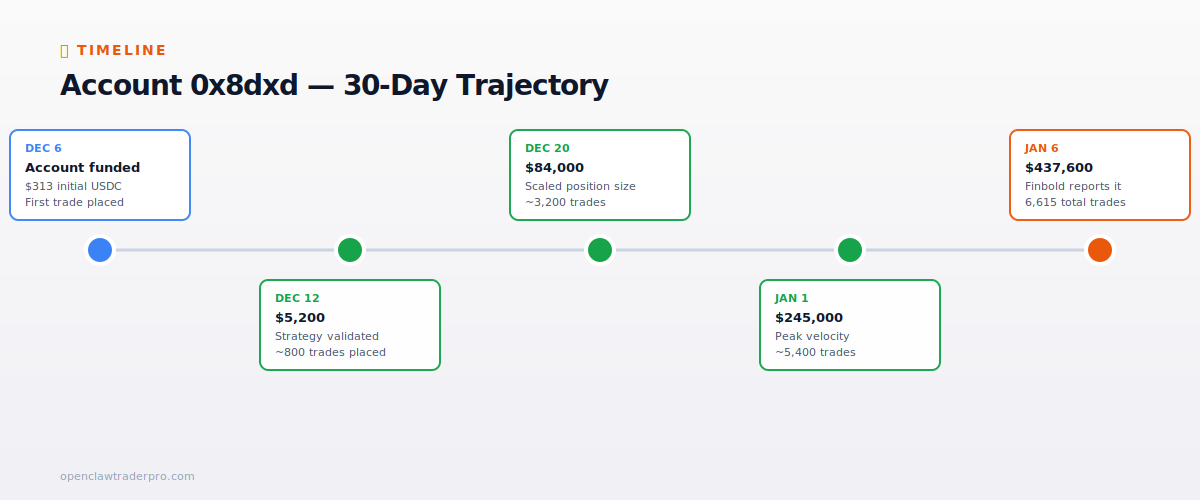
The account funded with $313 USDC on December 6, 2025. It placed its first trade within hours of funding. By December 12 (six days in) it had grown to roughly $5,200 across ~800 trades — suggesting positions of $5-15 each at first, growing to $30-50 by week's end.
By December 20 (two weeks in) the account was at $84,000 across ~3,200 trades. By January 1 it was at $245,000 across ~5,400 trades. By January 6 when Finbold reported it, the account stood at $437,600 across 6,615 verified trades. The growth curve is geometric — the kind that only works if the win rate is genuinely sustainable.
The numbers reveal the strategy
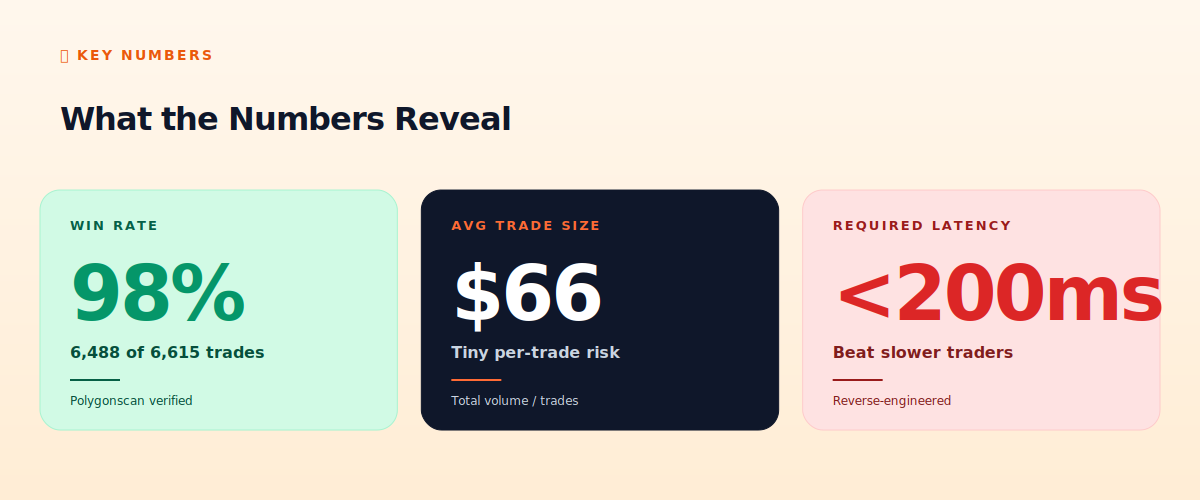
A 98% win rate on 6,615 trades is statistically impossible without structural edge. Random gambling at even 60/40 odds would expect 60% win rate with high variance — not 98%. The only way to achieve this is to systematically exploit a price discrepancy that exists for short windows.
The clue is the average trade size: $66. If you're trying to make $66 profit per trade on $66 of capital, you'd need to capture 100% of the value (impossible). If you're trying to make $1 of profit on $66 of capital, that's 1.5% per trade — achievable if you have a clear edge for 1-2 seconds.
Reverse-engineering: the strategy was almost certainly trading 15-minute BTC up/down markets on Polymarket. These markets resolve based on whether BTC's price on Binance at minute X is higher or lower than at minute X-15. The bot's edge was reading Binance's price feed in real-time and adjusting Polymarket positions before the rest of the orderbook caught up.
Why this likely no longer works
Latency arbitrage strategies have a brutal property: they're self-extinguishing. As soon as multiple bots compete for the same edge, the spread narrows to fee-cost-plus-epsilon. By February 2026 there were reportedly 15-20 bots running similar strategies on the same 15-minute markets. The reported edge dropped from 1.5%/trade to ~0.3%/trade.
After Polygon gas costs ($0.30-0.50 per trade) and Polymarket spread (1-3 cents), 0.3% edge on $66 trades is $0.20 of profit minus $0.45 of cost = net loss. The strategy isn't viable today the way it was documented in December 2025.
What replicators see in 2026: 15-40% win rates after fees when running the same strategy. That's just slightly worse than coinflip, because the original edge is gone and they're now paying fees for nothing. Multiple traders have reported losing $5K-$20K trying to replicate the published trajectory.
What's still possible
The 0x8dxd setup is gone, but similar opportunities recur on Polymarket regularly. The pattern is: a new market type launches, a small group exploits it for 1-4 weeks, then competition catches up and the edge dies. To capture the next 0x8dxd, you need to:
- Monitor for new market types. Set up alerts when Polymarket lists categories that don't have established bots yet.
- Be fast. First-mover advantage in a new market category lasts 2-4 weeks at most.
- Have infrastructure ready. Identifying the opportunity isn't enough; you need API access, latency-optimized VPS, and the OpenClaw skill to execute within days.
- Position-size appropriately. Don't start with $50K. Start with $200, validate the edge for a week, then scale.
- Accept the strategy will die. When competition arrives, exit. Don't fight diminishing edge into negative territory.
The case study lessons
What the 0x8dxd story teaches that the YouTube clones never mention:
- Pure edge can be found. If you're early and technical, real $/hour returns are possible. The 0x8dxd account was real.
- It requires infrastructure most retail traders don't have. Sub-200ms latency from a VPS within 50ms of Binance servers. CCXT integration with proper error handling. Polymarket CLOB API at API-key level.
- It requires accepting tiny positions for a long time. $66 per trade is small. Most retail traders feel they're "wasting their day" at this size and scale up too fast.
- It requires recognizing when the edge dies. The smartest move 0x8dxd made was withdrawing $437K in February before the strategy degraded. Continuing into 2026 would have lost most of it back.
- Survivorship bias is real. For every $437K trader, there are thousands of accounts that tried the same strategy with worse infrastructure and lost. We never see those accounts because they don't make headlines.
Realistic replication today
If you want to attempt latency arbitrage on Polymarket today (May 2026):
- Don't trade 15-minute BTC up/down markets. Compressed edge. Lose money slowly.
- Look for weather markets in regions with predictable data lag. NOAA updates create brief windows. Less crowded than BTC.
- Try sports markets at game-end moments. If you can ingest game outcome data 2-3 seconds before Polymarket orderbooks update, you have edge.
- Always use sub-second LLM models OR avoid the LLM entirely. Latency arb at LLM speeds (1.5-3 sec) means you're slower than competition. Use OpenClaw for monitoring and signal generation, not execution.
- Budget $500 for learning. Expect to lose all of it. The lessons are worth the cost — less than a college class.
📧 Get every new tutorial in your inbox
One email per week. Tutorials, CVE disclosures, broker updates. Unsubscribe in one click.
(Connect FluentCRM / ConvertKit / Beehiiv form here)
Frequently asked questions
Is the 0x8dxd account real?
Yes. Verified on Polygonscan. The Finbold reporting can be cross-referenced with the actual wallet address.
Could I make $437K starting with $313?
Not following the documented strategy. The edge is gone. New edges exist in new markets but require fast identification and execution.
How much capital do I need to start?
$0 for paper trading. $500 maximum for first month of live. Don't scale up until you've validated edge for 30+ days.
Can I copy successful Polymarket wallets?
Yes — you can see all their trades on Polygonscan. But by the time you're copying them, the edge is gone. Copy traders systematically lose money.
What's a sustainable monthly return for prediction market bots?
5-15% per month is the documented range for the consistently profitable. Anyone claiming higher is either lucky for now or selling something.
What to read next
- Polymarket Explained
- OpenClaw + Polymarket: Complete Bot Guide
- Polymarket Weather Bots
- Crypto Arbitrage Realistic Expectations
Sources cited: The Hacker News (CVE-2026-25253 disclosure, Feb 2026); Conscia 2026 OpenClaw Security Crisis advisory; Snyk ToxicSkills study; Cyber Press ClawHavoc reporting; Wall Street Journal Polymarket profitability analysis (May 2026); Andrey Sergeenkov via The Defiant (April 2026); Akey, Grégoire, Harvie & Martineau, SSRN paper (March 2026); openclaw.ai official advisories; Peter Steinberger public statements on X. Finbold reporting (January 6, 2026); Polygonscan verification of account 0x8dxd; on-chain trade analysis.