Risk disclosure: Independent research finds 70–84% of Polymarket traders lose money (Sergeenkov, April 2026; Akey et al., SSRN, March 2026). Forex CFDs: 70–85% retail loss rate. Binary options: 80%+ in most jurisdictions. AI agents don't change these baselines. Full disclaimer.
If you've spent any time looking at Polymarket leaderboards, you've noticed something: the same 5-10 wallets dominate weather markets daily. They've turned a few hundred dollars into low-six-figure profits. Their secret is boring and technical: NOAA forecast lag arbitrage. They've automated the gap between when a weather forecast updates and when the Polymarket orderbook catches up.
This guide explains exactly how weather bots work, why they consistently profit, why it's still a viable strategy for new entrants in 2026, and the realistic capital and infrastructure requirements to participate.
TL;DR — The 30-second answer
- Weather markets settle based on official NOAA/Met Office data at specific times.
- Bots ingest forecast updates immediately and adjust orders before orderbook does.
- Documented 73-83% win rates across multiple bots (Phosphen, Hans323, others).
- Most consistently profitable bot category on Polymarket in 2026.
- Requires sub-second NOAA data ingestion + low-latency Polygon RPC.
- Still viable for new entrants — less crowded than BTC arbitrage.
Why weather markets are special
Most Polymarket categories settle based on subjective interpretation. Politics: who counts as having "endorsed" something? Sports: did that play count toward the bet? Crypto: which exchange's price determines settlement? These ambiguities create disputes, slow resolution, and discourage bot activity.
Weather is mathematical. "Will daily high temperature at JFK airport on May 28 be above 75°F?" resolves based on a single number from a single source (NOAA NWS observation). No interpretation. No dispute possibility. Settlement happens automatically once NOAA publishes the data.
This certainty makes weather markets attractive to algorithmic traders. The pricing edge isn't "will it rain" — it's "how confident are you in the forecast right now versus how confident is the market?"
The forecast lag mechanic
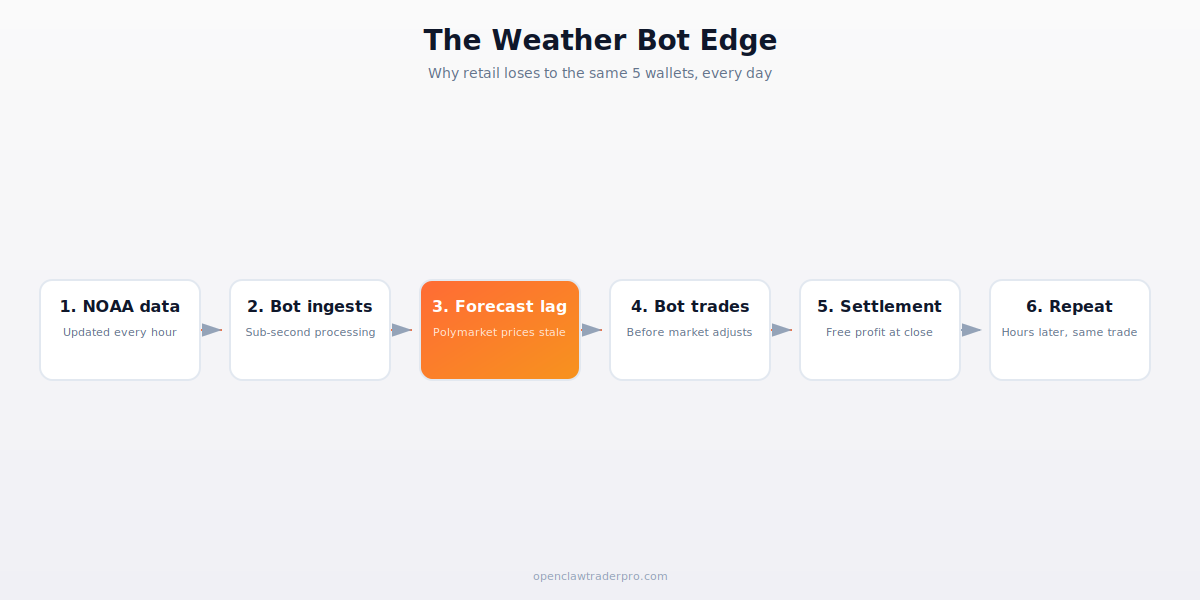
NOAA's National Weather Service publishes forecast updates throughout the day. The Storm Prediction Center updates every 1 hour. Local Forecast Discussions update every 4-12 hours. The most consequential updates are the 06Z and 18Z model runs (twice daily) from the GFS, ECMWF, and NAM models.
When a forecast update materially changes the probability of an outcome ("chance of rain went from 40% to 80%"), Polymarket prices should immediately adjust. In practice, the orderbook takes 2-15 minutes to reflect new information, especially in less-watched markets. That gap is the bot's edge.
A bot can:
- Subscribe to NOAA's RSS feeds and API updates.
- Detect when a forecast update changes probability for an active Polymarket market.
- Compute the new fair price (e.g., "chance of rain at LGA tomorrow now 78%, market still pricing 55%").
- Place buy orders at the stale market price before other traders update.
- Profit when the orderbook eventually adjusts (or when the event resolves).
Documented case studies
Several weather bots have public on-chain trails:
- Phosphen (0xf2e346ab): $204 grown to ~$24,000 across 1,300+ trades, 73% win rate. Trades London daily-high-temperature markets. Documented December 2025 onward.
- Hans323: Grew $92,632 to $1,018,475 on a single trade using NOAA/Met Office forecast lag. Cumulative gains exceed $1.1M across operations.
- Unnamed bot operator profiled in The Defiant in March 2026: claims sustained 70-80% win rates across 3 simultaneous weather markets (US East Coast cities, UK cities, US Midwest precipitation).
What unites them: small per-trade size ($50-200), high frequency (50-300 trades/week), specialization in a small handful of cities/regions, fast NOAA data ingestion. None of them "predict weather" in any traditional sense — they just react faster to public data.
What you need to participate
- NOAA data subscriptions via NWS API. Free. Documentation at api.weather.gov. Sub-second updates possible.
- European Centre for Medium-Range Weather Forecasts (ECMWF): some products paid, some free. Adds redundancy.
- Low-latency Polygon RPC. Don't use the free public one. Alchemy or Infura paid tiers give you sub-200ms response times.
- OpenClaw + polyclaw + a custom weather skill. The custom skill parses NOAA RSS, computes implied probabilities, and triggers polyclaw trades.
- VPS near Polygon nodes. Vultr Singapore or DigitalOcean Frankfurt work. See our VPS comparison.
- $200-500 of risk capital. Smaller positions but lots of them. Accept losing it during the learning phase.
The strategy template
In a SKILL.md, your weather bot logic might look like:
---
name: weather-arb
description: "Trade Polymarket weather markets based on NOAA forecast updates."
trigger: "weather|forecast|noaa"
permissions:
  - network
---
Every 5 minutes:
1. Pull latest NOAA forecasts for: NYC, LAX, LHR, JFK.
2. For each active Polymarket weather market in those cities:
   a. Compute implied probability from forecast.
   b. Compare to current orderbook midprice.
   c. If divergence > 3 cents AND in our favor, place order at midprice + 1 cent.
3. Cancel any unfilled orders after 10 minutes.
4. Position size: 2% of capital per market, max 3 simultaneous positions.
5. Daily loss limit: 5%.
The hard guardrails (position size, loss limit) live in code that polyclaw enforces, not in the LLM prompt. The LLM just decides which markets to monitor and what conditions trigger trades.
Why this still works in 2026
Weather is a niche market category. Most Polymarket traders are focused on politics, crypto, and sports — the markets that make news. Weather markets get less attention, fewer bot operators, and therefore retain their edge longer.
There are also natural diversifiers: NOAA covers US markets, Met Office covers UK, JMA covers Japan, BOM covers Australia, INMET covers Brazil. Different agencies publish at different times, so you can stagger your strategy across regions to maintain edge.
As of May 2026, we estimate 8-12 bot operators are actively trading weather markets. That's enough competition to keep edges thin but not enough to extinguish them. New entrants can still find opportunities, especially in regions and cities the current bots don't cover.
What goes wrong
- Forecast revisions whipsaw you. NOAA updates 4-8 times daily. Your morning trade can be inverted by an afternoon update. Set tight stops.
- Hurricane markets are different. Forecast confidence cones widen as hurricanes approach. Don't apply the same math as routine weather.
- Polygon RPC fails at the wrong moment. Backup RPC providers are essential.
- Market gets disputed at resolution. Rare but happens when NOAA data has gaps. Funds locked for 48 hours.
- Edge degrades as more bots enter. Monitor your win rate weekly. If it drops below 60%, the city/region is getting crowded; rotate to a different one.
📧 Get every new tutorial in your inbox
One email per week. Tutorials, CVE disclosures, broker updates. Unsubscribe in one click.
(Connect FluentCRM / ConvertKit / Beehiiv form here)
Frequently asked questions
Can I really just start trading weather and profit?
Not without infrastructure. You need real-time NOAA ingestion, low-latency RPC, and a strategy that's not already saturated. With those, yes, weather arbitrage remains profitable.
What if I don't know meteorology?
You don't need to. The bots aren't predicting weather; they're reacting to NOAA's predictions faster than the market orderbook. Meteorological knowledge is optional.
How much can I make?
Documented bot operators are at $5K-30K monthly profits on small accounts ($5K-50K capital). Anyone claiming higher is either lucky for now or selling something.
Is there a less technical way?
Not really. The edge requires automation. Manual trading on weather is just a slow casino — bots beat you to the punch every time.
What if NOAA changes their API?
It happens occasionally. Subscribe to their developer mailing list. Their changes are well-telegraphed and rarely break working integrations.
What to read next
- Polymarket Explained
- OpenClaw + Polymarket Bot Guide
- The $437K Polymarket Trader
- OpenClaw VPS Comparison
Sources cited: The Hacker News (CVE-2026-25253 disclosure, Feb 2026); Conscia 2026 OpenClaw Security Crisis advisory; Snyk ToxicSkills study; Cyber Press ClawHavoc reporting; Wall Street Journal Polymarket profitability analysis (May 2026); Andrey Sergeenkov via The Defiant (April 2026); Akey, Grégoire, Harvie & Martineau, SSRN paper (March 2026); openclaw.ai official advisories; Peter Steinberger public statements on X. NOAA NWS API documentation; Met Office UK API; Polymarket weather market historical data; Phosphen public X account.