Risk disclosure: Independent research finds 70–84% of Polymarket traders lose money (Sergeenkov, April 2026; Akey et al., SSRN, March 2026). Forex CFDs: 70–85% retail loss rate. Binary options: 80%+ in most jurisdictions. AI agents don't change these baselines. Full disclaimer.
Polymarket processed $3.1 billion in volume in the last 30 days alone. It crowned itself the de facto prediction market of 2025-2026 by being the place where the 2024 US election was priced more accurately than any pollster. It also produced documented retail losses of 84.1% across 2.5 million wallets, with just 0.1% of accounts capturing 67% of all profits.
This guide explains what Polymarket actually is, how the mechanics work in plain English, who profits and who doesn't, and what to know before you fund your first market. We'll keep it neutral — neither the hype nor the gloom is quite right.
TL;DR — The 30-second answer
- What it is: A blockchain-based prediction market on Polygon. Yes/No questions trade as shares between $0.00 and $1.00.
- What it isn't: A casino (mostly), a stock exchange, or US-legal for residents.
- Settlement: UMA Optimistic Oracle. Disputes resolved by token-holder vote.
- Volume: $3.1B in last 30 days. Crypto, elections, sports, weather, politics.
- Profit reality: 84.1% of wallets in red. Top 0.1% capture 67% of profits.
- Bots: Documented $437K-from-$313 cases exist. Statistically rare.
What Polymarket actually is
Polymarket is a prediction market — a venue where you trade contracts on the outcome of real-world events. "Will Bitcoin be above $100K on December 31?" "Will Trump pardon X?" "Will it rain in Chicago tomorrow?" Each question becomes a market with two outcomes (Yes and No), and shares of each outcome trade between $0.00 and $1.00. The price equals the implied probability.
If a Yes share trades at $0.65, the market is saying there's a 65% chance the answer will be Yes. When the event resolves, winning shares pay $1.00 and losing shares pay $0.00. You can buy and sell at any time before resolution, so your profit is the difference between your entry price and either the closing price (if you sell early) or $1.00 / $0.00 (if you hold to resolution).
How it works mechanically
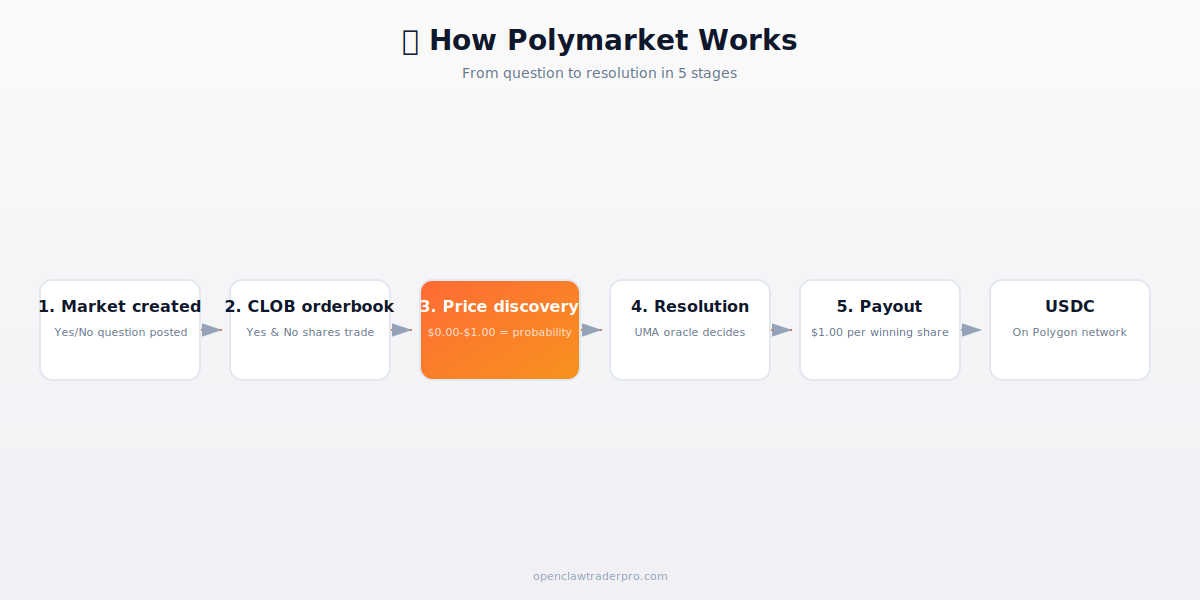
Polymarket uses a Central Limit Order Book (CLOB) hosted at clob.polymarket.com. Trades settle on-chain as USDC transfers on Polygon (the L2 sidechain). You don't need a Polygon wallet to start — the Polymarket UI handles the bridging from Ethereum or via fiat on-ramp (Stripe, MoonPay in supported regions).
For bots and API users, the CLOB exposes REST and WebSocket endpoints documented at docs.polymarket.com. Trades require signing an order with your wallet's private key. The order book is centralized off-chain for speed, then settlements are written on-chain when a trade fills.
UMA Optimistic Oracle handles resolution. After the event ends, anyone can propose a resolution (Yes or No). The proposal stands unless disputed within a window (typically 24-48 hours). Disputed proposals go to UMA token-holder vote. This system has resolved 99%+ of markets without dispute — the disputed minority makes headlines but isn't the norm.
Who actually profits?
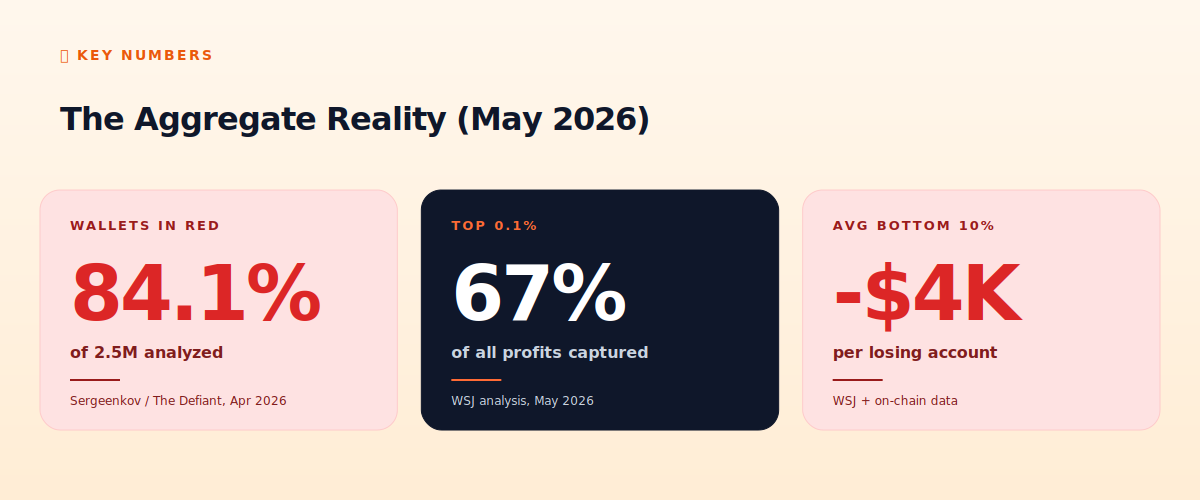
The honest aggregate picture: most accounts lose money. Andrey Sergeenkov's April 2026 analysis of 2.5 million Polymarket wallets, published by The Defiant, found 84.1% in the red. The Wall Street Journal's May 2026 study of 1.6 million accounts found that just 0.1% — fewer than 2,000 wallets — captured 67% of all profits. The bottom 10% of traders averaged $4,000 in losses per account.
The winners cluster around two patterns. The first is structural edge: market makers, arbitrageurs running price-discrepancy bots between Polymarket and Kalshi/Manifold, weather bots using NOAA data lag, and high-frequency latency traders. The second is information edge: domain experts trading single markets where their knowledge exceeds the consensus. Casual prediction traders — the people who read a tweet and "have a feeling" — are systematically the losers.
The viral $437K-from-$313 story we cover in our case study is real. It's also wildly unrepresentative. The same chart could be drawn for thousands of accounts that lost $313 going to $0.
Markets you can actually trade
Polymarket categorizes markets into clusters. As of May 2026:
- Crypto: BTC/ETH price levels, regulatory outcomes, ETF approvals. Highest volume. Quick resolution. Best for bot strategies that arbitrage with crypto exchanges.
- Politics: Elections worldwide, policy outcomes, geopolitical events. Highest emotional charge, most retail bias. Best for traders with domain expertise.
- Sports: Major leagues, championship odds. Low edge for casual traders — bookmakers do this better.
- Weather: Daily/hourly temperature, precipitation, hurricane tracks. Most consistently profitable for bots. See our weather bot guide.
- Pop culture: Celebrity events, award ceremonies, social media trends. Low volume, easy to manipulate, avoid.
- Custom long-tail: Anyone can propose a market. Wide spreads, often illiquid, occasional opportunities for niche experts.
Where Polymarket is and isn't available
This is where things get legally complicated. The headline:
Polymarket is geo-blocked for US residents after a 2022 CFTC settlement. Using a VPN to bypass the block violates the platform's Terms of Service and may violate US law. We do not recommend US residents use Polymarket, regardless of VPN access. Full jurisdiction guide.
Europe: most member states have no specific block. Polymarket self-classifies as a DeFi protocol and operates accordingly. Southeast Asia, Africa, Latin America: typically accessible. Local crypto regulations apply — if your country restricts crypto trading, Polymarket access likely falls under those same restrictions. UK: accessible but FCA has issued warnings.
The fees and friction
Polymarket itself doesn't charge a trading fee (no maker/taker fee on the CLOB). What you do pay:
- Polygon gas: typically $0.10–$0.50 per order placement, less for cancellations.
- USDC bridging from Ethereum: $5–$20 in gas during normal congestion.
- Spread: 1-3 cents typical, wider in illiquid markets. A 2-cent spread on a $100 position is $2 cost.
- On-ramp fees: 1-3% via Stripe/MoonPay if depositing fiat.
- Withdrawal: back to crypto wallet is gas only. Back to fiat varies by region.
Total cost for a $100 round-trip trade: typically $1–$2. Much less than CFD brokers (typically $5–$10 for the same), much more than US stock brokers (typically $0).
Bot vs human trading on Polymarket
The market is dominated by bots in the lower-volatility categories (weather, sports, crypto price levels) where structural edge exists. Politics and pop culture are still mostly human-driven and have more inefficiencies but also more emotional bias.
If you want to bot-trade Polymarket, the standard stack is: OpenClaw + the polyclaw skill + hardware guardrails (position size, daily loss limit, kill switch). Our complete bot guide walks through the setup end-to-end. Realistic expectation: months of paper trading before live capital, single venue and single strategy at the start, 1-2% position sizing.
Red flags to watch for
- YouTube ads promising guaranteed Polymarket profits. Anyone selling a Polymarket strategy that works is hiding selection bias. Real winning traders don't sell courses.
- "$CLAWD token" or "Polymarket airdrop" scams. Polymarket has no native token. Any token claiming to be Polymarket-related is a scam.
- Telegram "signal groups". Almost all are exit liquidity schemes. The signals come after the operators have positioned.
- Markets resolved by obscure data sources. Always check the resolution criteria. "Did X happen?" markets sometimes have edge cases that surprise traders.
- Wash trading. Some users boost volumes to game leaderboards. Doesn't hurt you directly but distorts market signals.
📧 Get every new tutorial in your inbox
One email per week. Tutorials, CVE disclosures, broker updates. Unsubscribe in one click.
(Connect FluentCRM / ConvertKit / Beehiiv form here)
Frequently asked questions
Do I need crypto experience?
You need a wallet (MetaMask is the standard) and USDC on Polygon. The Polymarket UI handles most of the complexity if you're not running bots.
Is Polymarket safe from hacks?
The smart contracts have been audited multiple times. The biggest historical risk has been oracle disputes on edge-case markets, not hacks of the protocol itself.
Can I deposit fiat directly?
Yes via Stripe and MoonPay in supported regions. SEA and African users typically have to come in via crypto (BTC/ETH/USDC bridged to Polygon).
How quickly do markets resolve?
Most resolve within hours of the event ending. Disputed markets take 24-72 hours. Politically charged markets occasionally take a week.
Are profits taxable?
Yes in most jurisdictions. US: crypto trading is taxable, full stop. EU varies by member state. SEA depends on local crypto rules. Not legal advice; consult a professional.
What to read next
- OpenClaw + Polymarket: The Complete Bot Guide
- Polymarket vs Kalshi: The Honest 2026 Comparison
- The $437K Polymarket Trader: Strategy Breakdown
- Polymarket Tax & Legal Guide (US, EU, SEA)
Sources cited: The Hacker News (CVE-2026-25253 disclosure, Feb 2026); Conscia 2026 OpenClaw Security Crisis advisory; Snyk ToxicSkills study; Cyber Press ClawHavoc reporting; Wall Street Journal Polymarket profitability analysis (May 2026); Andrey Sergeenkov via The Defiant (April 2026); Akey, Grégoire, Harvie & Martineau, SSRN paper (March 2026); openclaw.ai official advisories; Peter Steinberger public statements on X. Polymarket documentation; UMA Protocol documentation; on-chain volume data from Polygon.