Risk disclosure: Independent research finds 70–84% of Polymarket traders lose money (Sergeenkov, April 2026; Akey et al., SSRN, March 2026). Forex CFDs: 70–85% retail loss rate. Binary options: 80%+ in most jurisdictions. AI agents don't change these baselines. Full disclaimer.
Polymarket is the offshore crypto-native prediction market with $3.1B monthly volume, geo-blocked for US residents. Kalshi is the CFTC-regulated, USD-settled prediction market available to anyone with a US bank account. They look similar from the outside, but the underlying mechanics, the available markets, and the legal exposure are radically different.
This guide compares them honestly across the dimensions that actually matter to traders: liquidity, fees, regulation, jurisdiction, settlement, and bot-friendliness.
TL;DR — The 30-second answer
- Polymarket: $3.1B volume, blockchain settlement, US-blocked, broader markets.
- Kalshi: $420M volume, CFTC-regulated, US-only, narrower markets but cleaner taxes.
- For US residents: Kalshi only. VPN-to-Polymarket is risky and ToS-violating.
- For non-US: Polymarket has bigger pools, more variety.
- For bots: Polymarket has CLOB API. Kalshi has REST API but fewer market types.
- For tax simplicity: Kalshi wins by miles — reports to IRS automatically.
Liquidity — the most important metric
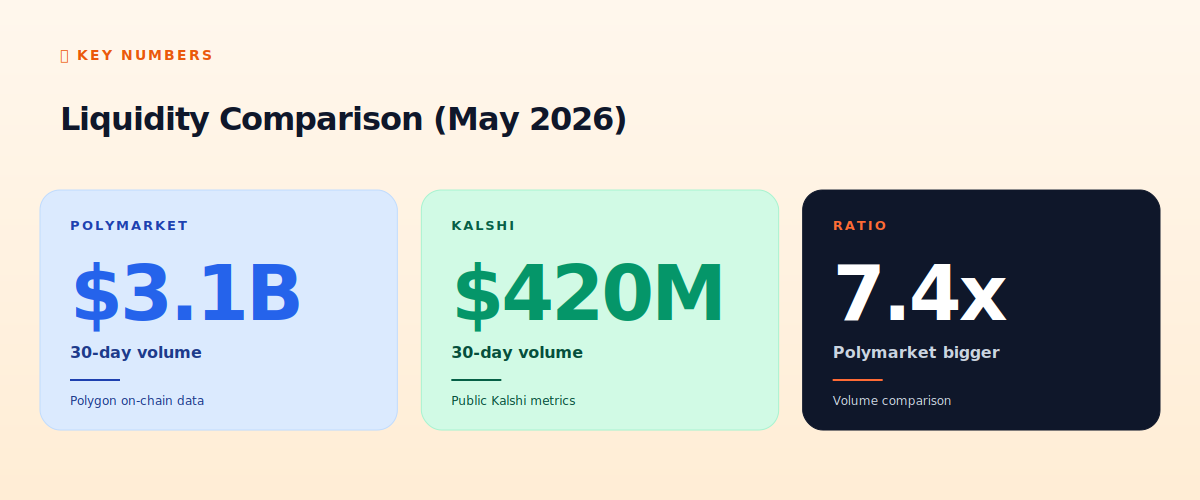
For traders, volume is the metric that determines whether you can size up without moving the market against yourself. Polymarket's $3.1B in 30 days vs Kalshi's $420M is a 7.4x ratio. But raw volume hides the picture: spreads matter as much as volume.
In the markets both platforms list (US elections, major crypto events), Polymarket consistently has tighter spreads on high-volume contracts. Kalshi has tighter spreads on small markets where MM bots concentrate due to CFTC requirements. Net effect: if you're trading election outcomes with $500 positions, Polymarket is friendlier. If you're trading niche economic data releases with $5K positions, Kalshi might be.
Available markets
Polymarket offers anything its community proposes. Politics, sports, weather, crypto prices, pop culture, geopolitical events, custom long-tail. Many markets see only $10K of volume but exist for niche speculators.
Kalshi is curated and approved by CFTC. Markets cover economic indicators (CPI prints, Fed decisions), elections (with caveats), weather (limited), and recently sports outcomes. No memes, no celebrity outcomes, no obscure long-tail. The trade-off: every Kalshi market has a clearly-defined resolution source that won't get disputed.
Fees and cost
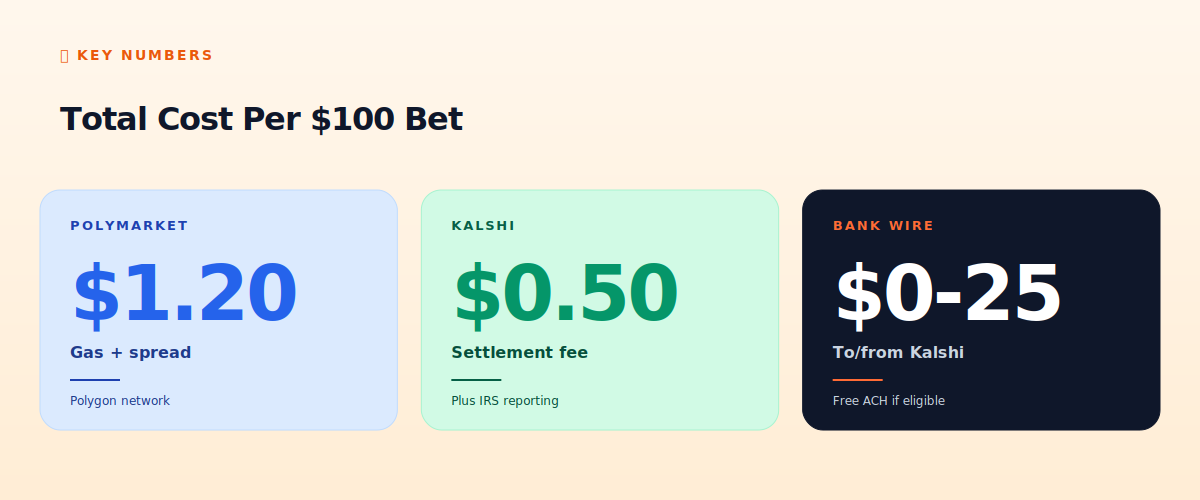
Polymarket: $1.20 average per $100 bet (Polygon gas + typical spread). No platform commission. On-ramp/off-ramp fees if you're moving fiat in/out.
Kalshi: $0.50 average per $100 bet (settlement fee). Free ACH deposits/withdrawals for verified US accounts. Wire fees if you use wires.
For high-frequency trading, the gas cost on Polymarket adds up. A bot placing 1,000 trades per day pays $200-500/day in gas, plus the strategy edge needs to clear that. On Kalshi, no gas, just settlement fees that scale with volume.
Regulatory exposure
Polymarket: classified as DeFi. CFTC issued a $1.4M settlement in 2022 and requires US geo-blocking. The platform operates from offshore. Using a VPN to access from the US is a Terms of Service violation and may expose you to CFTC enforcement.
Kalshi: fully CFTC-regulated. US residents can use it legally without restrictions. KYC required, tax forms (1099-B) issued automatically. Most boring possible regulatory setup, which is exactly the point.
For Latin America, SEA, Africa traders: both are accessible but Polymarket is much more common in practice. Local crypto regulations apply to using Polymarket; Kalshi requires US bank account so non-US users typically can't use it at all.
For bots specifically
Polymarket's CLOB has a fast REST + WebSocket API. Documented at docs.polymarket.com. Sub-second order placement possible from a well-located VPS. polyclaw skill abstracts the wallet signing and order construction.
Kalshi has REST API access but it requires KYC-passed account + API key requested through their portal. The endpoints are more conservative and rate-limited — designed for low-frequency strategies, not high-frequency. Their kalshi-py client is decent but maintained by a small team.
For OpenClaw + LLM bots specifically, Polymarket is much more developed. The community has built more skills, more docs, and more case studies. Kalshi works but you're more on your own.
Tax and reporting
Kalshi sends you 1099-B forms automatically. You import them into TurboTax or your accountant uses them directly. P&L is calculated for you. Trade history is downloadable as CSV. Tax-loss harvesting is straightforward.
Polymarket reports nothing to anyone. You're responsible for tracking your own trades, calculating gains/losses, and reporting per your jurisdiction. For US persons, every trade is a taxable event (crypto disposition). For active bots, you can easily have 1,000+ taxable events per year. Tax software like Koinly or CoinTracker can import Polymarket via Polygon address — necessary for any active trader.
Our recommendation
- US resident, casual trader: Kalshi. Don't VPN to Polymarket. Tax simplicity alone is worth it.
- US resident, serious bot operator: Kalshi for compliant operations, accept the narrower markets.
- Non-US, casual trader: Polymarket. Bigger pools, more variety, easier on-ramp.
- Non-US, serious bot: Polymarket. Better API, more community, more strategies.
- Anyone trading economic data (CPI, jobs): Kalshi if accessible, Polymarket if not.
- Anyone trading election outcomes: Polymarket has the volume globally.
📧 Get every new tutorial in your inbox
One email per week. Tutorials, CVE disclosures, broker updates. Unsubscribe in one click.
(Connect FluentCRM / ConvertKit / Beehiiv form here)
Frequently asked questions
Can I use both?
Yes, and many bot operators do. Arbitrage between identical markets on the two platforms is one of the documented profitable strategies.
Which has better customer support?
Kalshi by a wide margin. CFTC regulation forces a real support team. Polymarket support is Discord/Twitter and often unresponsive on complex issues.
Is Kalshi safer?
Regulatory-safer, yes. Both have had operational incidents but Kalshi's are less consequential due to insurance and CFTC backing.
Can I trust the oracles?
Polymarket uses UMA, which has resolved 99%+ of markets without dispute. Kalshi uses contracted data sources for each market. Both fail occasionally on edge cases.
What about Manifold Markets?
Different model — Manifold uses play money (Mana) primarily, with limited real-money tournaments. Not a serious profit venue but excellent for learning prediction markets.
What to read next
- Polymarket Explained: What It Is, How It Works
- OpenClaw + Polymarket: The Complete Bot Guide
- Polymarket Tax & Legal Guide
- Prediction Market Arbitrage Strategies
Sources cited: The Hacker News (CVE-2026-25253 disclosure, Feb 2026); Conscia 2026 OpenClaw Security Crisis advisory; Snyk ToxicSkills study; Cyber Press ClawHavoc reporting; Wall Street Journal Polymarket profitability analysis (May 2026); Andrey Sergeenkov via The Defiant (April 2026); Akey, Grégoire, Harvie & Martineau, SSRN paper (March 2026); openclaw.ai official advisories; Peter Steinberger public statements on X. Kalshi public metrics; Polymarket Polygon volume data; CFTC enforcement actions.